

Every 12 seconds, Bittensor mints a block of TAO and drops it into a system most people have never mapped end to end.
They see the price ticker and the subnet rankings. What they miss is the plumbing between those two things.
I’ve been involved in Bittensor for three years now, and I still meet smart investors who can explain alpha tokens but can’t tell you what actually happens to a single block of TAO after it’s created. They know the ingredients, but they can’t describe the recipe.
My wife can explain Bittensor to a friend using the mall metaphor, but ask her how the payment actually flows from the mall’s cash office to the store employees, and she’s stuck. That gap is where people fall off.
So let’s follow one block. From the moment it’s minted to the moment it lands in someone’s wallet.
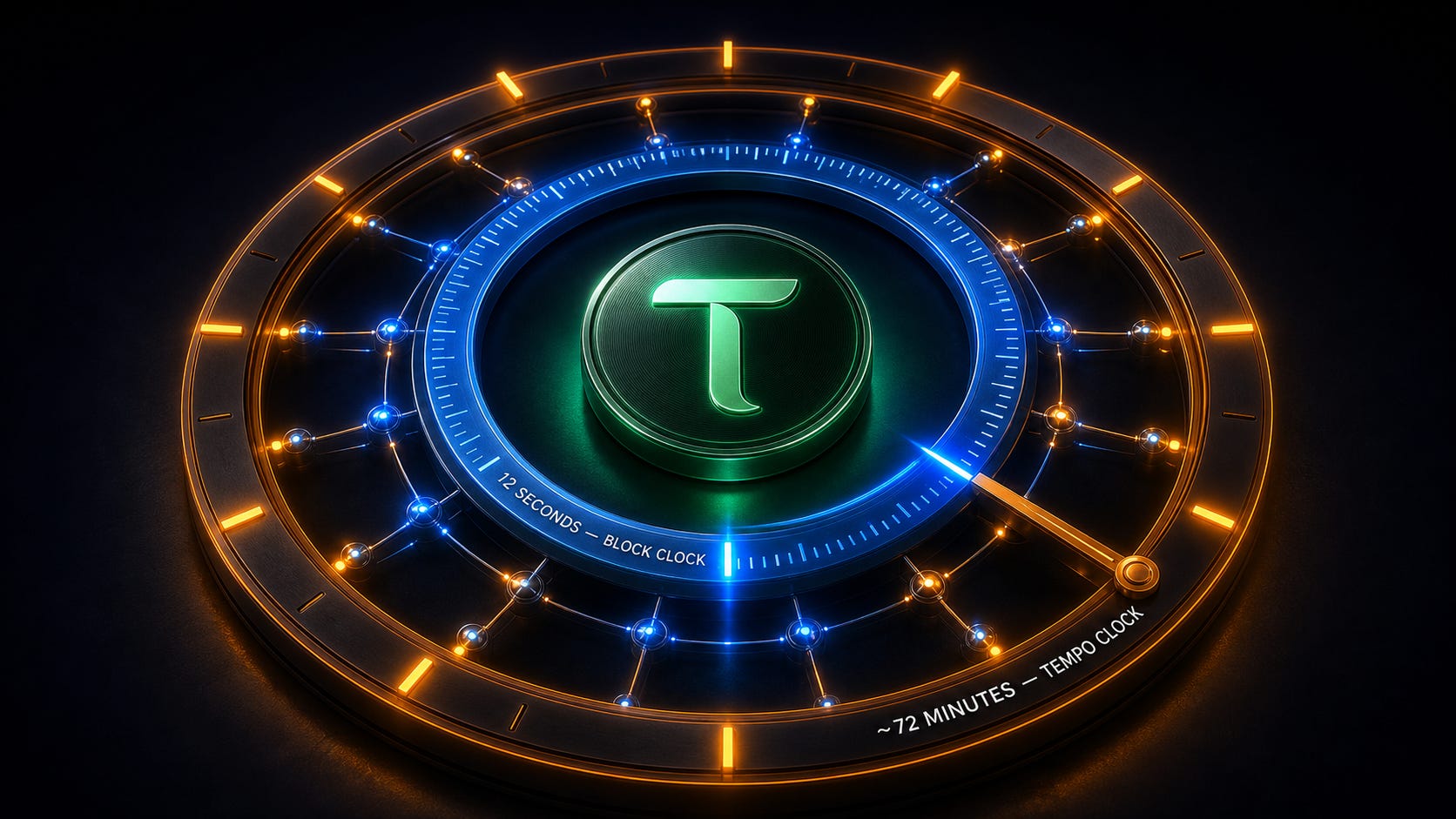
The mental model that makes everything click: Bittensor runs on two clocks:
The first ticks every 12 seconds (one block, one mint, one injection).
The second ticks every tempo, roughly 72 minutes, when accumulated alpha gets distributed to participants.
The block clock is for injection, the tempo clock is for distribution. Hold those two in your head and the rest follows.
Step 1: Mint
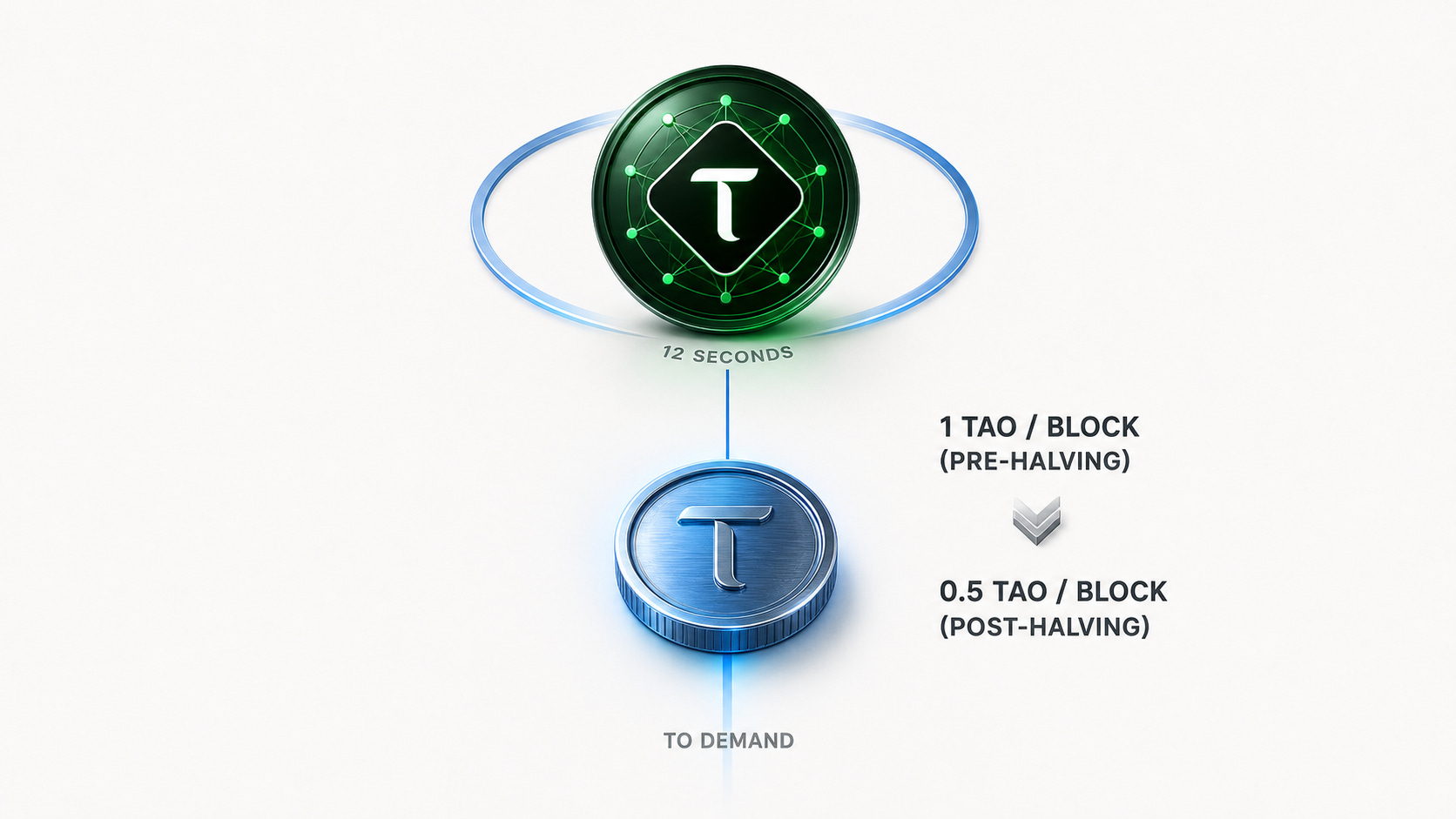
The block subsidy is where everything starts.
Every 12 seconds, the network creates new TAO. Before the first halving in December 2025, that was roughly 1 TAO per block, about 7,200 per day. Post-halving, it’s 0.5 TAO per block, 3,600 per day. I covered the halving mechanics in The First Bittensor Halving: The End of Easy Mode.
Think of this as the network’s budget for the next 12 seconds. How much new value can be allocated to subnets right now? That single number is the top of the funnel. Every split, every filter, every distribution downstream starts from here.
The halving schedule (copied from Bitcoin, 4-year cycles) sets the long-run supply path. The per-block cadence sets the heartbeat for liquidity injections. Every 12 seconds, the network decides where to spend its allowance.
Step 2: Demand
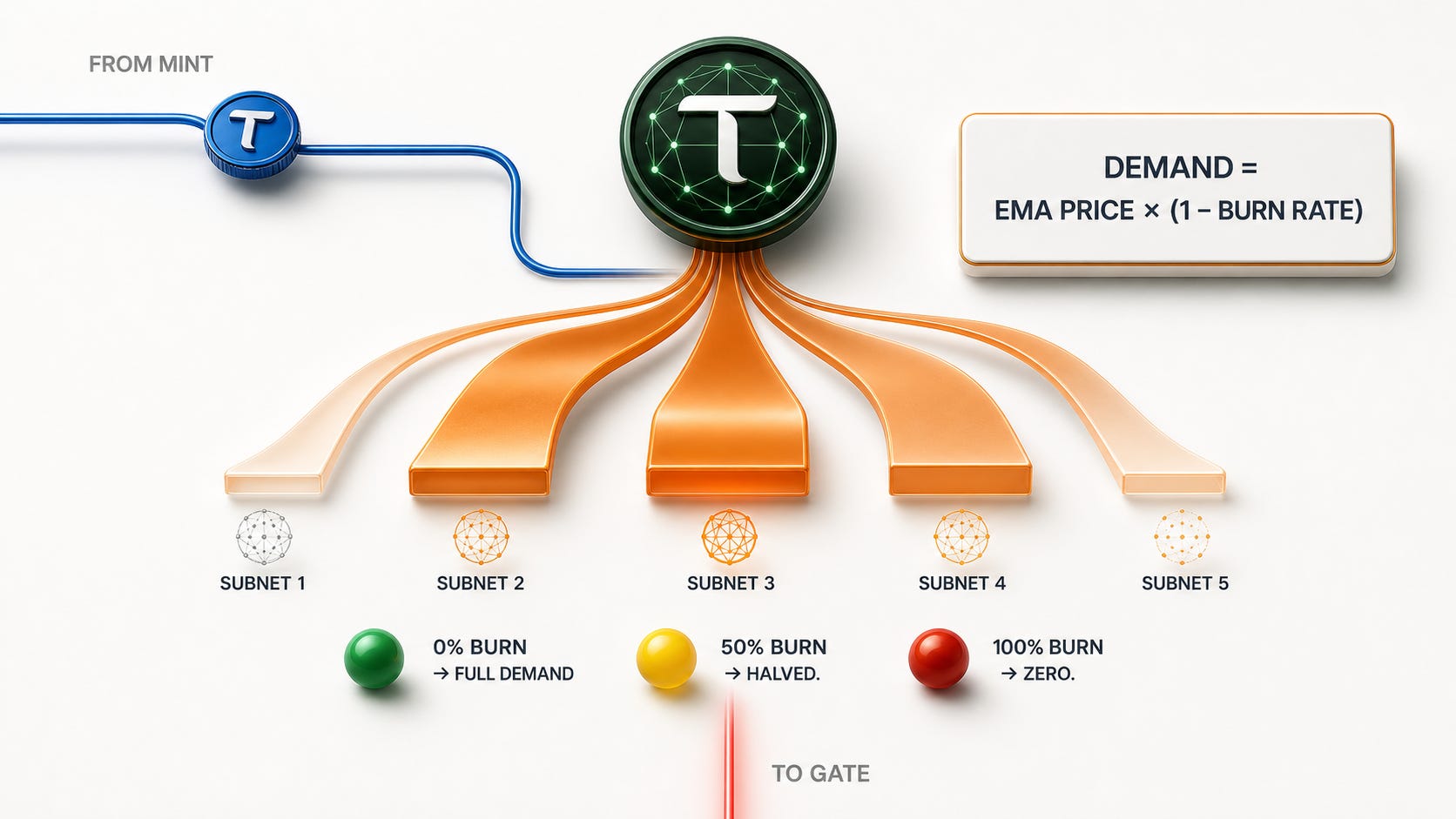
Now the freshly minted TAO needs to be divided among 128 subnets. How does the network decide who gets what?
It starts with demand. Each subnet’s demand share is driven by its Exponential Moving Average (EMA) alpha price relative to the sum across all emission-enabled subnets. The EMA smooths out single-block volatility so emissions don’t whipsaw on transient price spikes. A subnet that gets wash-traded for one block doesn’t suddenly redirect the network’s budget.
Then there’s miner burn. Miners receive a fixed share of each subnet’s alpha as payment for their work (we’ll break down the exact split in Step 5). But validators can vote to withhold some or all of that share from miners. The withheld alpha gets recycled instead of paid out. They do this when the work isn’t worth the full payout, when someone’s gaming the system, or sometimes collaboratively with the subnet owner to reduce sell pressure (miners are the most likely to dump alpha for TAO to pay bills).
The network treats this burn rate as a direct discount on demand. The formula: demand is proportional to EMA price multiplied by (1 minus burn rate). A subnet burning 100% of miner emissions has zero effective demand, no matter how high its alpha price is. A subnet burning 50% has its demand halved. A subnet paying miners in full faces no discount.
The network is saying: if you’re not compensating the people doing the work, your price signal doesn’t count as much. You can have a high alpha price and still get penalized.
In effect, demand is market-validated pull. Sustained price strength plus honest miner payouts means higher effective demand. You can’t fake it with a single block of volume. You can’t game it by withholding miner pay. The signal has to be durable, and it has to be honest.
Step 3: Filter
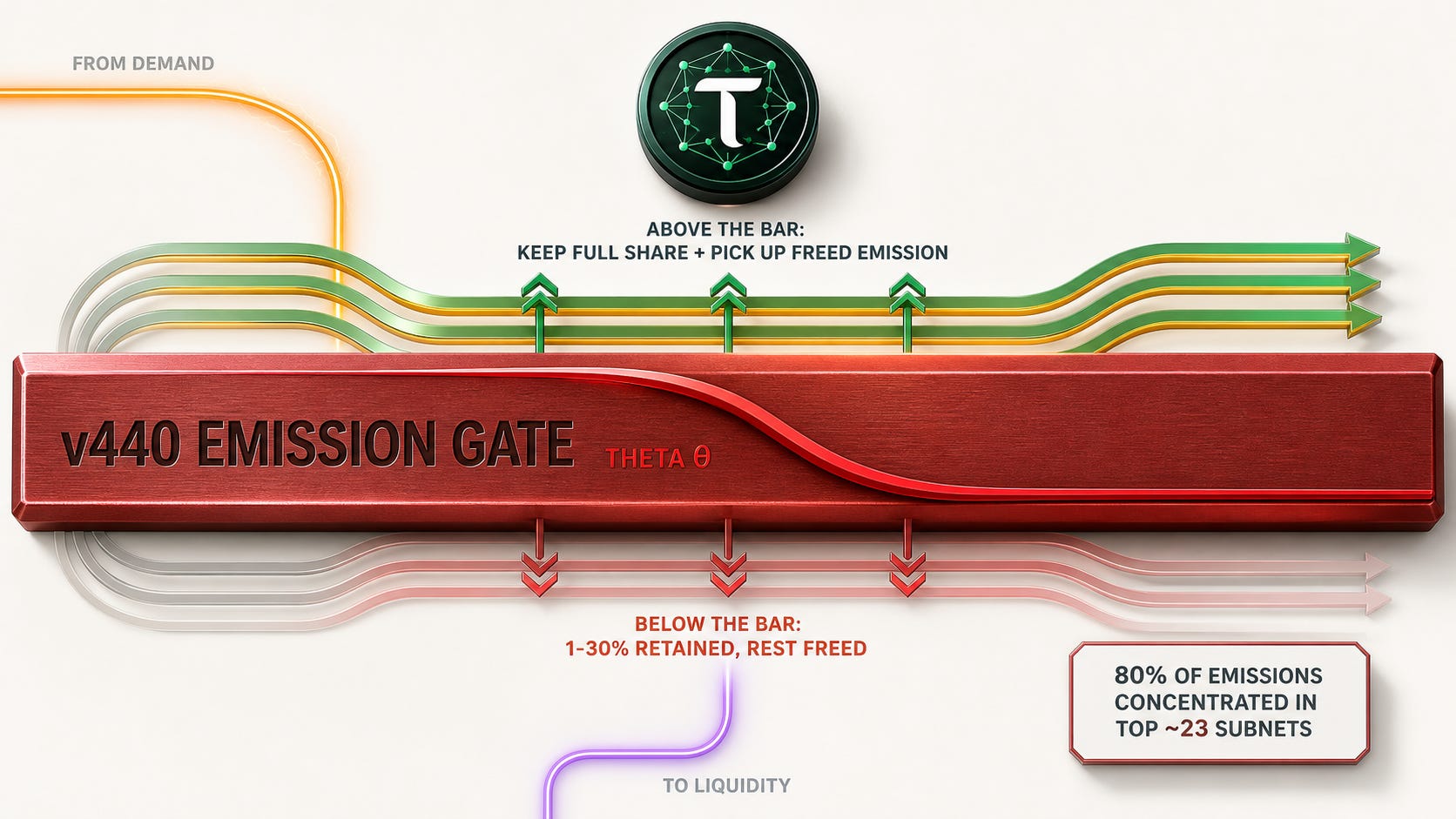
This is where the v440 Emission Gate comes in. If you read my three-level breakdown, you’ll recognize the mechanism.
The gate takes those burn-adjusted demand shares and passes them through a smooth cutoff around a quantile threshold (theta θ). Subnets with weak demand get suppressed. The emission they would have received gets freed up and reallocated to higher-signal subnets.
The math: final emission weight for each subnet equals its demand share multiplied by the gate function, normalized across all subnets. Low-signal subnets contribute their freed emission to the pool. High-signal subnets pick up the difference.
Why a gate instead of raw proportional sharing? It prevents fragmentation. Without the gate, emissions spread thinly across every subnet that exists, including the ones nobody is using. The gate concentrates liquidity where the market is actually signaling strength.
Demand gets you into contention, now the gate decides how much of the prize pool you actually receive.
Step 4: The liquidity boundary
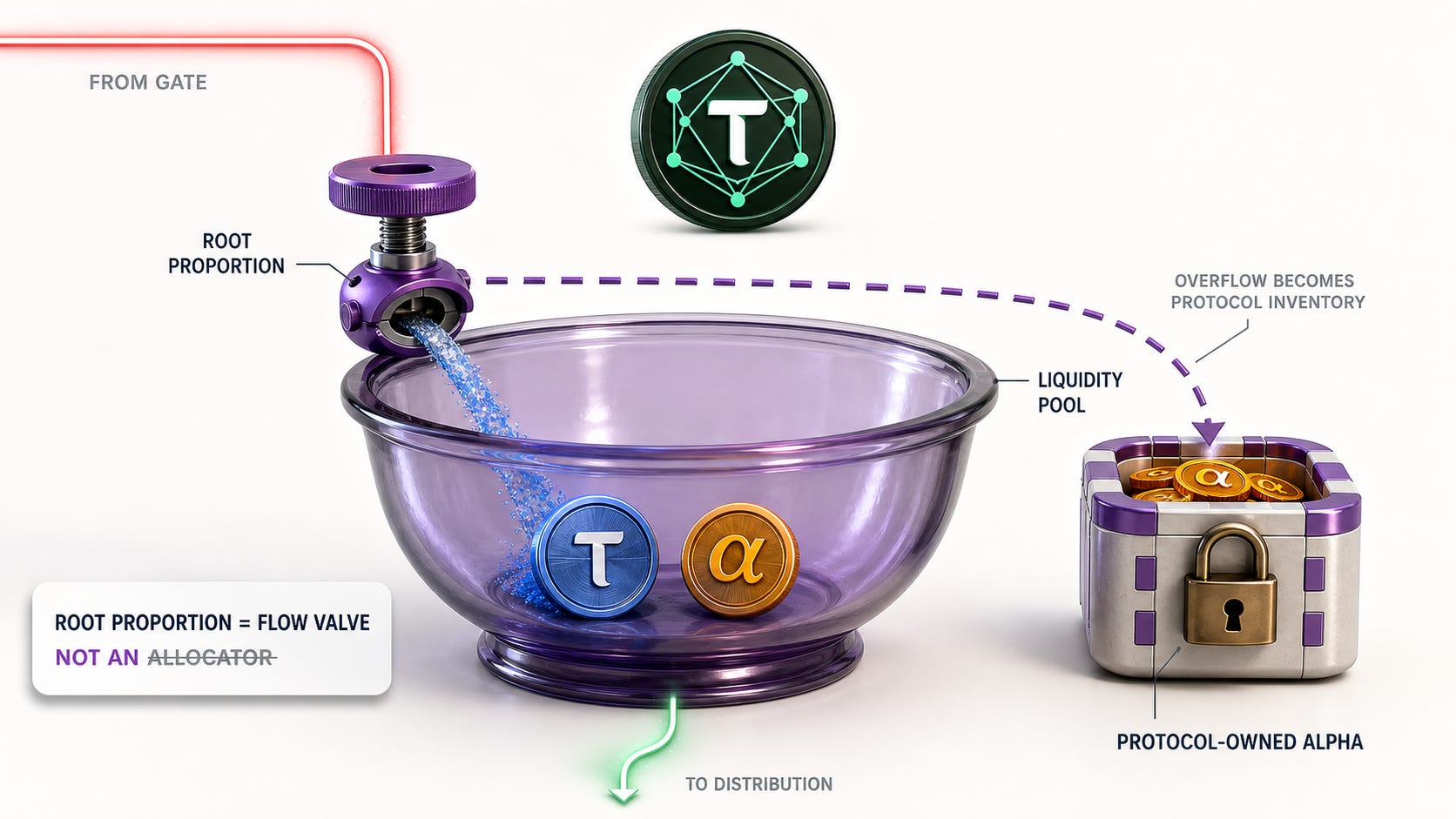
Each subnet gets its slice of TAO for this block. The gate already decided how big that slice is. Now the question is: where does that TAO go?
It goes into the subnet’s liquidity pool, paired with newly minted alpha. But there’s a limit. Every subnet has a setting called root proportion that acts like a valve on how much fresh TAO can flow into the pool per block. If the slice fits under the valve, all of it becomes pool liquidity. Simple.
If the slice is bigger than the valve allows, the excess doesn’t go to waste. The protocol takes the leftover TAO and uses it to buy alpha directly from the subnet’s pool. Think of it as the overflow pouring into a separate container: the protocol’s own wallet. That purchased alpha stays there. It’s not recycled. It’s not given to miners or validators. The protocol owns it permanently.
Why does this matter? Two reasons.
First, root proportion is widely misunderstood. A lot of people think it decides how much TAO each subnet gets. It doesn’t. The allocation already happened upstream at the gate. Root proportion only controls how much of that allocation becomes pool liquidity versus protocol inventory. It’s a flow valve, not an allocator.
Second, those chain buys quietly accumulate. Every block where a subnet’s TAO exceeds its root proportion cap, the protocol buys a little more alpha. Over time, the protocol builds up a position in subnet tokens across the network. That position becomes relevant if subnets ever get dissolved or their alpha gets redistributed. It’s a slow, per-block accumulation that most people aren’t watching.
Root proportion sets the maximum fresh liquidity per block. Anything beyond that becomes protocol-owned alpha.
Step 5: Distribution
We’ve followed TAO from mint to demand to gate to injection. Now we hit the second clock.
Over the tempo (roughly 72 minutes), each subnet accumulates alpha from two sources: the liquidity injections from Step 4, and the chain buys. Both feed the same pot. At epoch close, that accumulated alpha gets distributed to three groups of people who actually make the subnet work.
18% goes to the subnet owner. This is the creator's cut. The person or team who built the subnet, defined its incentive mechanism, and set the scoring rules. They get a fixed share of every alpha distribution for as long as the subnet is alive. Think of it as a royalty on the work the subnet produces.
The community has debated whether 18% is too high, whether owners should get closer to 1% and be forced to mine their own subnet to earn more. Until now, that debate was academic as the split was welded shut at the protocol level. That's changing. eTAO (runtime v480), shipping imminently, gives subnet owners a dial to adjust their own split within guardrails. The 18/41/41 defaults stay, but owners can now tune the ratio.
41% goes to miners. These are the workers. They run the compute. They produce the intelligence outputs the subnet exists to generate. On an inference subnet, they run the models. On a data storage subnet, they host the files. On a trading subnet, they execute the strategies. The 41% is their pay for doing the actual work.
41% goes to validators and their stakers. Validators are the scorers. They evaluate what miners produce, score the quality, and assign weights. If miners are the workers, validators are the quality control team. The stakers behind them, people who’ve delegated TAO to a validator, get a cut of the validator’s share. That delegation is how passive TAO holders participate in subnet economics without running any hardware.
The split encodes a deliberate balance. Nobody dominates.
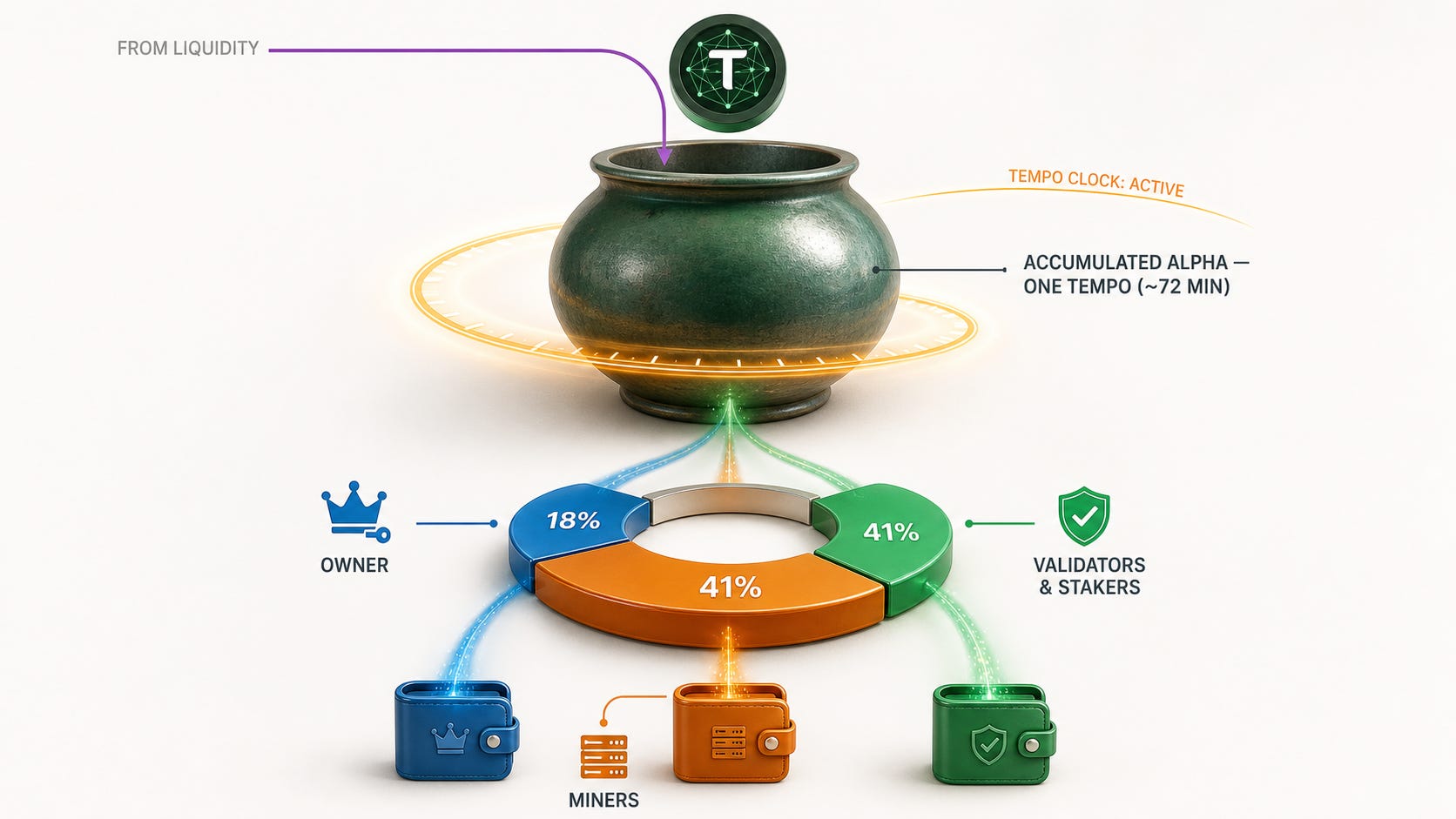
But the pot's size isn't fixed. And with eTAO arriving, the split won't be either.
Everything in Steps 1 through 4 determines how much alpha accumulates in that pot before distribution:
How much TAO was minted (the halving schedule).
How much demand the subnet generated (EMA price and miner burn).
Whether the subnet cleared the gate (or got suppressed).
How much TAO became pool liquidity versus chain buys (root proportion).
By the time the tempo closes and the alpha gets divided, the amount has already been decided. The split just decides who receives what's already there.
That's why a subnet above the gate can sustain all three groups, while a subnet deep in the tail is splitting crumbs.
If you're staking TAO to a validator, your returns depend on two things: how big the pot is (everything upstream, which you can't control) and how much of the validator share your validator earns relative to others (Yuma Consensus scoring, which you can influence by choosing carefully). Once eTAO lands, add a third: whether the subnet owner has adjusted their split, because that directly affects your validator's cut.
What this means for you
For subnet founders: Emissions reward durable price demand and honest miner payouts. Gaming burn or leaning on root proportion for share is outdated. The gate punishes weak demand. The burn formula punishes dishonest payouts. The only sustainable play is building something the market actually wants to stake into. If your subnet can’t answer “what problem, for whom, measured how” with specificity, it won’t survive the gate no matter how much hopium the Discord is pumping.
For validators and miners: The gate amplifies consistent, high-signal participation. Volatility is smoothed (by the EMA) but not rewarded. Steady demand beats sporadic spikes. If you’re on a subnet sitting near the bar, modest increases in demand produce disproportionately larger increases in emission once the gate applies. That’s the highest-ROI position on the network right now.
For investors and stakers: Chain buys create protocol-owned alpha that stays on the protocol’s balance sheet. That matters for long-term supply and any future dissolution or redistribution scenario. When you stake TAO into a subnet’s pool, you’re participating in a system where excess emission becomes permanent protocol inventory. Understand where the TAO goes that doesn’t go into your pool.
For anyone evaluating Bittensor as a platform: The emission stack is a two-clock system (block injection, tempo distribution) with a demand, filter, cap pipeline. That’s an unusual architecture, as most networks have one clock and one distribution rule. Bittensor separates the injection rhythm from the distribution rhythm, and inserts a market-driven filter (the gate) between demand and allocation. If you’re evaluating subnets as businesses, this is the incentive architecture you’re operating inside.
The takeaway
You can explain Bittensor to someone in 30 seconds with the mall metaphor. But if they ask “how does the money actually move?” you need this map.
Five steps. Two clocks. One block of TAO, tracked from mint to wallet.
Each step does work that a simpler design would skip, and the network is better for it. The block clock handles liquidity. The tempo clock handles distribution. Everything in between, demand, the gate, the cap, is the market deciding who earns what.
If you’re holding alpha or watching specific subnets, that two-clock model is where you start.
Until next time.
Cheers,
Brian
If this map helped you see how the money actually moves, three places to keep going.
5 terms that unlock 80% of Bittensor conversations is the vocabulary survival guide. Five words that show up in every Discord thread, governance proposal, and subnet debate, translated into plain English. If you can't tell a subnet from a validator yet, start there.
The Story of TAO: Bitcoin's DNA, Bittensor's Heartbeat is the big picture. Where TAO came from, how it survived crashing to $30 and rocketing to $757, and why a mechanism called dTAO turned every holder into a venture capitalist in the world's most open AI marketplace. If this piece taught you the plumbing, that one teaches you the story behind it.
If you're further along and trying to explain what you just learned to someone else, I Fixed My Bittensor Pitch walks through what happened when I tried five different pitches on five different people and what actually worked.
Spoiler: the version I practiced in the shower died on contact with a real human at a bar.
All three are free. No paywall. The goal is simple: make this ecosystem legible to people who don't code.
Disclaimer: This is not financial advice. I am a writer documenting the Bittensor ecosystem. Always do your own research.