

I’ve been writing this newsletter for over a year. Through all the coding experiments, marketing teardowns, subnet analysis and emissions analytics, its long enough to see a pattern I can’t ignore.
Every couple of issues, someone replies with a version of the same message:
“Great, now I understood about 60% of this. The other 40% I had to Google.”
Or:
“I’ve been following Bittensor for months and this is the first time X actually made sense.”
The 60% they got was the story and the metaphor. The 40% missed was always the vocabulary and the mechanism, where I name a concept and assume the reader already has a mental model for it.
They don’t. Most of the content ecosystem doesn’t either.
I see it at home with my wife. She can explain now Bittensor to a friend with the mall metaphor but if you ask her how the payment actually works she’s already stuck. That gap is where people fall off as the content jumps from metaphor straight to governance proposal with nothing in between.
I tried fixing it in pieces. The Bittensor Pitch, 5 Terms That Unlock 80% of Bittensor Conversations, Bittensor Terms Decoded (the living glossary with Textbook and Bar Talk versions). People bookmark the glossary, but in reality it’s only a dictionary. You look something up when you already know you need it, it doesn’t show why a concept matters this week.
Here's how we close that gap: a monthly deep-dive series where we tackle one concept at a time across three levels of explanation, with every topic pulled from something that actually changed subnet economics that month.
Level 1 (Bar Talk): If you can’t explain a concept to a friend over a pint without pulling out a glossary, you don’t actually understand it. Start here to get the core mental model.
Level 2 (Read the Signals): The mechanics and the numbers. How to understand what the live metrics actually mean for your portfolio.
Level 3 (Follow the Incentives): The product reality and unit economics. How the math alters incentive structures and accelerates the survival of the fittest across the network.
First up is the biggest change to emissions since dTAO: the Emission Gate that shipped with the v440 upgrade.
You can already see the new meta. Subnet 46 spent most of its life as RESI (then Zipcode): real-estate price prediction and appraisal models. In early August the team pivoted the entire subnet to Instant Inference: lightning-fast private inference.
That was not a random rebrand. Once the free lunch for low-demand slots disappeared, the calculus for every subnet owner changed. Holding a slot that could not clear the demand bar became expensive in a way it never was before. Teams that moved fastest started asking: what can this slot actually earn under the new rules, and is the current product the highest-value use of it?
Instant Inference is the first high-profile answer. The pivot is so drastic it deserves a separate conversation, but it’s an early example showing the pressure is now structural. Emission is still price-based, it just has to clear a moving bar first.
V440 - The Emission Gate Explained

Level 1 (Bar Talk): The End of the Free Lunch
Imagine the Mall of Intelligence.
Every day the mall prints a fixed pile of cash - the daily payday pot - and hands it out to the stores. That pile is emission. For a long time the rule was simple: every store got a slice based on how popular its location looked, even if the shutters were down and the lights were off. A boarded-up unit still collected rent money just for existing.
Quiet stores were diluting the payday for the ones actually serving customers. The cost of opening a new store stayed high because people treated empty slots as passive income machines.
Then the mall changed the rules.
They put a gate at the entrance to the cash room. The gate looks at real foot traffic. Stores that are busy keep almost everything they earned under the old system, and they pick up a bigger share of what the quiet ones lose. Stores that are empty still get a tiny trickle, but it is so small you can’t live on it. The gate itself moves every hour or so based on where people are actually shopping, so a store that was quiet last week can climb back if customers return.
That’s the Emission Gate in one picture.
What most people will feel:
The busy stores get richer.
The quiet stores get poorer.
Parking a store just in case stops making financial sense.
Opening a brand-new store should eventually get cheaper, because the free lunch that used to prop up empty leases is gone.
If you are holding the token of a quiet store, the math just changed. The network is no longer paying you simply for occupying space.
Level 2 (Read the Signals): The New Math for Subnet Survival
Since v440 went live the room has been asking the same questions on repeat:
Where is the bar right now?
Did my subnet just get gate-smacked?
Is the line still moving?
Should I be worried about deregistration?
Here’s how to answer them yourself.
The Emission Gate does not change the fact that emission is still driven by demand - the de-manipulated moving price, adjusted for miner burn. What it changes is how that demand turns into real TAO.
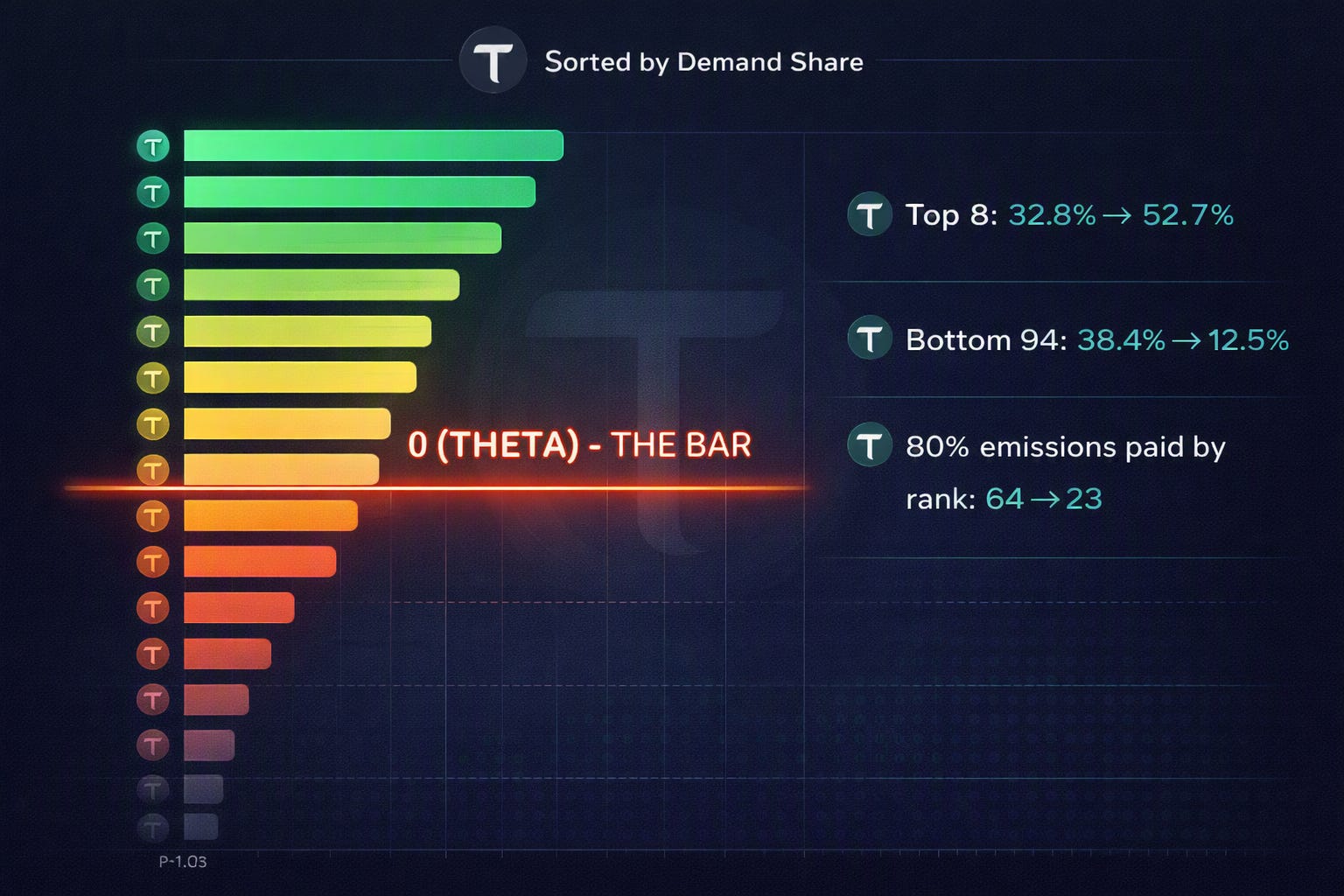
Every tempo (roughly 72 minutes) the network sorts every emission-enabled subnet by its current demand share. It walks down the list until the subnets above a certain point are carrying a set fraction of total demand. That crossing point is the bar (thetaθ). Everything then gets passed through a smooth threshold. The defaults that shipped put the bar roughly around rank 30-35 on the July distribution.
What that feels like in practice:
Comfortably above the bar: you keep almost all of your old proportional share, plus you pick up a slice of what the tail just lost.
Sitting right on the bar: you keep roughly half of what the old linear rule would have given you.
Below the bar: emission falls away quickly. Just under the line you might still keep 15-30% of your linear share. Deep in the tail you’re looking at 1-5%. The residual never hits absolute zero, but it is deliberately too small to make parking a slot economically rational.
The July snapshot numbers that still get quoted are useful anchors:
The 94 subnets that sat below the bar went from collecting 38.4% of total emission to 12.5%.
The top 8 went from 32.8% to 52.7%.
The rank at which the network has paid out 80% of emissions moved from 64 down to 23.
Effective subnet count collapsed from roughly 50 to roughly 22.
No subnet is hard-zeroed by the gate itself. That residual drip is intentional. It removes the incentive to game a hard cutoff while still making idle slots worthless.
For anyone holding alpha or watching specific subnets, growth near the bar is the highest-ROI move on the network right now. A modest increase in demand when you’re sitting just under or just over the line produces a disproportionately larger increase in emission once the gate is applied and the freed-up share is redistributed. Sliding further into the tail hurts more than the old linear model ever did.
A few practical checks:
1. Look at your subnets current demand share (moving price * (1 - miner burn)) relative to the live bar.
2. The bar is recalculated every tempo from the same manipulation-resistant prices that already drive emission. A single block of wash trading does almost nothing.
3. A sudden drop in emission after v440 does not automatically equal deregistration risk. Deregistration still cares about the lowest non-immune subnets when new ones register. The gate changes how much TAO a low-demand slot earns; it does not rewrite the immunity or pruning rules by itself.
4. Miner burn still matters. High burn reduces the demand signal that feeds the gate, so a high-burn subnet starts from a weaker position.
Level 3 (Follow the Incentives): Evaluating Subnet Viability Under v440
Lets strip away the analogies. If you are building on Bittensor or analyzing its tokenomics at a granular level, v440 isn’t just a fairness patch, it’s a fundamental shift in how subnet economics work and how you should model long-term viability.
Before the Emission Gate, the distribution curve for TAO was relatively forgiving. Even if a subnet was hovering at the bottom of the Root Network’s priority list, Yuma Consensus still trickled some emissions down to its miners and validators. It was a gentle slope.
v440 takes that gentle slope and introduces a cliff.
From a systems perspective, the Emission Gate is a step-function. It establishes a hard threshold (a minimum proportion of aggregate validator weight) that a subnet must achieve. If the subnet achieves 99% of that threshold, its emissions aren’t slightly reduced; they are effectively zero. Its a binary state: you are either economically viable, or you are starved of oxygen.
The Builder’s Dilemma: Subnets as Products
As someone who looks at this ecosystem through a product lens, this is where it gets fascinating. Pre-v440, you could launch a subnet as an experiment or a neat feature and let the trickle of emissions fund your iteration.
A post-v440 subnet cannot rely on technical novelty or a marginal use case alone. If we run this through an opportunity assessment, the stakes have completely changed:
Exactly what problem will this solve? (The Value Prop): The value must be strong enough to generate sustained demand. A specialised subnet can succeed, but only if it owns a valuable niche and has strong performance differentiation or becomes embedded in downstream products.
For whom do we solve that problem? (The Customer): Who creates demand for the subnet, who consumes its output, and who benefits economically from its success? This may include validators seeking reliable and valuable work to score, miners seeking profitable tasks, developers integrating the subnet’s output, enterprises consuming its service, applications using its intelligence or infrastructure, and TAO/alpha stakers allocating capital toward its future value.
How will we measure success? (The Metric): Success is no longer measured in gradual adoption. The critical metric is whether the subnet can establish and maintain enough genuine demand to perform strongly against the network’s dynamic emission bar.
Second-Order Effects: The Velocity of Compute
This brings us to the most critical downstream effect of the gate: miner migration. Miners are rational, profit-seeking entities. If a subnet falls below the Emission Gate and emissions drop to zero, the miners aren’t going to stick around for a turnaround story.
They will immediately repurpose their GPUs and migrate to subnets that are above the threshold.
This creates a ruthless, hyper-efficient market. Failing subnets will lose their compute power almost instantly, accelerating their death spiral. Meanwhile, surviving subnets will see a rapid influx of displaced miners, massively increasing the competition (and ideally, the quality of output) on the networks that actually have product-market fit.
The Emission Gate doesn’t just protect the TAO token; it turns Bittensor into an evolutionary pressure cooker.
What This Means for the Journey
The Emission Gate is Bittensor continuing to do what it has always done when the incentives drift: remove free options and force the network to reward real demand. The mall just got stricter about which stores get the good locations.
Holding a quiet slot is no longer a viable strategy. The residual drip still exists, but it is deliberately too small to live on. That pressure is already visible - the Zipcode teams pivot to Instant on SN46 is one early example of owners looking at the new surface and choosing a direction with a clearer path to sustained demand. More of those decisions will follow.
It also clears the path to expand beyond the current 128 subnets. With the gate in place, adding new slots becomes economically viable because unproductive subnets no longer drain meaningful emissions from the system. Only the subnets that clear the demand threshold get paid.
Where this leaves you depends on how deep you want to go:
If you’re explaining Bittensor to someone new, the gate is your clearest proof point that this network isn’t about hype: it’s about ruthless allocation to real utility.
If you’re tracking your portfolio, the bar is now your signal. Open Taostats once a week and check where your subnet’s demand share sits relative to the current gate threshold. That single habit will make every emissions discussion immediately legible.
If you’re building or evaluating subnet viability, stop treating subnets as token issuers and start auditing them as products. Run the Opportunity Assessment from Level 3 on any subnet you’re watching. Those three questions are: what problem, for whom, measured how. If a subnet can’t answer them with specificity, it won’t survive the gate no matter how much hopium the Discord is pumping.
Next month: We’ll break down another concept that moved the network using the same three-level structure. If there’s something you’re tired of half-understanding, reply and tell me. This series exists because the 40% you Google every issue adds up to the difference between casually following Bittensor and actually understanding what you hold.
Until next time.
Cheers,
Brian
Disclaimer: This is not financial advice. I am a writer documenting the Bittensor ecosystem. Always do your own research.