

So your Bittensor subnet pitch works.
You’ve convinced your friend to ditch Claude for the combined weight of Open-Source AI models using Subnet 64 (Chutes) at a fraction of the cost.
Next day: “I’m in. Where do I start?”
You send them to Discord.
30 minutes later: “What the f*ck is a hotkey weight validator epoch? I can’t understand a word of this.”
They’re gone.
You nailed the pitch but couldn’t bridge the vocabulary gap.
Last week, I (kind of) fixed my Bittensor pitch. This week, the problem evolves: They’re interested. They ask follow-up questions. And suddenly you’re drowning in jargon.
“What’s a validator weight?” “How do emissions actually work?” “Wait, what’s the difference between TAO and alpha?”
This is the language you’ll actually encounter in Discord, governance proposals and subnet performance debates.
Here’s what I learned: you can’t explain Yuma Consensus the same way to a validator as you do to your friend at the bar.
Most Bittensor resources only give you the technical definition. That’s perfect for Discord power users, but useless when your curious colleague asks “wait, what’s a validator again?” at lunch.
The Three Vocabulary Barriers That Kill Adoption
After I went down in flames trying to pitch Bittensor in a bar, I realized there are three distinct ways vocabulary kills conversations. Understanding them is the first step to bridging the gap.
Barrier #1: The Jargon Wall
This is when technical terms stop conversations cold.
My friend asked “how does it work?” and I said “validators judge miners” and watched his brain shut down. He heard “blockchain people doing blockchain things.”
Here’s what validators actually are: The Quality Inspector.
Think mystery shopper meets health inspector. They walk through each store (subnet), test the products (miner outputs), and file official reports. Their job is to make sure no one’s selling garbage and ruining the mall’s reputation.
That’s all “validator” means.
The moment I translated it from jargon to job description, it clicked.
The lesson: If you can’t explain it without jargon, you don’t understand it yet.
Barrier #2: The Metaphor Mismatch
This is when we use technical metaphors that mean nothing to civilians.
“Subnet” sounds like IT department speak. Crypto “Miner” makes people think of Bitcoin energy FUD and warehouse farms in Iceland.
So instead, I’ve committed to using the mall metaphor consistently:
Bittensor is The Mall of Intelligence. Think of a whole shopping district, not just one store, but the entire city center where anyone can set up shop. Want to build compute? Open a store. Storage? Another store. AI predictions? Yet another.
Subnets are The Specialty Stores. Subnet 85 is the “Video” store. Subnet 62 is the “Coding Agents” store. Subnet 8 is the “Trading” store. Each one is a mini-market competing to solve one specific problem better than anyone else.
My kids have a Lego store, a dinosaur store, and a toy car store at home. They’re all competing for Dad’s attention (emissions). That’s basically subnets.
Miners are The Store Workers. These are the workers behind the counter. Whether coding, generating images or scraping data, they’re doing the actual heavy lifting. If the workers fail, the product fails.
Once I committed to this metaphor and stuck with it, everything else fell into place. People can visualize the system instead of trying to decode it.
The lesson: The right metaphor makes complexity collapse into common sense.

Barrier #3: The Crypto Tax
This is when blockchain-native concepts make people think “this is a crypto thing, not an AI thing.”
The moment I said “TAO emissions,” my friend’s eyes said “here we go, another ponzi.”
But emissions aren’t a scam, they’re just the scoreboard.
TAO is The Mall Currency. It’s the only money accepted in this shopping district. You need it to open a shop (register a subnet), rent a unit (stake), or pay your workers (miners). Customers spend it, stores earn it, and landlords (stakers) collect it. The busier the mall, the more valuable each dollar becomes.
Emissions are Payday, Every Day. The network mints exactly 3,600 TAO every 24 hours. That’s the pot. Every subnet, miner, and validator is fighting to claim their share before it runs out.
When I stopped using crypto language and started using economic language people already understand: currency, payday, competition for rewards, the stigma evaporated.
The lesson: Decouple blockchain mechanics from blockchain stigma.
Why This Matters In The Real World
Bittensor’s growth depends on reaching beyond Discord power users.
Every subnet needs users. Every validator needs stakers. Every builder needs collaborators.
And all of that dies in the vocabulary gap.
Right now, someone is trying to explain Bittensor to their colleague at lunch. Someone else is pitching a subnet idea to a potential miner. Someone is attempting to convince their spouse why they should move their TAO off an exchange.
Most of those conversations are failing because we’re drowning people in terminology before we’ve given them a mental model.
The good news? You only need 5-7 terms to have 80% of the conversations.
You don’t need to memorize the encyclopedia. You need a survival kit.
The 5-Term Survival Kit
These are the terms that unlock understanding. Master these, and you can follow Discord conversations, explain Bittensor to a friend, and understand what people are actually arguing about in governance debates.
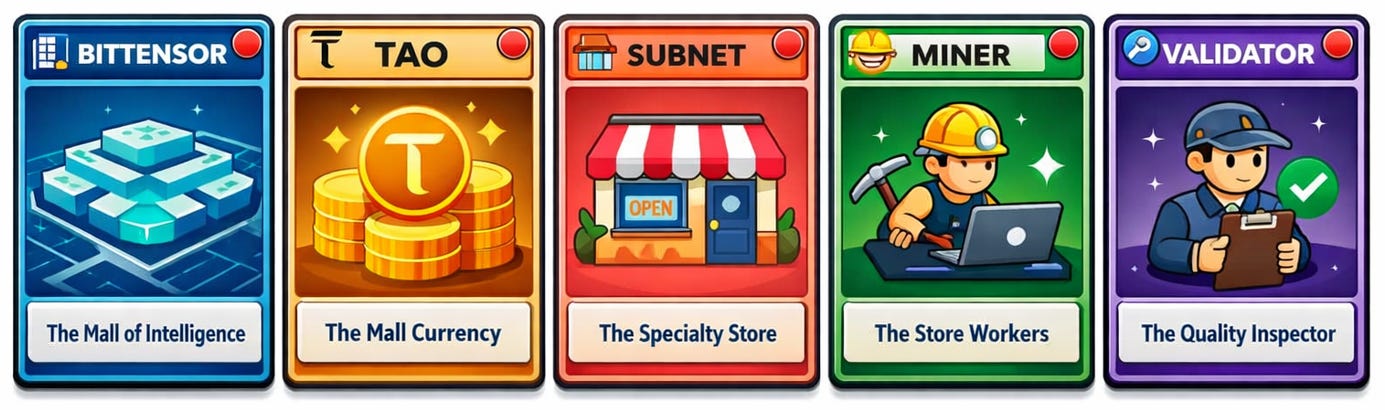
1. Bittensor 🔴
The Mall of Intelligence. A whole shopping district where anyone can set up shop. Want to build compute? Open a store. Storage? Another store. AI predictions? Yet another. It’s Bitcoin for brains: a global marketplace where intelligence is the commodity and no single landlord controls the whole operation.
2. TAO 🔴
The Mall Currency. It’s the only money accepted in this shopping district. You need it to open a shop, rent a unit, or pay your workers. The busier the mall, the more valuable each dollar becomes.
3. Subnet 🔴
The Specialty Store. Each subnet is a mini-market competing to solve one specific problem better than anyone else. Subnet 75 does storage, Subnet 34 detects deepfakes, Subnet 8 handles trading signals.
4. Miner 🔴
The Store Workers. These are the workers behind the counter doing the actual heavy lifting. Whether coding, generating images, or scraping data, if the workers fail, the product fails.
5. Validator 🔴
The Quality Inspector. They walk through each store, test the products, and file official reports. Their job is to make sure no one’s selling garbage and ruining the mall’s reputation.
Bonus terms if you’re going deeper:
6. Emissions
Payday, Every Day. The network mints 3,600 TAO every 24 hours. Every subnet, miner, and validator is fighting to claim their share based on the quality of work they’re producing.
7. Staking
The High-Yield Savings Account. You park your TAO with a validator to say “I trust this guy.” In exchange for your trust, you get a cut of their paycheck.
The Complete Arsenal
The 5 terms above will get you through most conversations. But if you’re ready to go deeper I’ve created something for you:
Bittensor Terms Decoded has 20 terms (so far) organized by skill level:
🔴 Survival Kit (5 terms) - Don’t sound like an idiot
🟡 Staking Decision Tier (13 terms) - Make informed choices
🟢 Builder/Operator Tier (20 terms) - Debate governance, evaluate subnets
Bookmark it. You’ll use it every week. And I’ll keep adding to this over time to be a more expansive resource.
Bittensor Terms Decoded
Mission: This is the living glossary for Bittensor terms you’ll encounter in Discord, governance proposals and subnet performance debates. Designed for quick lookups and long-term reference.
11pm: When Your Wife Finally Asks
On Sunday I retired late from my home office after researching Bittensor for a bit too long. Arriving in the living room, to my surprise my wife asked the question I’d been subconsciously avoiding for a while:
“So what exactly are you spending all that time on with this Bittensor AI newsletter? What is it actually?”
This was my shot at redemption.
“Think of it like this: Bittensor is a giant shopping mall for AI services. You’ve got stores competing to give you the best product. The currency is TAO. And the whole thing runs on quality inspectors making sure nobody’s selling garbage.”
She paused the TV.
“So basically no one company owns it? That’s the whole point?”
“Exactly.”
“And the mall thing means anyone can open a store?”
“Right. No permission needed. You just need to prove your store is worth keeping around.”
She nodded. Actually nodded.
“Okay, that makes way more sense than all that crypto AI stuff you were rambling about before.”
The vocabulary gap closed. Not because I memorized 20 definitions, but because I had the right 5 in the right language. That’s what this decoder is for.
Your Mission This Week
Pick one person in your life who’s curious about AI but doesn’t know about Bittensor.
Pitch them the concept (guide in my last piece) and use the mall metaphor to explain these 5 terms. See what happens.
Then come back and tell me: What worked? What broke? What question did they ask that you couldn’t answer?
Because the only way we fix the vocabulary gap is by testing these explanations in the wild and learning what actually lands.
Where Do You Go From Here?
If you’re new: Start using these 5 terms this week. Join a Discord channel, follow a governance discussion, listen to a podcast. See how much more you understand.
If you’re ready to go deeper: Bittensor Terms Decoded has the full 20-term reference organized by skill tier. Bookmark it. It’s designed for quick lookups when someone drops “Yuma Consensus” in chat and you need the definition now.
If you just want to lurk: That’s fine too. You now know enough to follow along. The decoder will be there when you’re ready.
Until next time.
Cheers,
Brian