

What if you could copy Bitcoin’s monetary policy (the exact code that created a trillion-dollar asset), and redirect it away from ledger security toward AI work?
Here's what that would look like:
21 million tokens. 4-year halvings. An emission schedule copied line-by-line from Bitcoin's playbook. But instead of paying miners to validate transactions, you pay over 100 specialized AI networks to run inference, fact-check outputs, train models, solve specialized problems.
Think of each AI network (subnet in Bittensor terms) as a specialized startup competing for a share of the daily TAO payout. They've got their own teams, their own miners, their own tokens. And if they don't deliver utility? They get deregistered from the network. It's the most ambitious fork of Bitcoin's monetary ideas I've found.
This is the story of where TAO came from, how it survived crashing to $30 and rocketing to $757, and why a mechanism called dTAO turned every holder into an involuntary venture capitalist in the world's most open AI marketplace.
What TAO Actually Is
So if the Bitcoin parallel covers the supply side, what does TAO actually do?
Every 12 seconds, the network mints 0.5 TAO. That TAO gets distributed to miners and validators across every active subnet as payment for work. A subnet running AI inference gets a share. A subnet fact-checking outputs gets a share. A subnet training models gets a share. The work is real. The payment is TAO.
But what makes TAO different from a mining reward is it’s also the only asset that can route capital between subnets.
If you want to support a subnet, you stake TAO into its pool. If you want to move your capital from one subnet to another, you withdraw TAO from one pool and deposit it into another. TAO is the on-ramp, the off-ramp, and the currency in between.
Think of it as the reserve currency of a decentralized AI nation. The subnets are the businesses. The miners and validators are the workers. And the emission schedule, the thing that prints new TAO every 12 seconds, is the central bank. But this central bank lets the market decide where the money goes.
Origin Story: The Pseudonym, the Chain, and the No-ICO Launch
Bittensor was founded in 2019 by Jacob Robert Steeves and Ala Shaabana. Steeves was a machine learning engineer who’d worked at Google. Shaabana was a computer scientist. They conceived the idea of an AI blockchain and started building.
In a nod to Bitcoin's Satoshi origins, the whitepaper was published under a pseudonym: Yuma Rao.
Its intentionally the same playbook: anonymous author, open-source code, no IPO, no pre-mine, no token sale.
The blockchain itself is built on Substrate, the same framework that powers Polkadot. But Bittensor is an independent Layer 1 chain, not a Polkadot parachain. It doesn't rely on another chain for consensus, security, or governance. Bittensor controls its own upgrade path, its own emissions, and its own destiny
The mainnet launched on January 3, 2021. Every TAO from genesis was earned through network participation. Miners ran nodes, contributed compute, and got paid in TAO. There was no ICO allocation to dump, no founder cliff vesting schedule or any pre-sale tokens sitting on exchanges waiting to be unloaded.
Early institutional capital did show up. Polychain Capital, one of the biggest crypto-native VC funds, was accumulating TAO before the public network launch. They saw a network with Bitcoin’s monetary discipline applied to AI instead of ledger security.
In 2026, both founders stepped down from the Opentensor Foundation. Steeves in February, Shaabana in March. They left to build subnets on the network they created. The founders became competitors within their own ecosystem (although Steeves is still centrally involved in protocol upgrades for now).
Tokenomics 101: The Bitcoin Blueprint
TAO’s tokenomics are deliberately modeled on Bitcoin. If you understand Bitcoin’s supply schedule, you understand TAO’s. The differences are in what the token actually does.
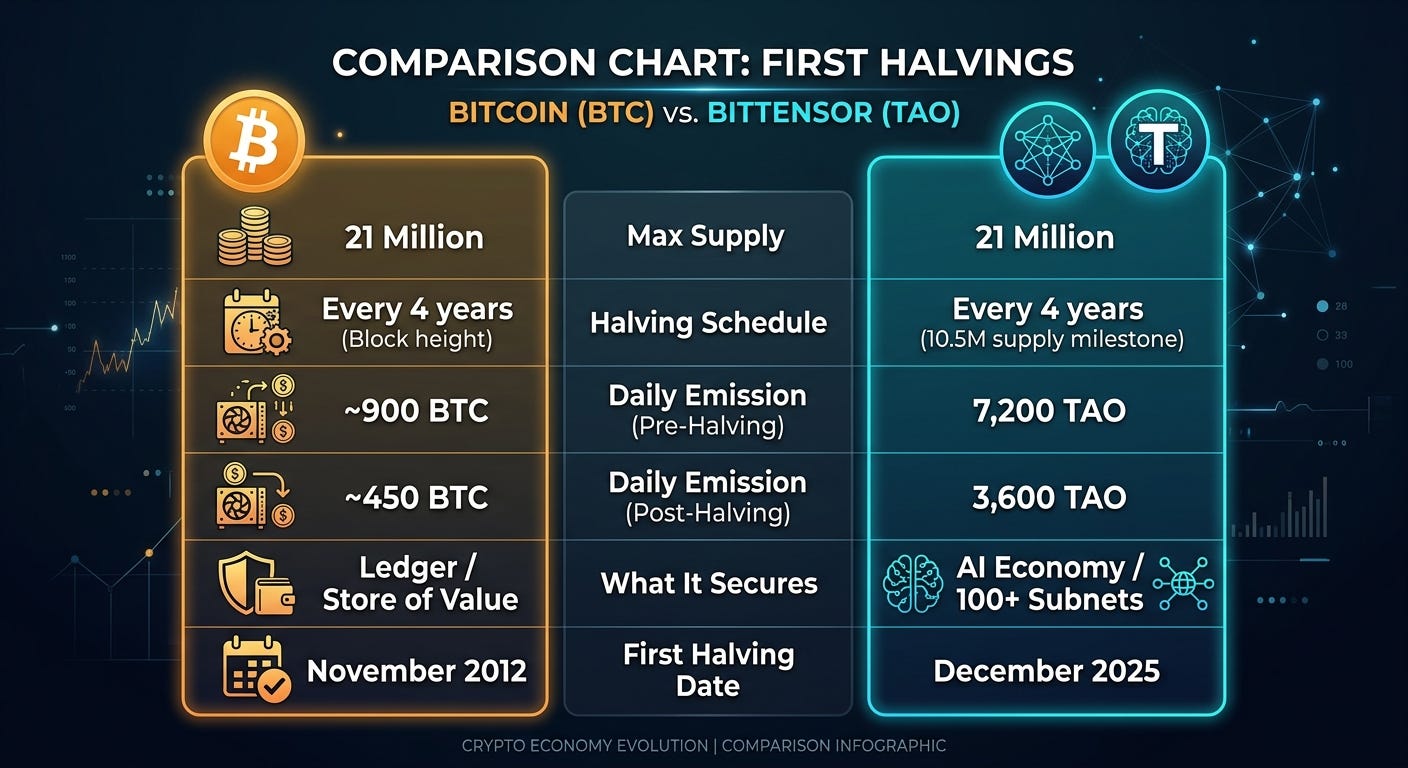
21 million max supply. Identical to Bitcoin.
Emission rate: Initially 1 TAO per block, roughly every 12 seconds. That worked out to about 7,200 new TAO per day, distributed to miners and validators across all active subnets.
4-year halving schedule: When circulating supply hit 10.5 million, daily emissions cut in half. The first halving happened in December 2025, dropping from 7,200 to 3,600 TAO per day. Network inflation went from roughly 25% to 12.5% annually.
Distribution: No founder allocation in the traditional sense. Miners and validators earn TAO by doing work. As of September 2026, roughly half of issued TAO is staked to Root (the base layer of the network). A further share is staked across individual subnets or held in subnet liquidity pools, while the remainder is unstaked or held in other wallet and exchange balances.
Circulating supply right now: roughly 11.3 million TAO of the 21 million cap. We’re past the first halving. Scarcity is tightening.
I wrote a full deep dive on the halving mechanics in The First Bittensor Halving: The End of Easy Mode.
Three Eras of TAO’s Price History
TAO’s price history breaks into three distinct eras. Each one was driven by a completely different force.
Era 1: Genesis (2021 to 2023) — The Dark Ages
The mainnet launched January 3, 2021. And then…. nothing happened. At least nothing you could see on a price chart.
TAO had no exchange listings for most of this period. It traded over-the-counter or through obscure channels. There was no price discovery and no narrative to play off. The token was essentially invisible to the broader market while the network was live and miners were earning TAO for real work.
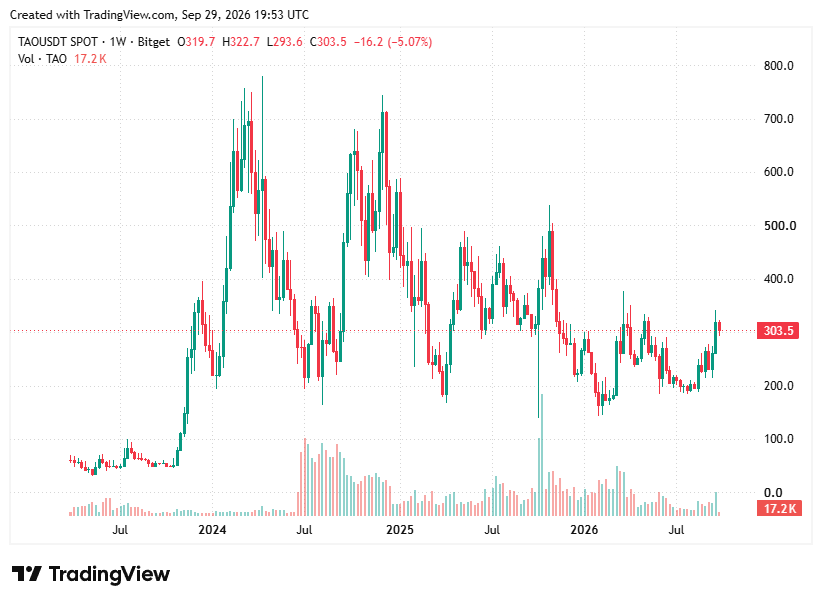
First exchange listings arrived in March 2023. TAO opened at around $91.
Then it crashed.
All-time low: roughly $30 in May 2023. This was a classic post-listing dump. The market found Bittensor, got excited for a minute, then the early holders and miners took profits. TAO went from $91 to $30 in two months. Most people who’d just discovered it wrote it off. Probably another altcoin after all.
Era 2: The AI Narrative Boom (2023 to 2024) — From $30 to $757
The AI narrative exploded in late 2023. ChatGPT had been live for a year, every tech company was pivoting to AI, and crypto needed an AI story. Most AI tokens were whitepapers with a logo. Bittensor was one of the few projects with actual infrastructure: a live network with real miners and working subnets.
TAO became the AI crypto trade.
All-time high: approximately $757 in March 2024. A roughly 25x move from the May 2023 low of $30.
Institutional capital hit the big time during this phase. Grayscale launched a Bittensor trust. Bitwise filed for a TAO ETF. DCG created an index fund. The trade was crowded and the narrative was hot.
The rally didn’t hold. By late 2024, the broader crypto market cooled and TAO gave back significant gains. The AI narrative alone couldn’t sustain a $750+ price. The market needed proof that the subnets could actually generate revenue, not just emissions.
Era 3: The Mechanism Era (2025 to Present) — dTAO Changes Everything
February 2025 is the line in the sand. dTAO launched, and TAO’s market structure fundamentally changed. Price was no longer just about TAO scarcity. It became about which subnets deserved capital.
December 2025: the first halving. Emissions cut in half. TAO’s price dipped about 20% amid miner repositioning and market jitters, then stabilized. I covered this in my 2025 End of Year Report Card.
March 2026: TAO rallied to $377 with $900 million in daily trading volume on consecutive days. That volume was the strongest institutional signal we’d seen. The price was ripping while Bitcoin was flat. Something had changed.
July 2026: the V440 Emission Gate shipped. Subnets now have to clear a demand threshold before they receive full emissions. No more free lunch for idle subnets. I did a full three-level breakdown of how this works in Bittensor 101: V440 - The Emission Gate.
September 2026 (today): TAO trades at roughly $300. About 67% below its all-time high. Market cap around $3.5 billion. Circulating supply near 11.3 million of 21 million.
The price doesn’t reflect what’s happened to the mechanism. The mechanism has never been stronger, but the market hasn’t caught up. Or the market doesn’t believe yet.
The dTAO Pivot: What Changed in February 2025
Before February 2025, Bittensor had a centralization problem. A small group of Root validators decided which subnets got emissions. They were the gatekeepers. Politics ruled. If you wanted your subnet to survive, you needed the validators on your side. The system worked, but it concentrated power in too few hands.
dTAO was the solution. The pitch was simple: stop letting a handful of validators play God with emissions. Let the market decide. Turn every TAO holder into a venture capitalist.
How it works: TAO is the reserve currency. Each of the 100+ subnets issues its own alpha token: subnet equity, tradeable against TAO in a liquidity pool. You stake TAO into a subnet’s alpha pool, and that pool acts as an automated market maker.
The more TAO staked into a subnet, the higher its alpha price, and the larger its share of daily TAO emissions. If a subnet delivers real utility, users stake TAO to support it. Alpha price goes up. Emissions flow. If a subnet fails to attract staking, alpha price drops, emissions dry up, and eventually the subnet gets deregistered. The market, not a committee, decides which subnets survive.
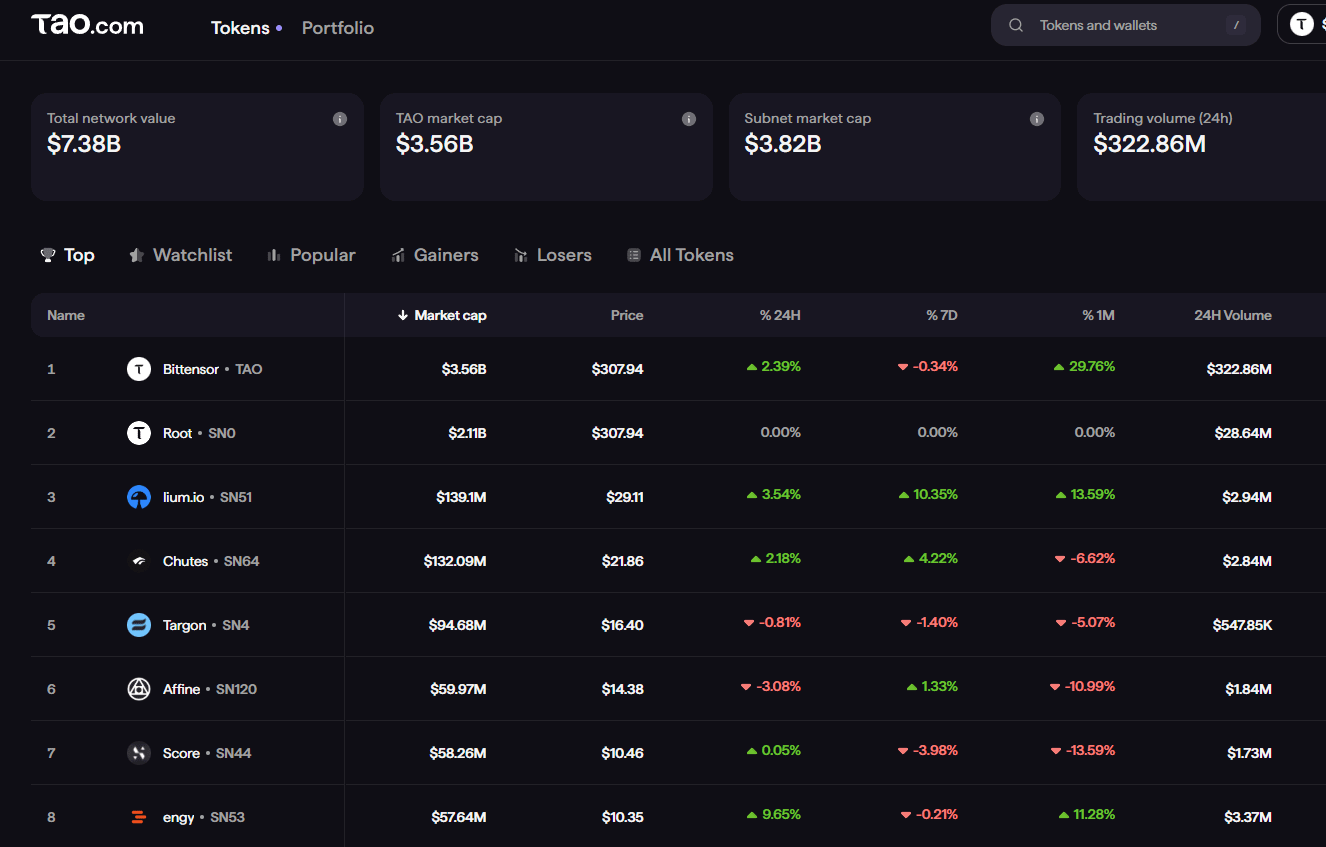
Think of alpha tokens the way you’d think about venture investments. TAO is the bank account. Alpha tokens are the bets. Each one has its own halving schedule — roughly every 2 to 2.5 years, separate from TAO’s 4-year cycle — so subnet-level scarcity tightens on its own timeline, independent of the broader network. Some will compound into real value, but most end up deregistered.
dTAO changed the staking dynamics fundamentally. TAO staked to Root (Subnet 0) is now only counted at 18% of its nominal value in validator weight, while alpha stakes are fully weighted. Every TAO holder became an active allocator whether they wanted to be or not.
I put skin in the game. I picked three subnets with real utility, and moved meaningful TAO into their alpha pools. My thesis was simple: the market rewarding quality.
Six months later, I was down 30%, and my alpha trading phase was over before it started.
The subnets were still working, but the capital had moved elsewhere.
What I learned: these markets reward allocation speed, not patience. You can’t hold alpha like regular equity. The full autopsy is in One Year of dTAO: The Market That Took Over Bittensor. But the mechanism was doing exactly what it was designed to do: forcing capital toward whatever’s working today, not what you think should work tomorrow.
The Product Take: TAO Learned to Measure the Right Things
Here’s the question that matters: how do you know if the work being done on your platform is actually good?
Bitcoin answered this clearly. Proof-of-work. You either produce a valid hash or you don’t. The network verifies it in milliseconds with no committee or judgement calls.
Bittensor inherited Bitcoin’s monetary discipline but a harder version of the verification problem. AI work isn’t a hash. You can’t score a weather prediction model or a fact-checking agent with a single function. The output is messy, subjective, and constantly evolving.
The design philosophy that makes this work is simple: define what to verify and how to reward it, then leave the method undefined. Anyone in the world can show up and solve the problem however they can. By not prescribing the method, you expand the global state of potential solutions.
For TAO as a currency, that evolution matters more than any single subnet’s balance sheet. A reserve currency is only as credible as the system that routes it. When the routing mechanism goes from committee politics to market signals to demand thresholds, the currency backing it becomes more trustworthy because the system filters out the noise on its own.
Jacob Steeves compared it to NVIDIA. GPUs were a new type of computing. It took roughly 30 years for them to become the foundational layer for AI. Bittensor, he argued, is inventing another new type of computing (incentive computing) and the trajectory is just as long. The network started with one incentive mechanism in 2021. Now there are 128, with a new one appearing roughly every four days. When GPUs were first invented, they had a couple of applications. Now they’re in every industry on earth.
Which is how you should read the revenue numbers. The SubConnect Bittensor Revenue Index counts roughly 24 revenue-generating subnets today, estimating ecosystem ARR at $28M–$35M with a plausible path to $100M+ by end of 2026. These are subnets earning dollars from real customers, not just recycling TAO emissions.
Bittensor is moving from emissions-funded experimentation to customer-funded businesses. When 24 subnets are generating real external ARR and the projection is 35–40 by year-end, the question becomes “when does revenue become the dominant signal?”
Where TAO Goes From Here
The Bull Case:
The mechanism has never been stronger. dTAO solved allocation. The halving solved supply. The Emission Gate solved quality. Institutional volume is real. TAO bridged to Base through Chainlink, opening the subnet economy to one of the deepest DeFi liquidity pools in crypto. And 24 subnets are generating real external revenue with a credible path to $100M+ by end of 2026.
The Bear Case:
TAO trades at $300, 67% below its all-time high. The revenue is real but early and emissions still subsidize the majority of subnet operating costs. The complexity problem also hasn’t gone away. Ask 10 people to describe what TAO does and you’ll get 17 different answers. The market either hasn’t caught up, or it doesn’t believe yet.
Why I’m Still Here
I’ve been through all three eras. I bought the narrative. I staked into alpha tokens and lost money. I’m still here, not just from faith, but because the product keeps shipping. Each era fixed a real problem the previous one couldn’t. The mechanism today is unrecognizable from the one I started with, and every change has made the system more honest.
What I’m watching
The trajectory, not a single moment. Can the number of revenue-generating subnets scale and can canonical bridges (already existing on EVM, Solana, Base) start measuring external demand as an emissions metric, so the mechanism rewards subnets pulling in real buyers from outside Bittensor? Can the complexity gap narrow before patience runs out?
The Bigger Stakes
Steeves framed the stakes in a way that connected back to Bitcoin. Bitcoin was money outside the state. Bittensor is trying to build intelligence outside the state: AI that doesn’t sit behind a lab’s closed doors. If you build a data center, someone can seize it. If you build a mechanism, it doesn’t have an address.
This is the trajectory TAO is on. A currency backing a new type of computing that defines the outcome, leaves the method open, and lets the world come solve the problem. The mechanism keeps getting more honest and the revenue keeps getting more real.
Every subnet is a business competing for capital. Some are shipping revenue. One just shipped a frontier model. Most won’t survive. The mechanism will kill them without a committee vote.
That’s what you bought when you bought TAO. Not just exposure to AI. Exposure to a sorting mechanism that might actually work.
If this piece made the picture clearer and you want to keep going, two places to start. 5 terms that unlock 80% of Bittensor conversations is the vocabulary survival guide. It gives you the five words that show up in every Discord thread, governance proposal, and subnet debate, translated into plain English. If you can’t tell a subnet from a validator yet, start there.
If you’re further along and trying to explain Bittensor to someone else, I Fixed My Bittensor Pitch walks through what happened when I tried five different pitches on five different people and what actually worked. Spoiler: the version I practiced in the shower died on contact with a real human at a bar.
Both are free. No paywall. The goal is simple: make this ecosystem legible to people who don’t code.
Until next time.
Cheers,
Brian
Disclaimer: This is not financial advice. I am a writer documenting the Bittensor ecosystem. Always do your own research.