


You know what most job postings look like after you’ve read a thousand of them?Noise. Copy-paste corporate templates with the company name swapped out. Half the descriptions could be for any company, any role, anywhere.
I see them all the time in my 9-5. Then last month, I finally found an interesting one.
On June 19, 2026, the Opentensor Foundation posted a role on Polychain Capital’s job board. The title: Subnet Owner (Bittensor Network). Location: Toronto, Canada. Remote.

The pitch, in their words:
“Are you an AI innovator with an entrepreneurial spirit? The Opentensor Foundation is seeking visionary builders to become Subnet Owners on the Bittensor network. In this role, you won’t just join a company, you will found a new AI product venture powered by Bittensor’s decentralized compute network.”
The ask is to found a new AI product venture. And the job description makes it explicit:
“Essentially, you will act as both the lead engineer and the CEO of your decentralized AI venture, responsible for its technical direction and business growth.”
The responsibilities read like a startup founder’s wish list crossed with a machine learning engineer’s dream: design incentive mechanisms, architect tokenomics, build an AI product, manage a community of miners and validators, and drive business strategy. You get dual revenue streams: traditional product revenue and network TAO rewards. And maybe best of all, you keep ownership of your company and your IP.
This job didn’t exist three years ago. The idea that someone could “found a new AI product venture” on a decentralized network, with the chain paying their workforce, with no VC pitch deck, with no cloud infrastructure bill, that’s a category of work that Bittensor’s incentive architecture invented.
And it’s just the beginning.
The Decentralized AI job market
Silicon Valley is fond of saying AI will create new jobs that haven’t been invented yet. Usually it conveniently sidesteps the transition pain. But what if it’s directionally right and just incomplete?
What if the new jobs aren’t “prompt engineer” or “AI trainer”? Those are transitional roles. What if the real new jobs are structural, roles that exist because of a fundamentally different economic architecture?
Bittensor is quietly creating exactly that. Across 128 active subnets, people are getting paid in TAO, directly by the chain, for work that doesn’t fit any existing job category. There’s no LinkedIn profile for a miner, or a standard career path for incentive mechanism design yet.
Call them decentralized AI jobs, if you need a label, but the key is Bittensor is building economic plumbing for a job market nobody can see yet.
The Three Economic Primitives That Change Everything
These roles don’t exist because of better AI. They exist because Bittensor rewrote the rules of how work gets paid for, who owns it, and how it’s coordinated.
1. The Protocol as Employer
Your boss doesn’t decide your paycheck. The protocol does.
Bittensor distributes 3,600 TAO per day based on measurable performance. There’s no infuriating HR department involved here. Just one question: did you produce useful work?
You’re not hired. You’re permissionlessly participating in a market. On Bitcast (Subnet 93), podcasters earn TAO from advertisers while an AI verifies the work. The chain pays automatically.
2. Ownership Baked Into the Protocol
Traditional startups grant equity. Bittensor grants emissions.
Launch a subnet and you get roughly 18% of block rewards. This is protocol-level ownership with a revenue stream that flows as long as your subnet is useful.
The Subnet Owner job posting says it plainly: dual revenue streams (product and TAO), and you keep your IP.
3. Markets, Not Managers
Bittensor turns coordination into competition.
Centralized AI companies use managers to coordinate teams. Bittensor uses incentives to coordinate miners. The protocol rewards useful work with no middle management required.
When Subnet 85 (video) feeds into Subnet 62 (coding) feeds into Subnet 75 (storage), someone needs to architect those workflows. When AI agents start transacting autonomously, you need someone to manage fleets of autonomous workers. You need yet another someone to stress-test incentive mechanisms. You also need a certain someone to provide the judgment machines can’t replicate.
The work is being reorganized around incentives instead of bosses.
The 7 Hidden Roles
Here are 7 roles that only exist because decentralized AI built a new kind of economy. Some of these are live right now. Others are emerging as subnets stack, agents transact, and protocol economics get more complex. (These came from pulling subnet landing pages, cross-referencing Taostats emission data, and reading community discussions about what each subnet actually needs. I listened to every founder interview I could find and 7 roles kept surfacing across all of it.)
A note before we start: You won't see "miner" on this list. Mining is critical technical work, but it predates decentralized AI. The roles below are new job categories that didn't exist until Bittensor created them, and many are accessible to non-coders.
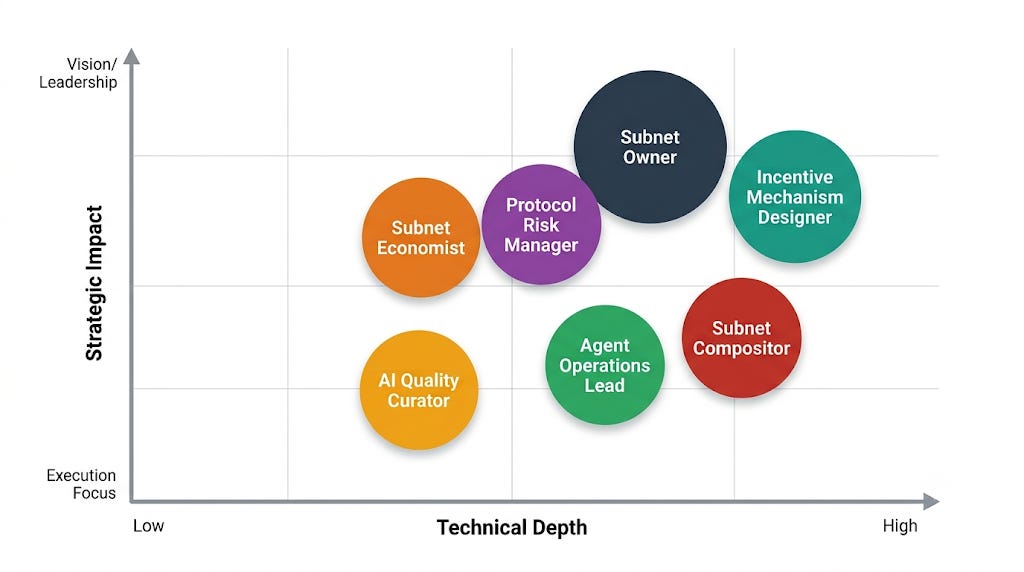
1. The Subnet Owner (already hiring)
Picture a startup founder. Now remove the VC pitch deck, the cloud infrastructure bill, and the board of directors.
What’s left is a person who designs an incentive mechanism, builds a product on top of it, and lets the chain pay their workforce. The Opentensor Foundation is actively recruiting for this. The application is a resume and a proposal for the AI product you’d build.
In a centralized world, founding an AI company means raising capital, hiring a team, renting compute. On Bittensor, the chain subsidizes your miners, the protocol provides your infrastructure, and the incentive mechanism IS your organizational structure.
2. The Agent Operations Lead
You manage a team of 50 workers who never sleep, never tire, and never ask for a raise. They’re AI agents, and on Bittensor they’re economic actors: mining subnets, consuming services, transacting autonomously.
Someone needs to set their objectives, review their outputs, and intervene when they go sideways.
The infrastructure is landing right now. SOMA (Subnet 114) is building MCP servers so agents can reliably connect to external tools. Loosh AI (Subnet 78) launched a “Cognition Engine” to give agents memory and ethical reasoning. As these systems start operating across multiple subnets, the need for human oversight becomes real. A runaway agent can drain resources before anyone notices.
In a centralized company, AI agents are tools. On Bittensor, they’re workers. Workers need managers.
3. The Subnet Compositor
Take compute from Lium. Add storage from Hippius. Bolt on inference from Chutes. Feed in data from D-Search. You’ve just built a complete AI product without touching AWS or buying a single GPU.
A compositor chains subnets together into production pipelines. In a centralized world, one company owns the entire stack, so nobody needs this role. On Bittensor, each layer is a separate, competing market. Composing them into something coherent is a skill that literally didn’t exist before decentralized AI fractured the stack into independent, incentivized pieces.
Builders are already doing this. Lium (SN51) plus Chutes (SN64) gives you a vertically integrated AI product with zero cloud spend.
4. AI Quality Curator
Machines can generate. But they’re a terrible judge. (As an easy test, just ask ChatGPT to rate its own jokes).
Which dataset actually matters? Which model output is genuinely good? Which subnet is solving a real problem versus recycling emissions into a circle of nothing? Without human judgment, competition devolves into a pure compute race. Your taste, your domain expertise, your editorial instinct become the premium differentiator.
“Let’s use the human talent to do the stuff that’s less mundane and focus the energy in the proper space so that value is created. That’s what Bittensor is really trying to do.” (Ala Shaabana, Bittensor co-founder)
Subnets like Subnet 13 (Data Universe) scrape and curate datasets from X and YouTube for model training. Without human editorial judgment guiding the scoring, those pipelines fill with garbage fast.
In a centralized AI company, the curator is a product manager inside the org. On Bittensor, curation is open. Anyone can do it. The chain rewards you for being right. Your judgment becomes a stakeable asset.
5. Subnet Economist
128 subnets. Each one a tokenized startup with its own economy, incentive mechanism, and its own alpha token. They compete, some succeed and others get deregistered.
Someone needs to read the prospectus.
You analyze tokenomics, emission flows, alpha/TAO ratios, net TAO flow. You separate real value from recycled emissions. Capital allocation depends entirely on staker behavior across those 128 micro-economies.
Analysts are already using Taostats to track which networks generate real revenue. Chutes AI is projecting over $2.4M in annual usage fees. Targon Compute is projecting $10.4M. Those numbers may justify Alpha token demand, or other factors may play a bigger part.
In traditional markets, equity analysts cover public companies. On Bittensor, each subnet is a micro-market that needs the same scrutiny, for a community of stakers and delegators who need to know where to put their TAO.
6. Protocol Risk Manager
I wrote about this in a previous issue: Bittensor doesn’t just need machine learning experts, it desperately needs people who understand how complex systems fail and how to build resilience.
That was me speaking from the inside of 20 years of corporate risk management. Those skills transfer directly.
You stress-test incentive mechanisms, identify failure modes, build crisis response frameworks. Bittensor is a complex system with no central authority. When something goes wrong, there’s no CEO to issue a directive. The community has to spot the problem and respond.
Right now, dedicated community members informally stress-test deregistration vulnerabilities, where underperforming subnets lose immunity and get dropped. If subnet count continues to grow, the risk of cascading failures grows. Formalizing this into a dedicated role will be essential.
A centralized company has a risk department because the company is the entity at risk. On Bittensor, the network itself is the entity at risk.
7. Incentive Mechanism Designer
Every subnet runs on a custom grading algorithm. That algorithm is actually the product.
It determines who gets paid, how much, and for what. Get it wrong and your subnet fills with garbage or gets gamed. Get it right and you’ve built a self-sustaining economy.
“Bittensor abstracted the incentive layer, not the money layer. A subnet is just somebody figuring out how to best incentivize a large swath of resources to do one task very, very well.” (Jacob Steeves, Bittensor co-founder)
The Opentensor Foundation lists incentive design as a core responsibility of Subnet Owners today. Tomorrow, it becomes a specialized consulting role: designing mechanisms for other people’s subnets.
Subnet 8 (Vanta) requires a specific mathematical structure to score algorithmic trading strategies. Designing that means treating the mechanism like a product roadmap, balancing game theory, market demand, and technical feasibility.
In a centralized company, incentives are salaries, bonuses, and stock options, designed by HR. On Bittensor, the incentive mechanism is the core product. No traditional job category covers that intersection.
Can't decide? Hit reply and tell me which role you want to unpack in detail in a future issue.
The Gap Machines Can't Close
These 7 roles all sit at the intersection of three things:
1. Human judgment (taste, oversight, risk assessment, economic design)
2. Machine autonomy (agents, subnets, incentive mechanisms)
3. Decentralized infrastructure (the chain as payroll, the protocol as employer)
All three are required. Remove human judgment and you have automation. Remove machine autonomy and you have a traditional job. Remove decentralized infrastructure and you have a job at OpenAI.
The data says this is already happening
The evidence isn’t just in the job postings. It’s in the numbers:
AI created 640,000 U.S. jobs between 2023 and 2025, according to LinkedIn analysis reported by the Wall Street Journal, including new white-collar positions that didn’t exist before.
Stripe Atlas hit 100,000 incorporations, up 130% year over year. AI‑native founders and agents are building companies faster than they’re tearing down jobs.
At the top end, Bittensor subnets are already streaming tens of thousands of dollars per day to miners. These on‑chain income flows increasingly look like a native payroll layer for AI.
Major decentralized AI milestones are being hit: large-scale LLM training runs using commodity hardware, subnet composition pipelines in production, and autonomous agent marketplaces going live.
Code is digital lego. If these lego bricks get cheaper and easier to lay, you don’t use fewer builders. You build what was previously too expensive, too slow or out of reach.
Bittensor is making the bricks (compute, inference, storage, data) radically cheaper. But who builds with them? And what do we call the new jobs that emerge?
Right now, we don’t call them anything. They’re invisible. But they’re real and they’re multiplying.
Start before the job title exists
In my previous scenario planning issue, 83% of you said the “B2B Backend” scenario would arrive by 2027. That’s the future where Bittensor powers your company’s AI infrastructure without anyone in marketing knowing. It’s also the future where these invisible jobs get real job titles.
And when I think about my kids’ future careers, I do worry about whether they’ll know where to look for the jobs being created right now. The ones nobody’s named yet.
The answer in my mind is clear. It’s embracing entrepreneurship.
And in a world where AI automates more tasks every quarter, incentive mechanisms like Bittensor’s may be one of the few options left to add real value to society.
The Subnet Owner job posting is open right now. Its a fully remote role available worldwide. But you don’t have to start there. The funnel is wide:
Start with content. Subnet 93 (Bitcast) pays creators. An AI verifies your work. The chain pays you.
Start with data. Subnet 42 (Masa) pays for data cleaning. Basic Python is enough.
Start with monitoring. Pick a subnet on Taostats. Track its health. Document what you see.
Start with community. Join a subnet Discord channel. Help someone who’s stuck. Document the solution.
Start with analysis. Read subnet white papers. Evaluate incentive mechanisms. Become the person others rely on for subnet research.
The worst thing you can do is wait until the job title exists. By the time it has a name and a LinkedIn category, the people who invented it will already be three roles ahead.
Bittensor is designed to reward measurable utility. The invisible job market doesn’t care about your resume. It cares about what you can do.
The chain is the boss. And it’s hiring.
New to Bittensor? Start Here
If this is your first time reading about Bittensor and your head’s spinning a bit, I’ve written a few pieces specifically designed to get you oriented:
Can’t explain Bittensor to save your life?
Start with I Fixed My Bittensor Pitch. Five real conversations, five different angles. Find the one that works for your audience.
Drowning in jargon?
Check out 5 Terms That Unlock 80% of Bittensor Conversations. Think of it as your survival kit. This has just enough vocabulary to follow Discord without feeling lost.
Want to actually use the network?
Read The Missing Front Door. It walks you through the current state of apps and tools so you can stop researching and start experimenting.
Ready to hold TAO properly?
My 2026 Guide to Bittensor Wallets breaks down your options based on your actual needs, not what crypto Twitter thinks you should use.
The invisible job market is real. These pieces will help you see it.
Disclaimer: This is not financial advice. I am a writer documenting the Bittensor ecosystem. Always do your own research.