

I saw a question pop up on Reddit last week that stopped me in my tracks.
It wasn’t about price action, subnet emission schedules, or validators. It was simple, direct, and exactly what every normal person is thinking:
“Is Bittensor likely to get a user-friendly interface? Similar to ChatGPT, DeepSeek, etc.?”
The user went on to ask why they can’t just open an app and use the network they keep hearing about.
This question is a milestone. A year ago, people were asking, “What is Bittensor?” Now, they know the name, they know the narrative, but they want a clean, intuitive experience.
But it’s also a fair critique and the only one that matters for long-term adoption.
Reality Check: The Shopping Mall, Not the Store
ChatGPT is one product.
Bittensor is a marketplace of many.
When you walk into a shopping mall, you don’t “buy the mall.” You look for a directory to find the specific store that sells what you need, whether that’s clothes, coffee, or electronics.
Bittensor doesn’t have that directory yet.
When I first tried to use Bittensor back in 2023, the only consumer-facing app I could find was Corcel chat. It was basic. Everyone else was getting blown away by early ChatGPT, and here I was testing a chatbot that felt like it was stuck in 2018.
I remember reading old tweets saying Bittensor was a scam. “There’s nothing happening on it. Corcel is useless.”
But those critics missed the point entirely.
Corcel wasn’t the network. It was one room in the mall. And the mall was still under construction.
Framework: The Three-Layer Front Door
If you are waiting for an official Bittensor Super App to launch from the Foundation, you might be waiting a while. That’s not what this protocol is designed to do.
Instead, the ecosystem is building the Front Door in three layers. Here is where we stand today:
Layer 1: The Key (Wallets)
This layer is basically solved.
You need a way to hold TAO and interact with the network. There are several wallets now that make this relatively painless- check here if you want a quick start figuring out which one to start with.
TAO.com: iOS beginner-friendly option
Nova: Mobile wallet with hardware support
Crucible: For more technical users
Talisman: For multi-chain power users
The key is no longer the bottleneck. You can get in.
Layer 2: The Lobby (Discovery)
Six months ago, finding a subnet meant scrolling X threads, decoding raw blockchain data on Taostats, or asking Discord and getting 47 conflicting opinions.
That just changed in December 2025 with Subnet.ai.
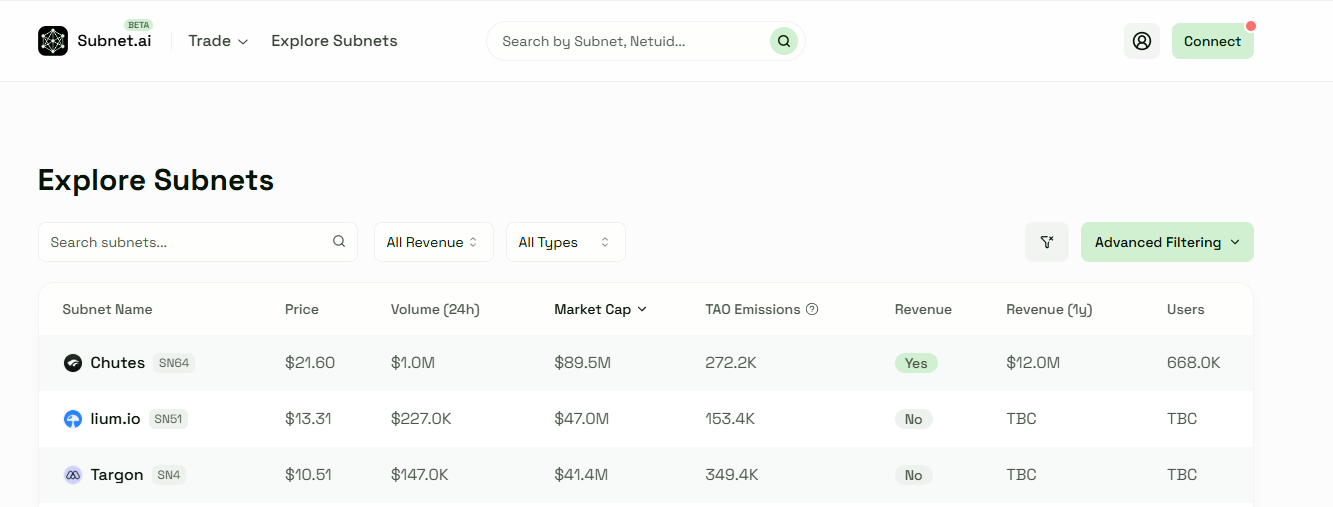
This is the first real Mall Directory for Bittensor. Not just a prettier Taostats—a purpose-built discovery layer.
Every subnet gets one profile page with plain English explanations and key metrics (emissions, liquidity, miner distribution, age, TVL).
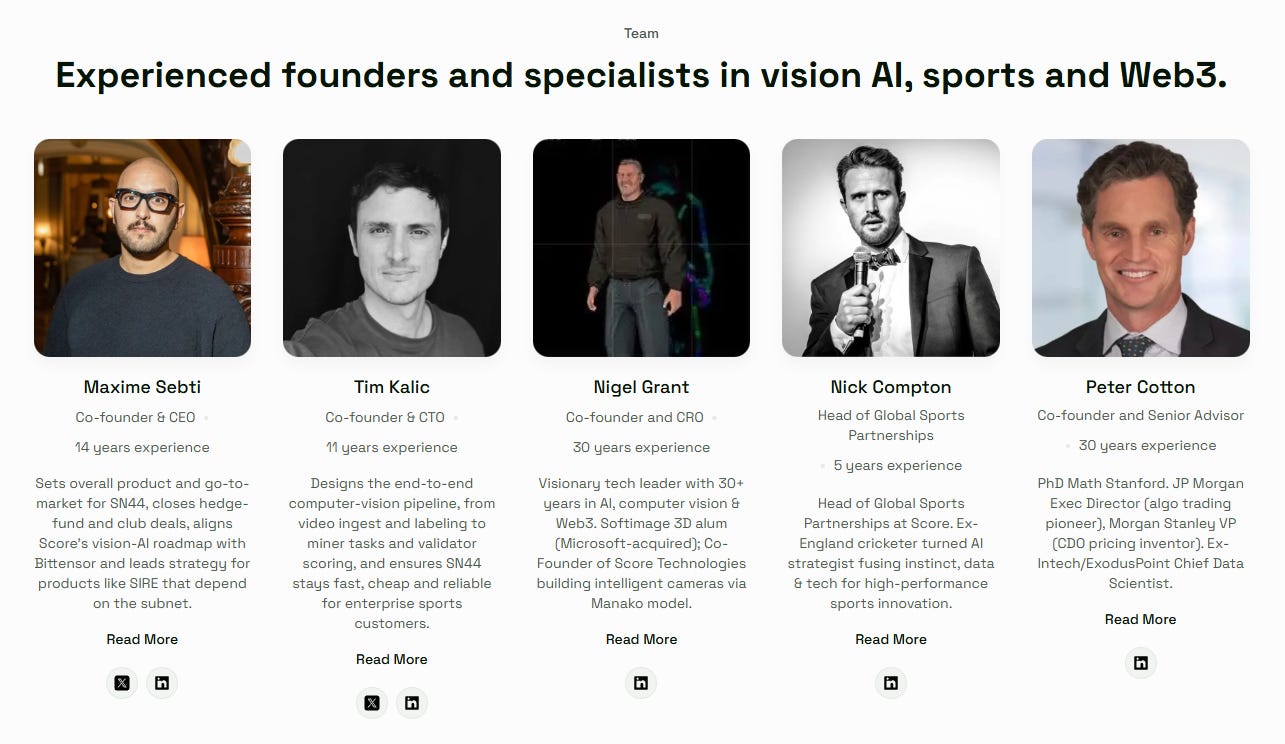
But it goes further than other explorers have so far, now you can access information on the subnet team (most of them doxed), their roadmap and even historical context (who owned the subnet slot before and what they did) in the one place.
I’ve spent months drowning in information on Taostats and other explorers, switching between tabs, cross-referencing Discord messages, trying to piece together whether a subnet is legitimate or just emission farming.
Subnet.ai gives you just enough context to make a decision. Seeing actual LinkedIn profiles of team members, understanding the subnet’s history, knowing who you’re trusting with your attention. It makes the abstract feel real.
The Remaining Gap:
We still need guided discovery—a tool that asks what you need help with and surfaces the right subnet in 3 clicks. Subnet.ai gives you the full directory, but for now (the app is still in beta) everything is not so easily categorised.
Most people still want a simple path: state their need, get directed to the solution.
That’s coming. But for now, if you want to research a subnet before getting stuck in, this is where you start.
Layer 3: The Rooms (Applications)
This is where the magic happens.
These are the actual apps that give you something to do once you're inside. Think ChatGPT equivalents, trading tools and image generators.
The good news is they’re emerging fast.
The bad news? They’re scattered and most people don’t know they exist yet.
Here are some user friendly options:
For Chat & AI Assistance:
Try Chutes (chat interface with auto model selection).
For Trading:
Explore GoTrader from Gopher (reported ~60,000 signups in ~1 month, high retention).
For Compute & Infrastructure:
Check out Celium (rent GPU compute peer-to-peer).
For AI Detection:
Download BitMind to verify the authenticity of photos and videos in real-time.
For Decentralized Storage:
Try Hippius (decentralized file storage with encryption).
Now that you know what exists, here's how a beginner actually navigates these layers.
User Journey: Find Your Room in 4 Steps
This is a simple onboarding journey a non-technical user can follow starting this week.
Layer 1: Get a Key (Wallet)
Choose one wallet, transfer a small amount of TAO. Stake to root once to start earning basic network rewards.
Layer 2: Use an Explorer as a Map
Use Subnet.ai to identify 1-3 subnets that match a goal you care about. Don’t try to understand all 128 or you hit instant overwhelm.
Layer 3: Step Into One Room
Choose a subnet based on your use case. Sign up and run one basic task a few times. See how it feels. Check the latency. Does it solve your problem?
Track and Expand
Check how often you actually use it. Stay or try a different subnet.
My Current Setup:
I’m following this exact path. I use Crucible as my wallet (as I mentioned last issue), now Subnet.ai as my directory when I need to research new subnets and I’ve settled into a simple daily workflow: running models through the Chutes API for AI tasks and Hippius for decentralized storage when I need it.
Nothing fancy. Just two rooms that solve specific problems.
That’s the point—you don’t need to use the entire mall. Find your two or three rooms and stick with them until you need something else.
Spotlight: A Front Door You Can Try Today
Want to see what a unified front door actually looks like right now?
Check out Macrocosmos. They’re building something that feels closer to an integrated AI research workspace than isolated tools scattered across Discord channels.
Their web app at Gravity Marketplace is the hub. Think of it as your home base.
From there, you can jump into:
Gravity – an LLM-powered scraper that pulls data from the web
Mission Commander – an AI agent (powered by their Apex subnet) that helps you brainstorm queries
Nebula – visualizes your data by sentiment and scale so you can actually see patterns
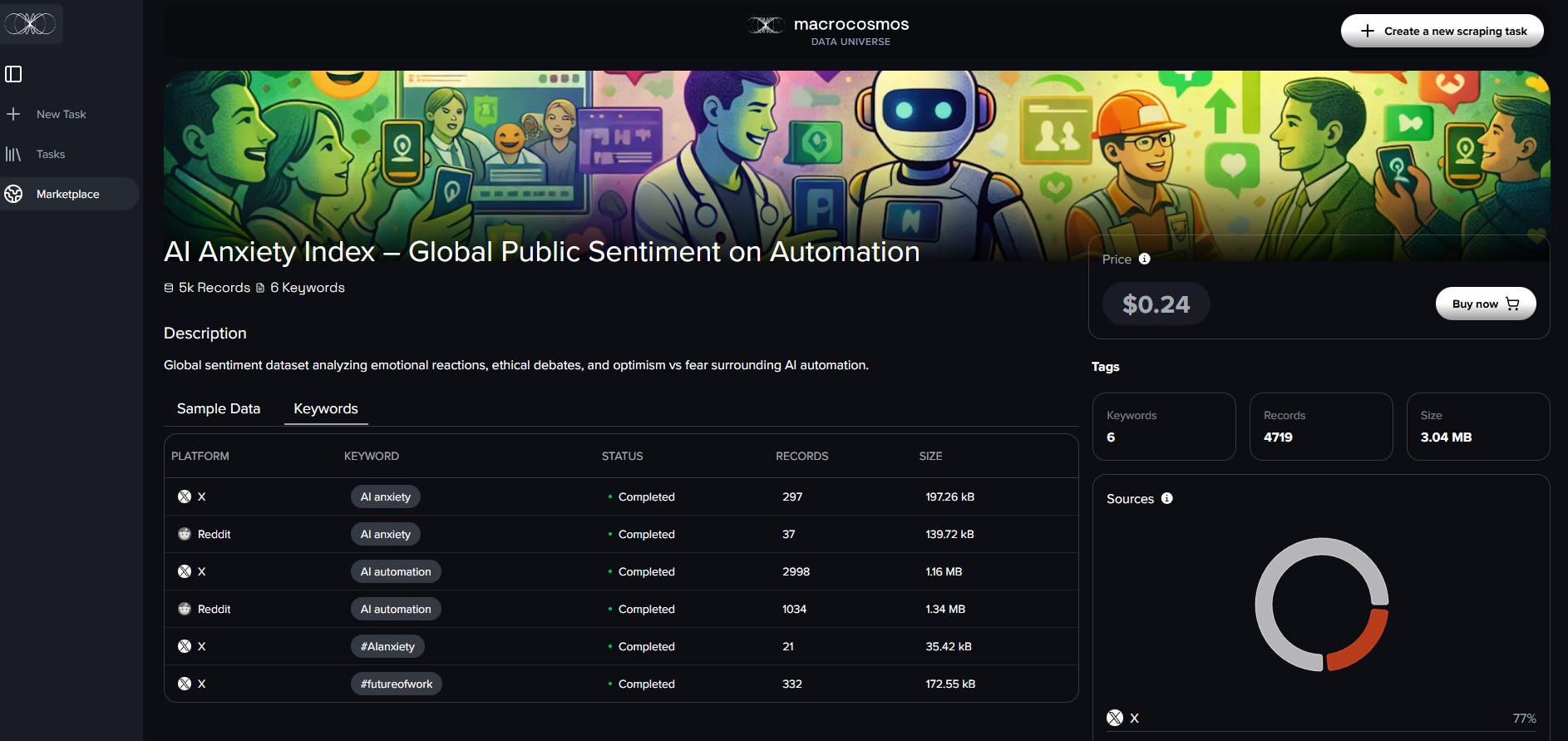
Here’s a real use case:
Say you want to build a global sentiment dataset analyzing how people really feel about AI automation—the emotional reactions, ethical debates and the balance between optimism and fear.
You could scrape X conversations, Reddit threads, and news commentary with Gravity, use Mission Commander to refine your search parameters (filtering for specific industries, demographics, or discussion themes), then visualize the emotional landscape in Nebula to see where fear clusters versus where optimism dominates.
Or maybe you’re training a custom chatbot and need quality datasets. Same workflow.
It's still beta, still evolving. But you can use it right now to get actual work done.
This is what the future looks like: subnets bundled into workflows that solve actual problems.
The UX Gap Is Worth Millions
Joseph Jacks said it best on The TAO Pod:
“Bittensor subnets provide raw commodity outputs. It's really the job of the subnet team to provide an interface to access that commodity.”
Think oil before refineries, electricity before light bulbs. The value isn’t in the raw resource, it’s in making it accessible. We’re where the internet was in 1991. Most subnets are grossly undervalued because they have no user interface.
Here’s what actually matters in 2026. Watch for these signals:
Which subnets ship no-login demos that deliver value in under 60 seconds.
Which teams bundle workflows, not just APIs (like Macrocosmos is doing).
Which apps stop requiring you to understand TAO, validators, or miners to get started.
Multiple teams are racing to build competing front doors. Some will bet on AI chat interfaces, others on productivity suites, others on specific verticals like storage or compute.
One or two will nail it so well that the technology disappears. You won't be just using Bittensor, you'll just be solving problems.
Don’t wait for the perfect onboarding experience. Click one link from this piece—Subnet.ai, Macrocosmos, TAO.com—and test one workflow this week.
Because six months from now, when someone asks you “How do I get started with Bittensor?” you won’t send them a whitepaper.
You’ll say: “Here’s the app I use. Takes two minutes.”
Be that person.
Until next time.
Cheers,
Brian
What’s your biggest frustration trying to use Bittensor? Hit reply and tell me what confused you most. I’d love to feature community experiences in a follow-up piece.
This is a truly fantastic article, and really understands what’s needed next from a user perspective imo, I love the mall analogy. There are so many great stores inside, with no front door to currently walk through. Cheers, and keep up the great work!
Keep up the information flow I like what you’re doing. I was looking into microcosms about a month ago at least we’re on the same page. I believe once this gets easier the volume of people will grow immensely.