


Ask anyone who has ever managed infrastructure in corporate tech about their cloud bill, and you’ll get a very specific kind of quiet sigh.
Every single bill follows the exact same script: you size your infrastructure for the worst-case scenario, hit peak capacity for two chaotic days during the month, and then watch in horror as the finance team approves invoice after invoice for hardware that sits entirely idle for the remaining 28 days.
That burned corporate budget isn’t just an inefficiency, it’s the exact problem Lium (Subnet 51) was built to solve.
On paper, the tension is simple: renters need guaranteed, cost-effective GPU power right now, while providers refuse to keep hardware powered on without guaranteed revenue. Traditional cloud giants solve this with heavy-handed central planning, rigid contracts, and massive markups. Lium takes a market-driven approach powered by Bittensor emissions.
Its core mechanism comes down to a “two paychecks” design: paying providers when their GPU compute is actively being rented, and paying them under strict conditions when it sits idle, ready, and available. Understanding how those two paychecks balance out is the key to answering the only question that matters: is Subnet 51 building a sustainable computing business, or just subsidizing idle silicon with tokens?
What Lium Actually Sells
People constantly blur two entirely different forces when evaluating Lium.
The marketplace creates real-world customer demand. The subnet mechanism structures and subsidizes the supply.
Collapsing those two concepts into a single narrative leads straight to flawed analysis. In this ecosystem, it’s easy to mistake a successful incentive mechanism for genuine product-market fit. Seeing high subnet activity doesn’t necessarily mean customers are beating down the door: it often just means the token rewards are doing their job.
For any provider asking the practical question “Should I actually list my GPUs on Lium?” evaluating the opportunity requires dissecting both income streams independently.
Paycheck One: Rental Revenue
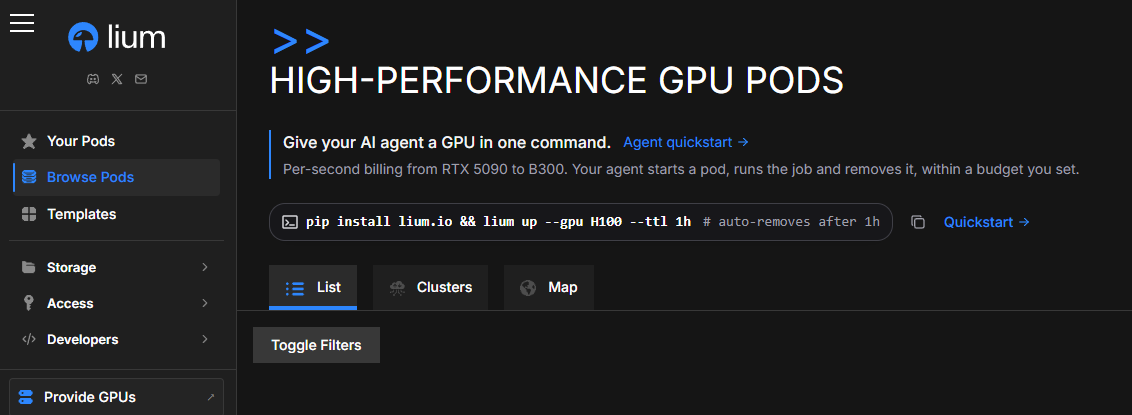
A renter books GPU time. Lium bills the renter in USD. Lium distributes the provider’s share daily to their coldkey after a settlement delay. Lium advertises a 95% provider share of rental revenue, paid daily on-chain at 17:00 UTC. Exact terms and bonuses depend on their current rewards configuration, so check the official docs and payout details before committing hardware.
This is the income stream most directly tied to customer value. It reflects actual demand for compute: if nobody rents your GPU, this paycheck is zero.
Paycheck Two: The Emission Layer
Every Bittensor tempo, SN51 receives a share of network emissions. Validators then decide how to allocate that share among providers. Lium’s design splits that allocation into three buckets: rented GPUs, eligible idle GPUs, and burn.
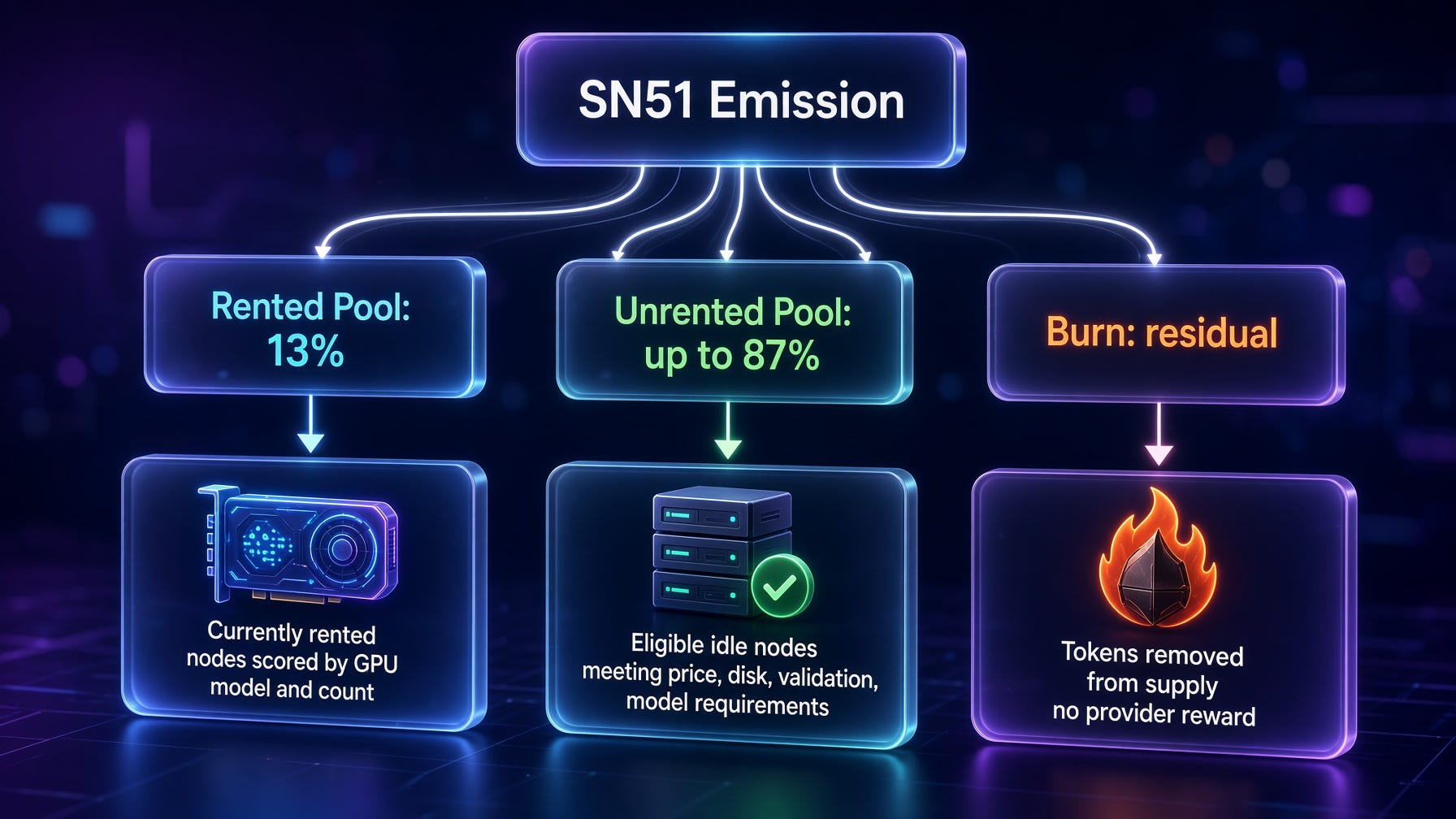
Rented pool: A fixed 13% of the provider-facing emission allocation goes only to currently rented nodes, scored by GPU model and count. This rewards utilization directly.
Unrented pool: Up to 87% can go to eligible idle nodes that meet Lium’s price, disk, validation, and model requirements. This is the “inventory readiness” payment.
Burn pool: Whatever is not allocated to eligible idle providers is burned. Those tokens are removed from supply. No provider receives them.
The unrented pool is not inherently wasteful. It compensates providers for maintaining capacity before demand arrives. Think of it like paying a taxi driver to stay at the rank during a quiet afternoon, so they’re there when the evening rush hits.
But it becomes economically questionable if idle rewards stay large while utilization, pricing discipline, or customer demand don’t improve. You’re paying for readiness that never gets used.
Why Idle Pay Exists
The obvious objection: “Why should idle GPUs earn anything?”
GPU marketplaces have a cold-start problem. They need supply before they can attract demand. Providers won’t list hardware if income arrives only after a rental occurs. The risk is too high. Idle pay reduces that risk and encourages a deeper, more responsive supply pool.
But it also creates moral hazard. Providers may focus on eligibility and emissions rather than competing on rentability. If you can earn emission rewards by keeping a node online that meets minimum requirements, the incentive to compete on price or performance weakens.
This is a design trade-off. Lium is paying providers to be ready for the next customer. The enduring question, and this applies to all subnets, is whether they can reduce that subsidy over time as real demand grows. If Lium’s unrented pool stays near 87% while billed revenue plateaus, the system is subsidising supply that demand doesn’t want.
Is Customer Demand Real?
Let’s look at the evidence.
Lium’s most recent monthly review, published on 10 October, reports $1.4M in GPU rental spend, up 45% month-over-month, from 1,379 paying customers, up 16%. Rentals more than doubled to 17,497, while 68.7% of launches were initiated programmatically by code or AI agents. Lium also reported 32% fewer rental failures, 32% more first-time renters, and 15% more providers.
Since then, the demand signal has become more immediate. On 22 October, Lium reported that 91% of its listed GPU supply was rented, across a fleet it valued at more than $30M and including 225 B300s. Its public network dashboard currently shows a similar picture: 1,614 of 1,799 listed GPUs rented, or roughly 90% of supply, with 83% utilization over the trailing 30 days.
Agent-initiated demand is the kind of usage that compounds. Agents don’t browse marketplaces. They call APIs, book capacity, run workloads, and release. If such a large proportion of your rentals are happening without human hands, you have early evidence of repeatable compute consumption.
OpenTensor also reported that Lium used marketplace revenue to buy back and burn nearly $2.7M of SN51 alpha across five buybacks from April to September, removing roughly 171,000 alpha tokens from supply.
Third-party estimates back up the general direction, even if they don’t tell a single uniform story.
SubConnect (October 2) put total annualized Bittensor subnet revenue above $50M, attributing roughly a third of that pie to Lium.
SubnetRank estimates Lium’s external revenue at $8M–$10M annualized, placing it squarely at the top of its 24-subnet tracking cohort.
Own Your Mind’s integrity board reported September billing alone at $1.295M, which annualizes out to roughly $15.5M.
These are undoubtedly encouraging signals for the subnet’s trajectory, but let’s be disciplined about what we’re looking at here: this isn’t one clean, audited dataset. What we have is a mix of team-reported billing, third-party projections, and buyback disclosures, each spanning different timeframes and relying on different methodologies.
The strongest new evidence is that Lium’s demand and supply metrics now point in the same direction: billed revenue is rising, agent-initiated usage is high, and most listed GPUs are rented. The open question is is whether Lium can sustain that utilization as it adds supply.
Does the Incentive Design Work?
Each income stream proves something different.
Lium has more evidence of external demand than most emission-led subnets. The monthly billing and high agent-initiated rentals are material. The buybacks show revenue flowing back to token holders.
The open question is the ratio between customer-funded revenue and emission-supported supply income. If a provider earns more from sitting idle than from being rented, the incentive system and the marketplace are pulling in different directions. If rental income dominates, the emission layer is doing its job as a bridge.
High utilization makes that question more tractable. When 90% or more of listed GPUs are rented, idle-pay emissions are supporting a smaller share of the fleet at any given moment. But utilization is volatile: Lium’s own dashboard distinguishes a roughly 90% current utilization rate from an 83% trailing-30-day rate. That gap is exactly why the rented-versus-idle emission split still needs to be published consistently.
Lium does publish aggregate network statistics through an unauthenticated public stats feed, including billed revenue, GPU-hours, rentals, listed versus rented GPUs, and 30-day utilization. That is a real improvement in transparency. What is still missing is a standardised monthly reconciliation of emission allocation across rented, unrented, and burn pools, alongside provider payouts and buyback value for the same period.
VITALS Scorecard
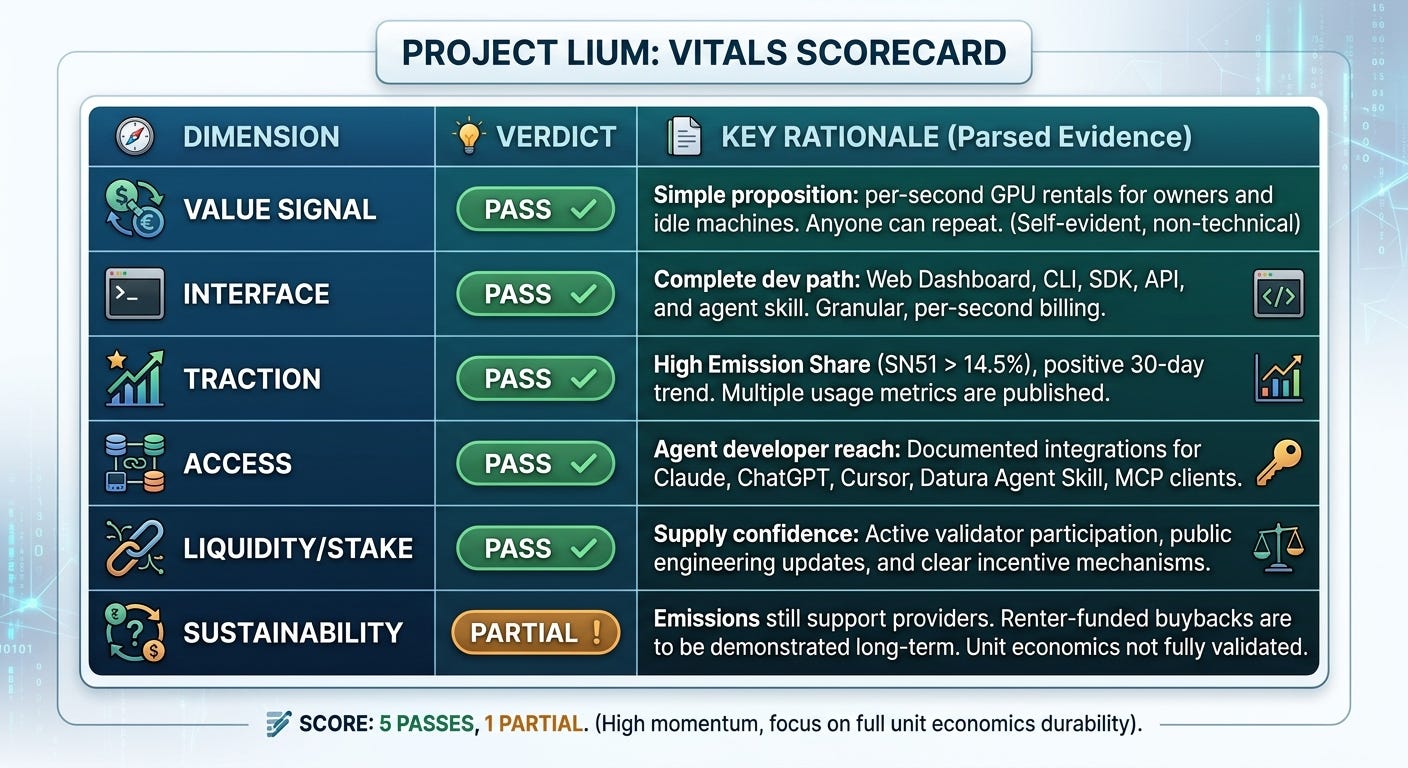
I ran Lium through my VITALS framework using a three-level scale: Pass, Partial, Fail. Unsurprisngly, given its place in the top tier of Bittensor subnets, it has scored extremely well. We’re not uncovering a diamond in the rough here.
Value signal: Pass. “Rent GPUs by the second; GPU owners earn when their machines are idle.” Anyone can repeat the proposition without needing to understand TAO, validators, or mining. Lium positions itself as a GPU rental marketplace with per-second renter billing and provider income from both rentals and idle supply.
Interface: Pass. Lium explicitly offers a web dashboard, CLI, Python SDK, REST API, and agent skill; the SDK can list nodes, bring up a pod, run a command, and tear it down; pods are billed per second with no minimum.
Traction: Pass. Lium clears the threshold easily: SN51’s emission share is roughly 14.5–15%, well above 0.20%, and the 30-day trend is positive. It also publishes multiple impressive usage metrics.
Access: Pass. Lium has a documented MCP integration for Claude, ChatGPT, Codex, and other MCP clients, plus a Datura-published Agent Skill for Claude Code, Cursor, and Codex. These are real distribution surfaces for agent developers, though not yet deep platform partnerships or verified customer pilots.
Liquidity/Stake: Pass. Supply-side confidence is visible: Lium has active validator participation, public validator and engineering updates, and a clear mechanism through which validators assess GPU hardware and performance to allocate incentives. Providers also receive daily on-chain payouts, giving the supply side a recurring, transparent reward loop.
Sustainability: Partial. Pricing is transparent and competitive, however, this is a pricing-and-revenue-model pass rather than proof of full unit-economics sustainability: emissions still support provider economics, the burn allocation is dynamic, and the durability of rental-funded buybacks remains to be demonstrated over time.
Score: 5 Passes, 1 Partial. The marketplace has a clear value proposition, an unusually strong agent-native interface, meaningful early traction, emerging distribution through agent tools, and visible supply-side confidence. The remaining question is sustainability: rental pricing is competitive and revenue is real, but emissions still materially support provider economics, so Lium has not yet proven it can stand on rental revenue alone.
My Recommendations
1. Tie more emission weight to measured utilization.
Gradually shift allocation from static eligibility toward realised GPU-hours, repeat renters, price competitiveness, and successful job completion. The goal is to make idle pay responsive to evidence of demand. If a provider’s node has been idle for 30 days with zero rentals, the emission weight should reflect that. Right now, the unrented pool rewards eligibility. It should reward readiness that converts.
The new utilization disclosure makes this recommendation more actionable: Lium already tracks current and 30-day utilization publicly. The next step is to connect that same utilization signal to provider-level emission allocation in a transparent, auditable way.
2. Publish a canonical monthly marketplace dashboard.
Include billed revenue, active renters, rentals, GPU-hours, utilization rate, emission allocation across rented/unrented/burn, provider payouts, and burn value, all for the same reporting period. This would make the “two paychecks” comparison reproducible. Right now, we’re stitching together team-reported figures, third-party estimates, and buyback disclosures from different sources. A single, standardised dashboard would settle the ratio question.
The Real Test
Lium has designed an incentive system that pays for both demand and readiness. The encouraging part: customer revenue is real and growing with more evidence of external demand than most Bittensor subnets can point to.
The unresolved part: whether emissions are a temporary bridge to a functioning market, or a permanent cost of keeping supply online.
The next phase of Lium’s story will be decided by which of those two paychecks grows faster.
Until next time.
Cheers,
Brian
Disclaimer: This is not financial advice. I am a writer documenting the Bittensor ecosystem. Always do your own research.