

If you have kids, or if you’ve ever spent time in a house where kids live, you know the specific, sharp pain of walking across a living room at 2AM.
The lights are off. The house is quiet. You take a step.
And suddenly, your foot finds it.
A single, rogue LEGO brick.
Last weekend I sorted LEGOs for an hour. Not by choice, after stepping on three bricks in two days, I’d had enough.
But somewhere in that pile of Spidey and Bluey pieces, I saw Bittensor.
On the floor, those bricks are just sharp edges. But snap them together with an instruction manual and that clutter becomes Bluey’s house.
As my four-year-old would tell you, if he wasn’t screaming about a missing piece he flung away in rage five minutes earlier, the value isn’t in the brick.
It’s in the assembly.
For the last year, Bittensor has felt exactly like my living room floor.
We have the absolute best pieces in the world: subnets that generate incredible text, scrape the entire internet in real-time, handle complex mathematics. But they’re scattered and they function in isolation. Brilliant, lonely bricks.
If you’re an enterprise looking at Bittensor today, you don’t see a functional machine: you see a floor covered in sharp objects that looks painful to navigate.
To turn a pile of plastic into a vehicle that can actually drive, you need a mechanism that snaps them together.
You need a Master Builder.
The Master Builder’s Blueprint
This is where Affine (Subnet 120) changes the game. And it’s no accident who is building it.
The team includes Jacob Steeves (Const), the co-founder of Bittensor itself. He recently stepped down as CEO of the Opentensor Foundation, not to retire, but to build in the trenches again.
When the architect of the entire network decides to focus his time on one specific subnet, that’s a signal to pay attention to. He’s the literal Master Builder coming back to show us how the pieces fit.
Here’s what Affine actually does: It coordinates other subnets so they can work together through reinforcement learning and model evaluation.
In other words, its an invisible gym where the world’s smartest open-source AIs train 24/7 to get better at reasoning.
It doesn’t sell you a chatbot. It runs a never-ending competition: miners fine-tune models on hard puzzles (coding, multi-step logic, program synthesis). They upload the improved model to a public library (Subnet 64: Chutes).
Validators test every model head-to-head. The single best one wins the entire daily prize pool and every other miner immediately downloads it and tries to beat it next round.
The winner becomes the new baseline for the whole network. This is decentralized intelligence that keeps leveling up automatically, forever.
Think of it as the neural spine of Bittensor. The connector that glues 100+ specialized subnets into one evolving super-brain instead of 100 isolated apps.
You’ll instantly see:
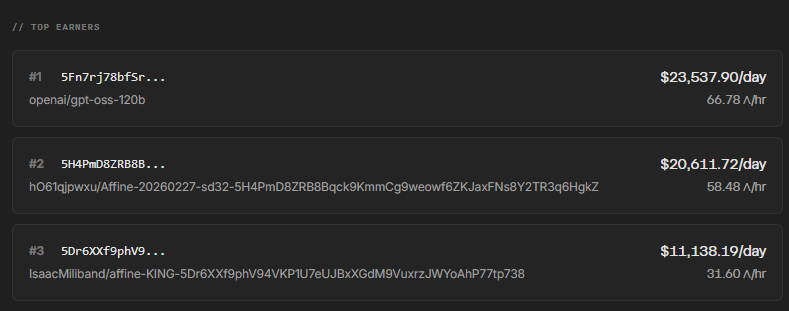
A leaderboard of real models ranked by how much money they’re earning right now (top one often $1,000–$1,300 per hour)
Scores on actual benchmarks (LiveCode, GPQA math, coding challenges, etc.)
A radial chart + “COMPARE” button so you can click two models side-by-side
The Machine Comes Alive: How the Pieces Snap Together
If Affine is the Master Builder, what exactly is it building?
Affine has positioned itself as the glue that snaps the most powerful, specialized blocks in the ecosystem together:
1. The Hardware Bridge: Integration with Chutes (Subnet 64)
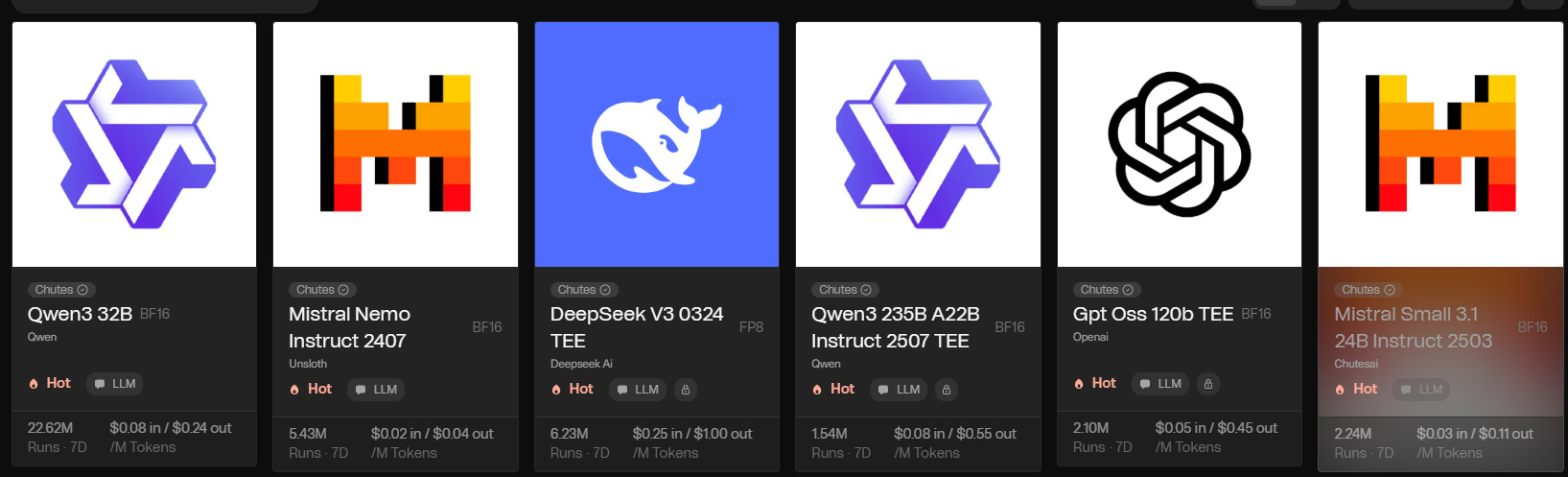
The most critical technical update is Affine’s successful integration with Chutes (Subnet 64).
Think of this as the bridge between mind and muscle. Affine provides the high-level logic and reasoning agents, but those agents need a physical place to run.
By integrating with Chutes, Affine effectively bridges the gap between software and hardware. It allows Affine to utilize Chutes’ decentralized compute and model hosting capabilities instantly.
The Result: A seamless pipeline where logic/reasoning agents (the software) are automatically deployed onto scalable compute resources (the hardware). The LEGOs aren’t just sitting there; they are now powered on.
2. The Composition Layer: Making Subnets Talk
In ecosystem analysis, Affine is increasingly described as “The Bridge” or a “composition layer.”
Until now, subnets have largely been isolated silos. A forecasting subnet makes a prediction, and it stays there. A trading subnet executes a trade, and it stays there.
Affine’s core utility is allowing these subnets to talk to each other. It enables the output of one subnet to serve as the input for another.
Example: Affine takes a market prediction from a forecasting subnet and feeds it directly into a trading bot or agentic subnet to execute a strategy.
Affine’s architecture is fundamentally built to integrate with reasoning subnets (like Numinous or Almanac) to create complex, multi-step AI workflows. It turns a room full of shouting voices into a coherent conversation.
3. The External Gateway: Project Rubicon
Affine isn’t just connecting subnets to each other; it is connecting Bittensor to the global economy.
In November 2025, General TAO Ventures announced Project Rubicon, a massive initiative designed to bridge Bittensor subnets to global Web3 markets.
Affine was named as part of the initial cohort for this project, alongside heavyweights like Vanta (Subnet 8).

This isn’t just internal plumbing. This partnership focuses on external integrations, helping Affine export its utility beyond the Bittensor ecosystem. It creates a path for real-world capital and external crypto markets to access the super-brain Affine is assembling.
4. The Agentic “Hands”: Future Integration with Ridges (Subnet 62)
While Chutes provides the raw power, the architecture is fundamentally built for a higher purpose: Agentic Coordination.
This is where Ridges (Subnet 62) fits into the blueprint. Ridges is an agentic coding powerhouse as it writes and executes software.
The vision for this integration creates a complete brain-to-hand workflow:
The Architect: Affine uses high-level reasoning to break a complex problem into a multi-step plan.
The Builder: It then hands those blueprints to Ridges, which writes the actual code to execute that plan.
This moves us beyond simple chatbots into complex, multi-step AI workflows. We are looking at a future where one subnet thinks, checks its work against Chutes, and then commands Ridges to build the solution, all automatically.
Why Invisible Infrastructure Is Where Smart Money Goes
Most people invest in products they can touch.
Smart money invests in infrastructure before anyone knows they need it.
The AWS Moment
In 2006, Amazon Web Services launched. Most people didn’t understand why an online bookstore was suddenly renting servers.
The real money wasn’t made by the people who bought things on AWS. It was made by the people who bought Amazon stock while everyone was confused.
By the time AWS became obvious, the asymmetric upside was gone.
The Nvidia Moment
In 2016, Nvidia was known for gaming GPUs. Then they started talking about “AI compute.”
Most investors thought: “Why would AI companies need gaming chips?”
The smart ones thought: “If AI scales, whoever makes the picks and shovels wins.”
By 2023, when everyone understood that AI runs on Nvidia chips, the 100x gain was over.
The Affine Moment
Right now, Affine is in the “What do you mean subnets need coordination?” phase.
Most people are chasing Chutes because they can use it. They can see the chat interface. They can test the models. It’s tangible.
Affine has no consumer demo. It has no viral moment. It’s pure B2B infrastructure.
But the market is telling you something: Affine is firmly in second place for market cap, behind only Chutes.
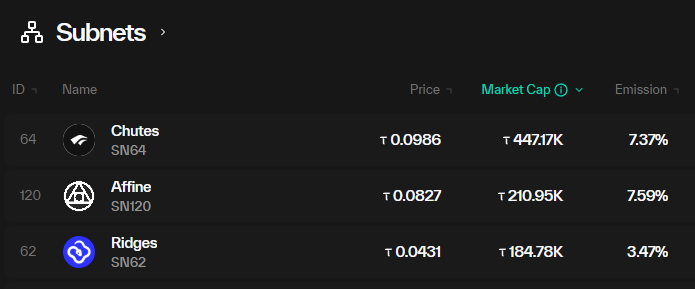
That’s millions of dollars in TAO staked by people who understand the coordination layer matters more than any individual application.
The dTAO market already decided that Affine is important. The question is whether you’ll recognize it before it becomes obvious to everyone else.
The Bull Case and The Bear Case
Let me give you both sides, because that’s how you evaluate infrastructure bets.
Bull:
Jacob Steeves doesn’t do vanity projects. When the co-founder leaves the CEO role to build in the trenches, that’s a signal.
The market has already voted with emissions: #2 spot without a consumer demo means deep conviction from sophisticated players.
Every subnet solving real-world problems will eventually need high-quality reasoning models and coordination. Affine is building that foundation.
First-mover advantage in coordination infrastructure is massive. Once subnets integrate with Affine, switching costs are high.
Bear:
“Invisible infrastructure” can stay invisible indefinitely if consumer adoption never materializes.
Coordination could happen at the application layer (like Macrocosmos is doing) instead of the protocol layer.
Affine’s technical complexity might be overkill for what the market actually needs.
If Bittensor never breaks out beyond crypto-native users, enterprise coordination layers remain theoretical.
The Infrastructure Checklist (What I’m Watching)
If you want to monitor Affine’s progress without getting lost in technical specs, here’s your simple checklist:
Monthly Check-In:
Were any new subnet integrations were announced? (Look for press releases, X posts)
What’s Affine’s current emission rank? (Taostats updates daily)
Which subnets have started using Affine-trained models? (X posts, Discord miner discussions)
Quarterly Deep Dive:
Review Affine’s roadmap (future milestones are not published as yet)
Check if new subnet categories (trading, coding, research) are citing Affine as necessary infrastructure
Monitor whether alternative coordination solutions are emerging (competition validates the thesis)
The Future is Assembled
When I finally sort the piles of LEGO with my kids, we build something cool. But we only get there because someone had written down which pieces connect to which.
Affine is writing that instruction manual for Bittensor.
For a long time, we’ve had the pieces: just scattered, disconnected, painful to step on. But with Affine, for the first time, we’re hearing the click. The pieces are fitting and the messy floor is finally being cleared.
Infrastructure wins by becoming invisible:
You don’t think about TCP/IP when you browse the web.
You don’t think about Amazon Web Services when you stream Netflix.
And eventually, you won’t think about Affine when you use a Bittensor-powered app.
But it’ll be there. Coordinating. Verifying. Assembling the pieces so the rest of us can just solve problems.
That invisibility is the point. And if history has taught us anything, it’s that the boring stuff nobody understands at first is where the asymmetric returns hide.
My ask for you:
Bookmark this piece. Set a calendar reminder for March 2027. Come back and tell me: How many of those dependencies materialized? Which subnets couldn’t survive without Affine? Was this infrastructure bet obvious in hindsight, or did I completely miss the mark?
Because that’s how we learn to spot the next one before everyone else does.
Until next time.
Cheers,
Brian
This is a fantastic breakdown, Brian. The LEGO analogy is perfect; we've had the bricks for a while, but Affine feels like the first time we’re actually seeing the instruction manual. Coordinating and integrating these isolated subnets is exactly what was missing to turn Bittensor from a collection of experiments into a unified super-brain. Exciting times ahead.
Thanks for the support Agisilaos! Yes when we link subnets together, we stop building isolated features and start building true global intelligence. With Const leading this effort they may just be able to pull this off