

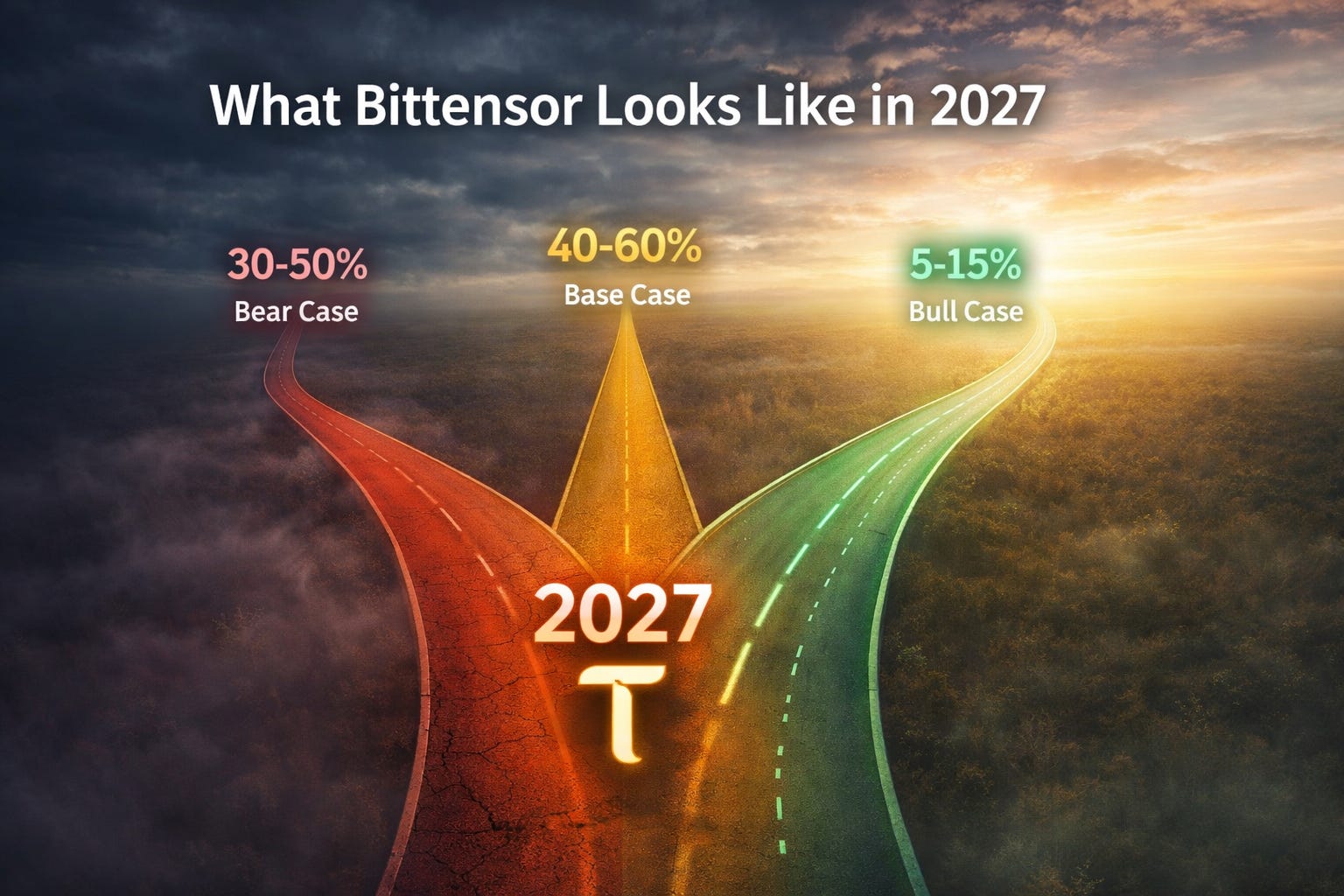
Take a look at the calendar. It’s March 2026.
If you want to understand the sheer magnitude of what Bittensor has become over the last year, look at what just captured the attention of the most important hardware company on the planet. Last week, Nvidia’s CEO, Jensen Huang, publicly praised Bittensor.
This wasn’t just a polite nod to a novel technology, it was validation of a milestone Silicon Valley traditionally thought impossible. Inside Subnet 3 (Templar), a group of 70+ independent, uncoordinated contributors just pulled off the largest permissionless, decentralized LLM pre-training run on record.
Using ordinary commodity GPUs and standard home internet connections, this swarm successfully pre-trained a massive open-weight LLM in a fully decentralized way across the open internet.
This is the exact moment a technology crosses the chasm. The mainstream tech media isn’t just covering Bittensor as a crypto token anymore; they’re covering it as a legitimate existential competitor to the centralized AI data center.
But signals can mean three very different things depending on what happens next.
That Nvidia validation could be the beginning of Bittensor becoming the default infrastructure layer for AI.
Or it could be a brief moment of hype before the ecosystem retreats back into the crypto bubble.
Or (most likely) it could be something in between: a quiet B2B backend that powers specific workloads while the giants dominate everything else.
Today, I’m not giving you a price prediction. I’m giving you a compass.
We’re going to walk through three concrete futures for Bittensor—Bear, Base, and Bull—and for each one, we’ll ask the only question that matters: What has to be true for this to happen?
By the end, you’ll have a framework to grade your own conviction. Not based on hopium or FUD, but on trackable, real-world metrics you can monitor over the next 12 months.
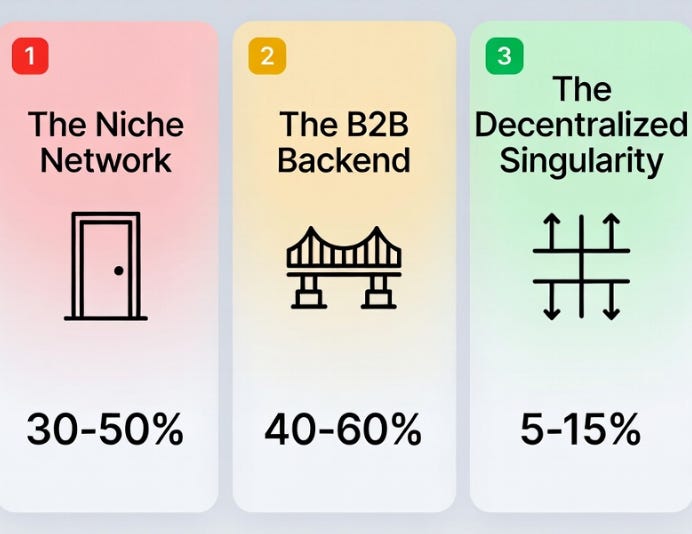
Scenario 1: The Niche Network (Bear Case)
Probability (by March 2027): 30–50%
The 2027 snapshot: Your friend at the bar still asks “what’s TAO?” Most subnets remain crypto-native tools, judged by on-chain rewards rather than broad external demand.
How to think about this scenario:
Product: Bittensor has lots of subnets, but very few are profitable outside the crypto bubble. The best are judged by on‑chain rewards, not real‑world revenue.
Adoption: You rarely hear Bittensor mentioned by non‑crypto founders. Discussion stays on X and Discord, obsessing over yields.
UX: Trying to use Bittensor directly still requires wrestling with wallets and gas. Gateways exist but see minimal non-crypto traffic.
Competition: Big AI players keep getting cheaper. Bittensor’s main advantage remains purely ideological, which doesn’t justify moving real enterprise workloads.
Your Investor Thesis: TAO is mostly “decentralized AI’s native token,” not a must‑hold infrastructure asset. You’re betting the ecosystem stays alive for crypto‑native builders, but not the rest of the world.
Litmus Test (March 2027): If fewer than 5 subnets have recurring external revenue, or most developers still need wallet setup for basic access, you’re in the Niche Network outcome.
Scenario 2: The B2B Backend (Base Case)
Probability (by March 2027): 40–60%
The 2027 snapshot: Your company’s DevOps team quietly uses Bittensor for running inference on internal tooling and doesn’t tell you. When you discover it and ask why, they shrug: “It was cheaper and faster than the alternatives.”
How to think about this scenario:
Product: A small group of subnets (5–15) stand out with real‑world utility and growing revenue. Like Chutes for inference, Hippius for storage, Score for computer vision, each carving out a defensible niche.
Adoption: Bittensor‑backed services are mentioned in technical blogs and internal product discussions. Mid‑tier tech companies quietly use it for large‑scale model fine‑tuning and inference, synthetic data, or coding tools.
UX: User‑friendly gateways exist: “Pay in dollars, we handle the crypto plumbing.” Integrating a subnet feels like integrating any normal SaaS API.
Competition: Big clouds dominate, but Bittensor carves out niches where it’s definitively cheaper or more flexible.
Your Investor Thesis: TAO is an infrastructure token tied to real AI usage. You’re betting on Bittensor becoming a quietly important layer for specific workloads.
Litmus Test (March 2027): If mid‑tier tech companies are quietly paying fiat invoices for AI services running on Bittensor, and developers use them without touching wallets, you’re in the B2B Backend outcome.
Scenario 3: The Decentralized Singularity (Bull Case)
Probability (by March 2027): 5–10% (This is more of a 2029+ upside).
The 2027 snapshot: You pay for AI the way you pay for electricity. You have no idea where it comes from, but Bittensor is powering a meaningful chunk of the inference requests happening across the internet. Censorship-resistant, cheaper, and good enough that enterprises are publicly announcing they’ve shifted workloads away from AWS.
How to think about this scenario:
Product: A visible top tier of subnets dominates with multi‑million‑dollar revenue streams. The narrative shifts entirely from token emissions to “which subnet is the best at doing X?”
Adoption: Mainstream non‑crypto founders talk about Bittensor‑backed products as “the best option.” Companies actively seek out this infrastructure for its performance and cost.
UX: A “Stripe for Bittensor” exists. You sign up with an email and credit card, and the blockchain layer is completely abstracted away.
Competition: Centralized giants still exist, but Bittensor offers credible neutrality and censorship‑resistant access. Major companies publicly shift significant workloads away from hyperscalers to Bittensor.
Your Investor Thesis: TAO becomes a critical infrastructure token for the AI era. You are betting it becomes the default decentralized layer for AI, accruing massive value as independent businesses rely on it.
Litmus Test (March 2027): If a non‑crypto developer googles ‘fastest cheap LLM inference API,’ lands on a Bittensor‑powered gateway and adopts it purely on its merits, and major enterprises publicly announce shifting meaningful workloads to the network, you’re on the Decentralized Singularity path.
How to Grade These Scenarios (The Four-Dimension Compass)
Think of building Bittensor like opening a restaurant in a city dominated by McDonald’s.
For your restaurant to survive and potentially thrive, four things have to be true:
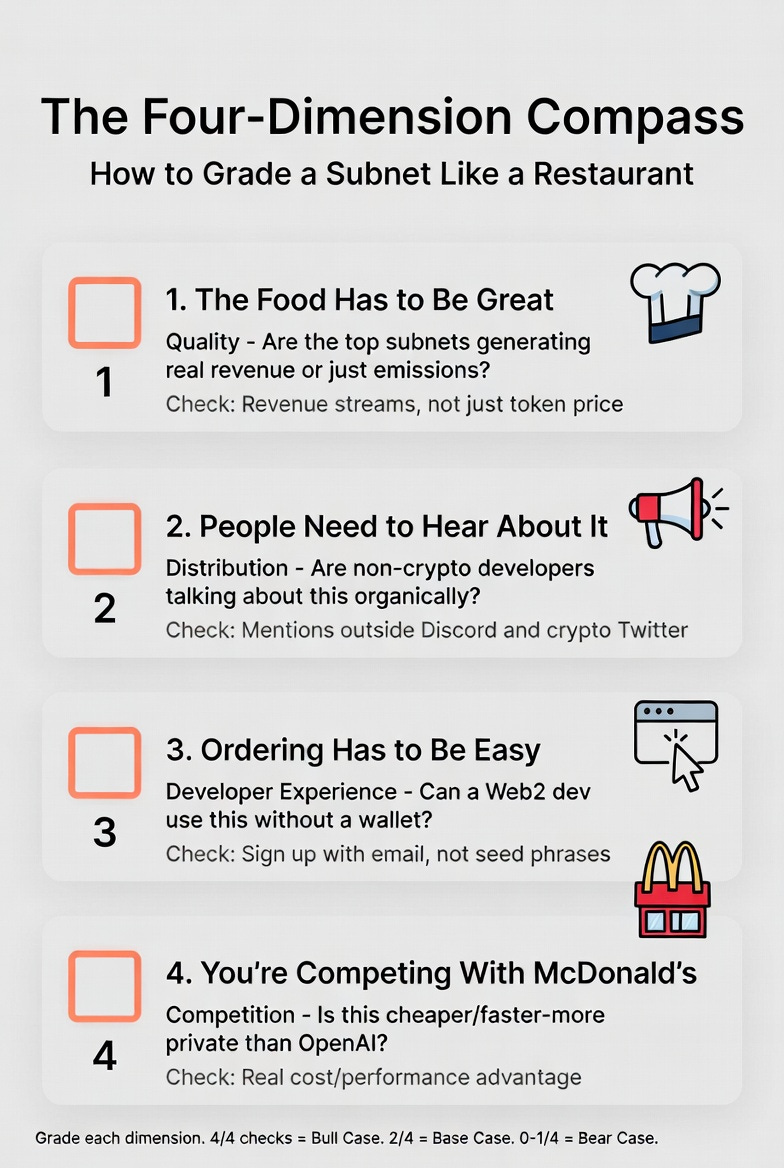
1. The Food Has to Be Great (Quality)
With the 128-subnet cap, the question isn’t how many subnets exist, but whether the competitive pruning mechanism has eliminated the mediocre ones. By 2027, have we evolved from 128 experiments into a consolidated leaderboard of high-revenue, undeniable utility subnets?
2. People Need to Hear About It (Distribution)
Are non-crypto developers and mainstream AI media talking about Bittensor organically? If we’re still sitting in an echo chamber on Discord arguing about validator yields in 2027, we’re not there yet.
3. Ordering Has to Be Easy (Developer Experience)
The “Stripe for Crypto” test. Ten years ago, Stripe won the internet by reducing payments to three lines of code. How many clicks does it take a Web2 developer to use a Bittensor subnet today? If they have to understand seed phrases and gas fees, the friction is too high.
4. You’re Competing With McDonald’s Next Door (Competition)
Centralized tech giants are pouring tens of billions into proprietary models. Can Bittensor maintain a legitimate cost, open-source and privacy advantage against that tidal wave of capital?
Over the next year, these four dimensions will tell you which scenario we’re heading toward. Not token price, but real-world adoption metrics.
Why I Built This Framework (And Why Crypto Metrics Are Broken)
A few weeks ago, I found myself staring at a subnet analytics dashboard, feeling completely paralyzed.
And I’ve been tracking Bittensor regularly for a long time now, I’m supposed to understand (mostly) this stuff.
But I was looking at Alpha/TAO price ratios, emission curves, validator weights, staking APYs, and I still felt lost.
Then a familiar realization hit me: None of these numbers tell me if a subnet is actually building a good product.
So I did something simple: I texted a friend who works closely with Enterprise AI at a TradFi company and asked: “What would it take for you to stop paying AWS and OpenAI, and route your company’s AI requests through open-source intelligence instead?”
His answer had nothing to do with tokenomics. Before it even got close to approval at board level, he cared about four things:
Is the output high quality?
Has anyone else in his industry tested it?
Is the API easy to plug into existing code?
Is it significantly cheaper or more private than what Sam Altman is selling him?
That conversation became the four-dimension compass above. It’s how I’m grading Bittensor’s trajectory as someone betting on teams building software the real world actually wants to use.
The Playbook: How to Be a Smart “Involuntary VC” Today
If these three scenarios are the maps, how do you navigate your capital today? The first decision you need to make is fundamental: Are you investing in the protocol or the applications?
Option 1: The Protocol Bet (TAO Only)
You’re buying the thesis that Bittensor itself becomes critical infrastructure, regardless of which specific subnets win. This is the “buy the index, not the stocks” approach.
Base/Bull lean: Your conviction is that TAO accrues value as the settlement layer for decentralized AI, regardless of which subnets succeed. You hold TAO and ignore subnet tokens entirely. You’re betting on aggregate network growth, not picking winners.
Bear lean: You stay mostly liquid or allocate minimally. You monitor whether TAO maintains its premium to Bitcoin/Ethereum, and watch for signs the network is actually capturing value from real usage versus pure speculation.
Option 2: The Subnet Bet (Alpha Tokens)
You believe specific subnets will create massive value, and you want direct exposure to those winners. This is venture capital: high risk, high potential return, requires active management.
Base/Bull lean: Your job is to find the teams building the bridges. Diversify your stake across 3-5 high-conviction Alpha tokens. Look specifically for subnet owners actively building strong Web2 frontends, identifying clear end-customers and abstracting the token entirely away from the user experience.
Bear lean: Your focus is capital preservation. Monitor subnet liquidity heavily. Thin Alpha pools mean highly volatile exits if a subnet fails its competitive metrics. Watch 30-day net TAO flows on platforms like Taostats—the direction of capital moving into or out of a subnet tells you more about its survival chances than its current Alpha/TAO price ratio.
This week’s action step: Pick one subnet in the top 15 emissions. Spend 30 minutes using their product as a non-crypto user would. Does it require a wallet? Is it faster/cheaper than ChatGPT? Grade it against the four dimensions above. If you can’t figure out how to use it without reading docs for an hour, that’s a potential red flag.
The 2027 Time Capsule
A compass is only useful if you actually check it against your surroundings. So, I want to hear from you.
Vote in the poll or hit reply to this email and tell me: which of these three scenarios do you assign the highest probability to, and why? I read every response, and the smartest insights make it into future issues.
Exactly one year from today, we’ll open this email back up together. We’ll grade these exact “What Has To Be True” conditions, step by step. We’re going to look at the metrics, the ecosystem and see exactly which timeline we manifested.
I’ll see you in the future.
Until next time,
Cheers,
Brian
Disclaimer: This is not financial advice. I am a writer documenting the Bittensor ecosystem. Always do your own research.
Excellent breakdown. When it comes to the investment playbook, I am firmly taking the Protocol Bet.
While finding the winning subnets offers high venture-style upside, the active monitoring and liquidity management required for Alpha tokens is just too intensive for my bandwidth. I would much rather hold TAO and bet on the aggregate growth of the network as the base settlement layer, regardless of which specific subnets come out on top.
Looking forward to opening the time capsule in 2027.