

I’m not one for drama.
People know me as composed, rarely one to react on a whim.
I hate soap operas, and I have enough conflict in my house pulling apart two toddlers fighting over a paper airplane for an hour this morning.
But that said... owing to the fast pace of Bittensor, disagreements are inevitable and even welcomed.
Decentralized AI sounds like a utopia where code is law, but in reality, it’s a messy human endeavor.
At times, the ecosystem has felt less like a computer network and more like a reality TV show. Public spats, accusations of “grifting,” and sudden price drops on specific subnet tokens.
It’s noisy. It’s uncomfortable. But I’m here to tell you this drama is a feature of a high-stakes ecosystem figuring out its identity.
Today, we’re looking at the “Benevolent Dictator” problem, why the Foundation almost rug-pulled a betting subnet, and why you should actually be happy about it.
The Players and The Beef
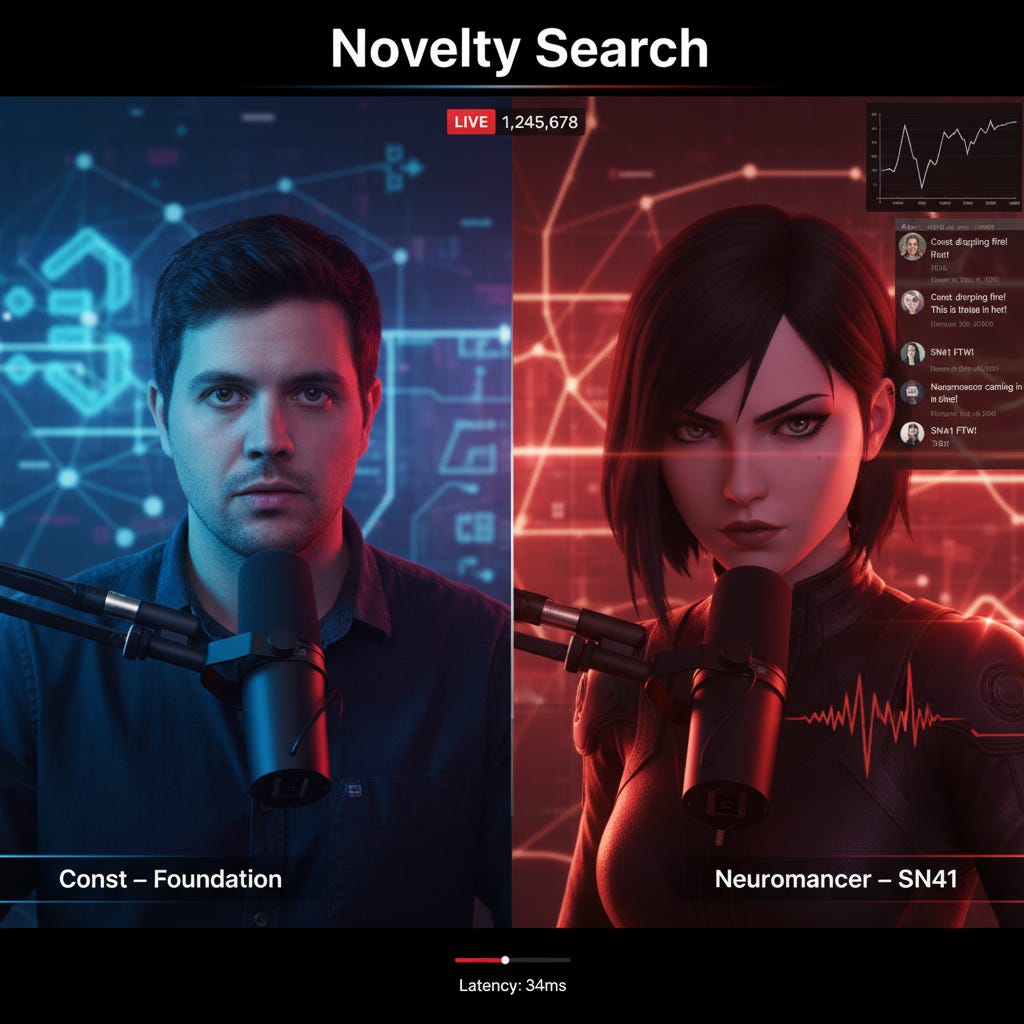
It’s late November 2025 (pre‑halving), and the Subnet Summer TAO Telegram group is buzzing with anger and accusations among key Bittensor figures— all in public view.
On one side, Const, the foundational figure in Bittensor, often seen as its lead architect and guardian of the vision. On the other, Neuromancer, the brains behind Sportstensor (Subnet 41), a betting-focused subnet integrating with platforms like Polymarket.
Const called out SN41’s incentive model, labeling it potentially unsustainable and misaligned with Bittensor’s goal of building genuine intelligence.
He even canceled (temporarily) their Novelty Search appearance, causing a 15% dip in SN41’s emissions value in minutes.
A furious Neuromancer fired back with data: their model avoids adverse selection by rewarding advanced miners (think those using computer vision from subnets like Score), and they’re pushing for net-positive revenue through token buybacks and market integrations.
Quick glossary for new readers:
Novelty Search: Livestreamed (on X and YouTube) exploration of new and innovative uses and projects emerging from the Bittensor ecosystem.
Emissions: Newly minted TAO distributed to subnets based on performance.
Token Buybacks: A mechanism where a subnet uses its earned revenue to repurchase its own alpha tokens from the market, enhancing fundamentals and liquidity.
Community members jumped in for clarity, turning the thread into a masterclass on incentives. Const retracted some points, SN41 recovered 10% quickly, and many called it a “goldmine for learning.”
Underneath it all was lingering critiques of founder led projects and a divide between core devs optimizing long term utility vs. subnet owners maximizing near term emissions.
This echoes tensions I’ve covered before in Bittensor’s marketing problem: how fragmented narratives lead to misunderstandings.
The core issue is quality control versus permissionless innovation: Does the Opentensor Foundation (led by figures like Const) have the right to “rug” or deregister subnets they deem extractive, even if the code allows them to exist?
These spats aren’t petty; they’re ideological battles for the network’s soul. As Siam Kidd has argued, young ecosystems need a “benevolent dictator” to prevent chaos before maturation. Without it, we risk dilution, exploits and apathy.
The Benevolent Dictator Thesis
True decentralization from day one sounds idealistic, but in practice, it leads to gridlock.
Imagine a startup (or a DAO) with ten co-founders who all have equal voting rights.
Like a bunch of young children fighting over what giant sticker to plaster on a wall (Spidey eventually wins in my house), they will argue and argue until they run out of cash.
You need a CEO. You need someone to say, “No, we aren’t doing that,” or “That product is trash, cut it.”
Right now, Const and the Opentensor Foundation are that CEO.
It’s imperfect centralization in service of survival.
Halvings mark maturity tests, shifting from bootstrapping to execution. Early on, someone has to prune the weeds (bad subnets or leaky incentives) to let the garden grow.
Why does this matter for your TAO holdings or subnet participation? You’re betting on leadership as much as code.
The dictatorship is a moat against bad actors: deregistering extractive subnets or reforming emissions to favor net TAO inflow.
But it’s double-edged. Const becomes the guardian and bottleneck while filtering decisions through human biases.
The question isn’t “What if they turn evil?” but “What if they become indispensable?” A network aspiring to outlive its founders must design its own obsolescence.

Slot Squatting and the Subnet Cap Rush
When Bittensor’s subnet cap was raised, first to 32 and then to 128 in mid-2025, it opened the floodgates for innovation, but also for opportunists.
Several anonymous users quickly registered slots by deploying the default “skeleton code” from the official bittensor-subnet-template repository on GitHub, purely to secure low-numbered slot IDs for potential future use or resale.
For a time, taostats.io served as visual proof of this rush. Multiple subnets appeared with identical or generic placeholders in their descriptions, such as “This is a template subnet” or simply “My Subnet,” straight from the template’s boilerplate.
These were bare-boned squatters, clogging the network and diluting focus from genuine contributors.
All of this underscored the challenges of open-source permissionlessness: low barriers enable rapid growth but invite minimal effort exploits.
The Foundation’s interventions; via deregistrations, immunity periods and anti‑gaming updates (e.g., limiting weight copying), reinforced the benevolent dictator’s role in maintaining quality, through periodic pruning to keep incentives honest.
The Institutional vs. Grassroots Clash
If the subnet drama is a family feud, the arrival of institutional capital is the noisy construction crew building a high-rise next door.
For years, Bittensor was a digital dive bar: gritty and built in the dark for uncensored AI. But now, the neighborhood has been discovered.
Entities like Grayscale and Yuma Asset Management are now entering the arena. They bring billions in liquidity, but that money wears a suit. It demands KYC, compliance and safe AI for Fortune 500s.
Nothing highlights the disconnect better than Yuma’s recent State of Bittensor report, which frames institutional access as a massive win. For the cypherpunks, it reads like a foreclosure notice on their ideology.
The dictator’s burden here is the Foundation as the only bridge between these two worlds. They must shake hands with Wall Street to drive the token price (which incentivizes miners) while convincing anons the soul of the network hasn’t been sold out.
It’s a dangerous tightrope. Lean too far into compliance, and Bittensor becomes just OpenAI with a token. Lean too far into the shadows, and the capital needed to compete with the giants flees.
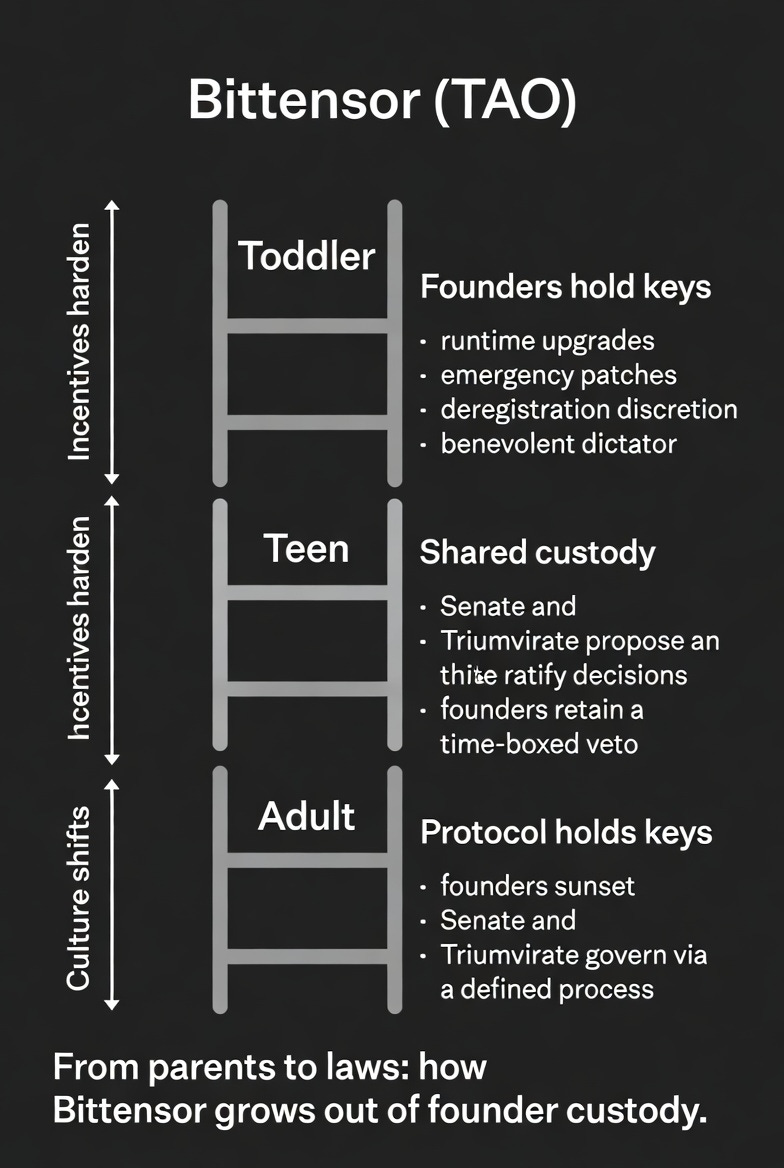
Governance in the Parent–Child Phase
Networks, like humans, pass through developmental stages.
Bittensor is, by its own admission, still in the parent–child phase.
A toddler needs a dictator. No turning the living room into a Ninja Warrior obstacle course while a parent is away.
A teenager needs negotiated boundaries. You can’t wrap them in cotton wool forever.
An adult needs laws and norms, not parents.
The current governance architecture—aggressive runtime upgrades, informal but real founder veto power—resembles a household more than a democracy.
The upside is when something breaks (exploitative emission games, sybil swarms), “the parents” can patch it quickly.
The downside is everyone implicitly trusting the parents are wise, aligned, and not captured.
The anxiety of the Foundation is every time they intervene, a faction of the community screams “Centralization!” while another faction screams “Thank you for saving us from scammers!”.
The Future: From Dictator to Observer
The goal for Bittensor’s governance is to eventually move from Benevolent Dictator to Benevolent Observer.
An observer is not powerless; it is restrained. It accepts that most coordination should be handled locally (by subnet constitutions) and automatically (by incentive responses), not centrally.
For this to happen, two things must change:
Incentive mechanisms must mature. If the games are leaky—easily gamed, riddled with loopholes—then governance will always be dragged back into firefighting.
Cultural expectations must shift. As long as the community implicitly expects “the Foundation will fix it,” it will not develop the reflex to fix things itself.
The roadmap toward true community governance involves two bodies: the Senate (elected delegates) and the Triumvirate (expert technical council), both designed to eventually take the keys away from the founders when the protocol is ready.
The Infinite Game
As I argued in The Text Truth Machine, scrutiny builds trust. These arguments harden incentives.
If you’re a beginner, lurk these debates as they’re free education. And don’t get scared off, all fledgling ecosystems start this way.
Look at early Bitcointalk forum blowups and the 2017 fork wars: some investors bailed, but that chaos was the pruning Bitcoin needed to thrive.
The drama you see on Telegram or X isn’t petty infighting. It is the friction of the training wheels coming off.
We are watching a network try to accomplish something most nations have never managed: to move from strong founders to strong institutions deliberately, without collapsing in the process.
Every ambitious network tells itself a prophecy. Bittensor’s north star is to coordinate the world’s intelligence, without gatekeepers, for the good of everyone.
But prophecies are dangerous. If they succeed too early (in price terms), they attract extractive players who care more about milking the story than fulfilling it.
Keeping TAO as an infinite game means accepting the drama as the churn of a living organism.
The real failure mode for Bittensor is not that some subnets rug, or that Const gets angry in a Telegram chat. The real failure mode is indifference.
So, don’t let the noise scare you off. The fact that we are arguing about the soul of the network means the network is still very much alive.
Until next time.
Cheers,
Brian
Brian, this is excellent. You captured the core tension perfectly: permissionless innovation needs pruning early, but pruning has to evolve into institutions that can outlive the founders. The “dictator → observer” framing is one of the cleanest ways I’ve seen to think about Bittensor’s next phase.