

Last month, I watched my son discover that passwords exist.
He was trying to unlock my phone to watch Bluey. When Face ID failed, he demanded the passcode. I showed him the pattern: six digits I’ve used for years.
“But what if someone sees?” he asked.
“They’d need to watch very carefully,” I said.
“But what if they have a really good brain?”
Somehow my five-year-old explained the quantum threat in a nutshell: what if someone builds a brain so powerful it can guess every password on earth?
Right now, your TAO wallet is protected by math that would take a regular computer longer than the age of the universe to crack. But quantum computers don’t play by those rules. They can try millions of combinations simultaneously.
And according to Google’s recent research, that “really good brain” might arrive sooner than anyone planned for.
When Someday Became 2029
Let me start with what I actually understand (and what you need to know without a PhD in cryptography):
Every major blockchain: Bitcoin, Ethereum, Solana, Bittensor, uses an encryption standard called ECDSA to secure wallets and sign transactions.
What This Actually Means: ECDSA is like a really complicated lock. When you send TAO, you’re proving you have the key without showing the key itself. The math is so hard that even the fastest supercomputers can’t guess your key before the sun burns out.
Unless you have a quantum computer.
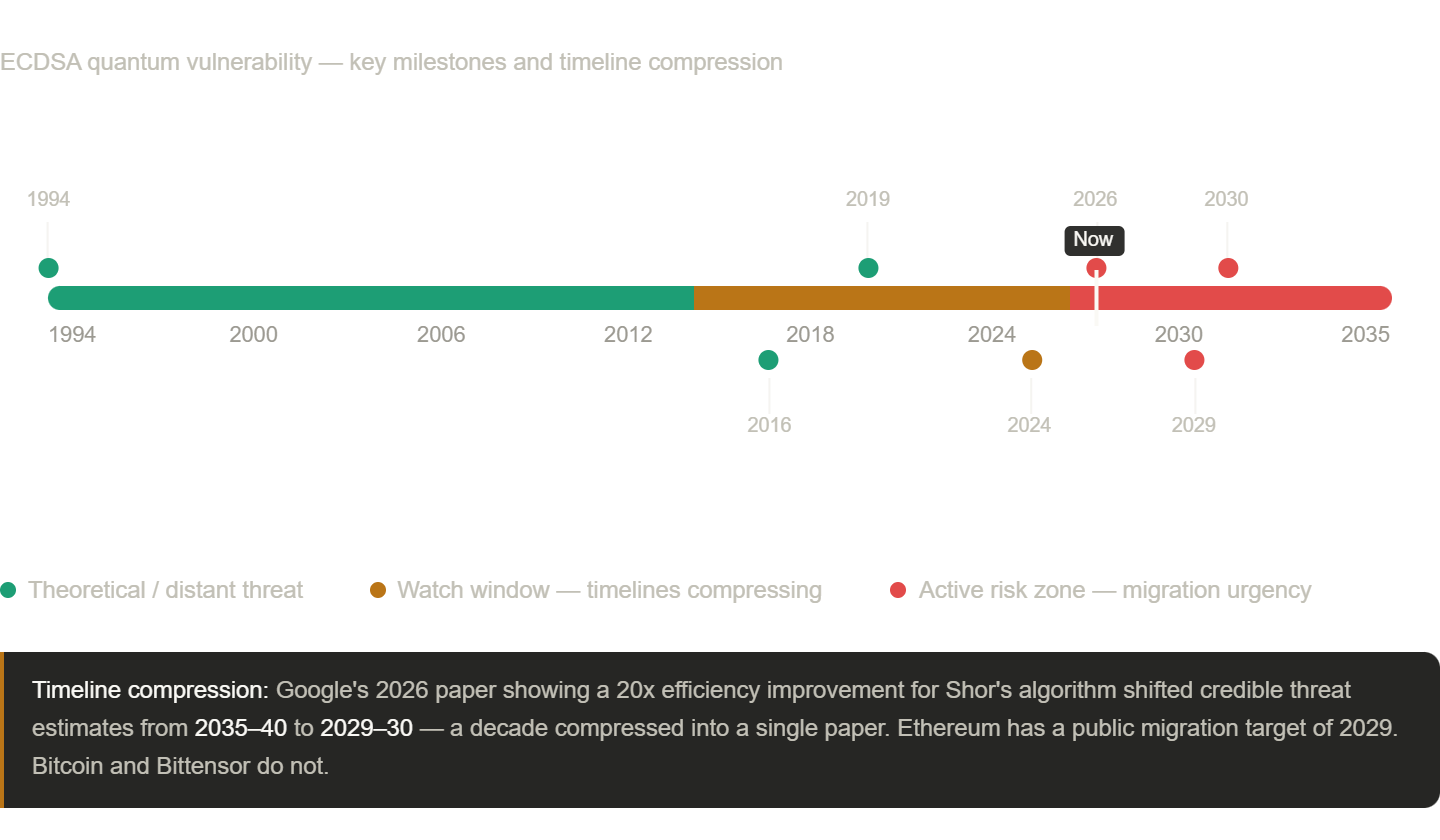
A sufficiently powerful quantum computer running Shor’s algorithm could reverse that math. We’ve known this since the 1990s. The threat has always felt distant, theoretical, a problem for a future generation of developers to solve.
Then the timeline compressed.
Google recently published research showing roughly a 20x efficiency improvement in running Shor’s algorithm, shifting credible threat estimates from 2035–40 toward 2029–30.
Solana’s Anatoly Yakovenko called it 50/50 within five years.
Nic Carter flagged something more alarming still: the possibility of a nine-minute on-spend Bitcoin attack, where a quantum computer intercepts a live transaction while it’s waiting to confirm within the standard ten minutes.
This isn’t just a far-off problem anymore. It’s a ticking clock.
The whole network has to be post-quantum before that machine exists.
Bitcoin has no roadmap.
Bittensor has no roadmap I’m aware of.
Ethereum has a public migration roadmap targeting 2029.
So when I started researching this piece, my first question was simple: Should I be worried about my TAO?
What Quantum Actually Threatens in Bittensor
Here’s where I had to stop and really understand the mechanics.
The panic is missing the target. Quantum doesn’t threaten the blockchain itself, the chain of hashed blocks is safe.
What quantum does threaten is authenticity: your signature proving you authorized a transaction. The ledger stays intact; the trust in who controls what does not.
Think of it this way: Quantum computers can’t rewrite the blockchain’s history. But they could steal your keys and write new history pretending to be you. This is a general blockchain problem, but Bittensor’s agile subnet architecture gives it tools to experiment and adapt faster than monolithic chains.
Blockchains like Bitcoin are like oil tankers. Changing course takes years of planning, coordination, and risk.
Bittensor is more like a fleet of speedboats. Each subnet can test different approaches, fail fast, and share learnings across the network.
When the quantum threat becomes real, that flexibility matters.
This is what clicked for me: Bittensor doesn’t need to be first to solve quantum threats. It needs to be fast to implement when someone else does. And it has infrastructure that could help test those solutions.
The Quantum Subnets: Building Both Sides of the Equation
While everyone else is either panicking about quantum threats or hyping quantum computing, Bittensor has subnets building both.
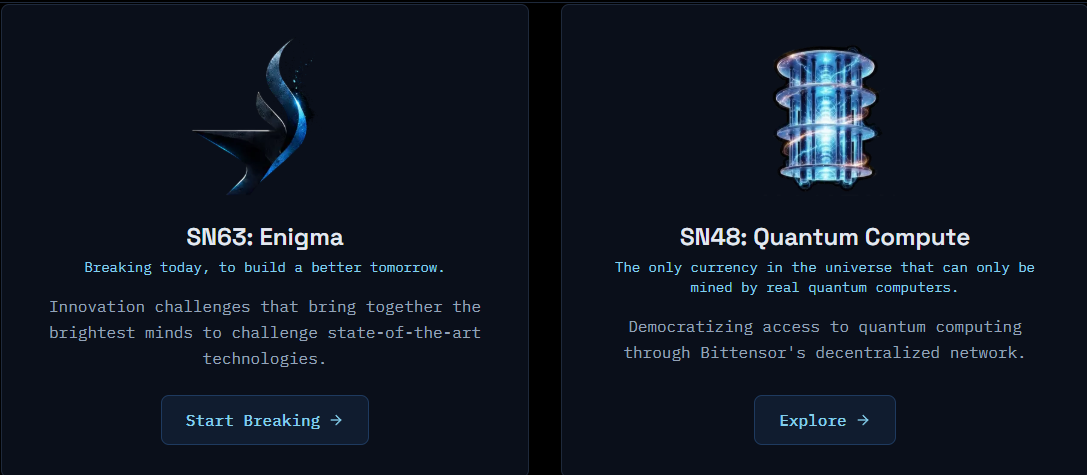
QBittensor Labs runs two related subnets that caught my attention:
SN63 (Enigma): The Research Lab
Think of this as the quantum computing gym where miners train to get better.
Validators generate difficult quantum problems: things like peaked circuits and hidden-stabilizer tasks. Miners compete to solve them using simulation software called Quantum Rings, which runs on regular hardware (no actual quantum computers required yet).
The best solutions get scored on correctness and efficiency. Winners earn emissions.
What This Actually Means: Miners are getting really good at quantum algorithms right now, using simulated quantum hardware. When real quantum computers become more accessible, these miners already know how to use them.
SN48 (Quantum Compute): The Production Marketplace
This is where the training becomes real work.
At OpenQuantum.com, anyone can submit quantum circuit jobs: computational problems that might benefit from quantum approaches. Miners execute these jobs on simulators or actual QPUs (Quantum Processing Units) if they have access to them.
Then validators issue “proof-of-quantumness” (yes this is a real phrase) challenges to verify the results actually came from quantum computation, not classical shortcuts.
Both subnets are at full capacity: 256 miners registered in each. They’ve generated over 300 million proofs and the difficulty curve keeps climbing
Why This Matters for Quantum Threats:
If you want to test whether a new post-quantum signature scheme actually resists quantum attacks, you need quantum computers to try attacking it.
Right now, only IBM, Google, and a handful of others have that hardware. It’s expensive and you’re basically asking permission from the same companies whose centralized models you’re trying to escape.
SN48 is building a permissionless alternative. Need to simulate quantum attacks on a proposed new signature scheme? Submit the job. Miners with QPU access compete to run it with results verified on-chain.
The Structural Hedge Nobody Saw Coming:
QBittensor Labs is playing both sides of the quantum revolution:
If quantum becomes a commercial compute primitive (drug discovery, financial modeling, optimization), SN63 and SN48 are early infrastructure for those markets.
If quantum arrives as a cryptographic threat faster than anyone’s ready, the QPU access becomes directly useful for testing post-quantum defenses.
And because it’s happening on decentralized markets, the progress is visible. You’re not waiting for a Google press release. You can watch circuit complexity scores, fidelity rates, and proof validation metrics update in real-time on Taostats.
The Part I’m Still Figuring Out:
I don’t have strong conviction on whether these subnets are good investments yet. They’re early-stage infrastructure plays in a technology that’s still maturing.
I’m watching for signs these subnets keep delivering. Are circuit complexities climbing? Is proof-of-quantumness validation holding up under scrutiny?
If yes, this could become the R&D lab for Bittensor’s own quantum-safe future. Testing post-quantum signatures requires simulating quantum attacks. That’s exactly what this infrastructure enables.
Your Quantum Readiness Framework
Here’s the framework I now use to decide if quantum panic is warranted.
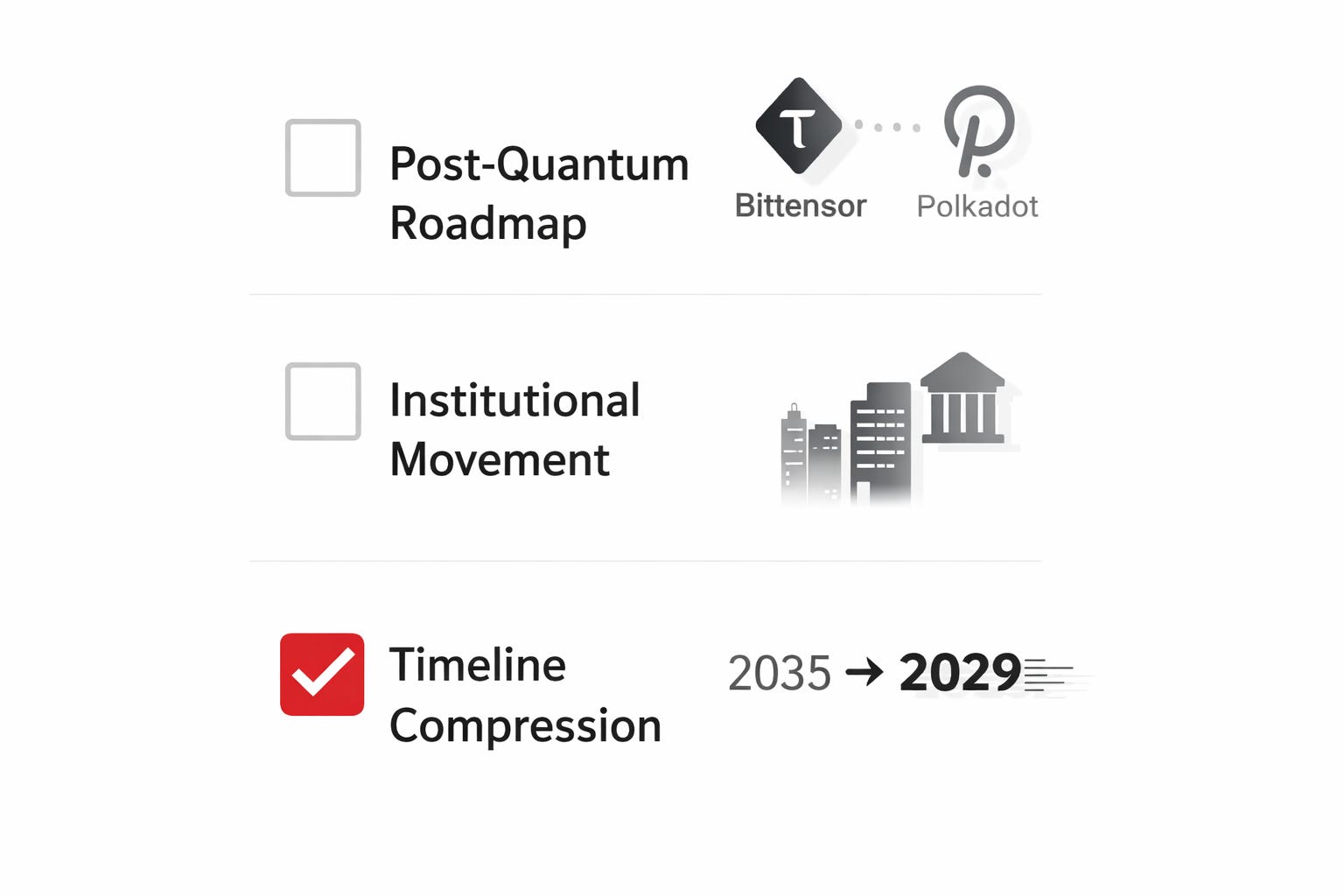
The Three-Signal System:
Signal #1:
Does Bittensor publish a post-quantum migration roadmap? TAO runs on Substrate with sr25519 signatures. This is the same threat class as Bitcoin and Ethereum. Ethereum’s targeting 2029. Bittensor has nothing public yet.
Here’s the test I ran this week:
I checked the last 8 weeks of OpenDev call notes for any mention of “quantum” or “cryptography upgrades”
Result: Zero mentions
I searched the Bittensor, Church of RAO and TAO Community Discord for “quantum” going back 90 days
Result: Numerous mentions from community members asking. No official response.
I looked at Polkadot’s quantum discussions (since Bittensor runs on Substrate)
Result: Polkadot has an active RFC discussing post-quantum primitives.
Signal #2:
Are institutional players treating this as real? Watch for:
Exchanges announcing post-quantum wallet support.
Large validators discussing migration plans.
Foundation developers mentioning it in OpenDev calls.
Signal #3:
Does the timeline keep compressing? If Google publishes another efficiency breakthrough, or if someone demonstrates Shor’s algorithm on a meaningfully large key, the clock speeds up.
What Changes: Move your TAO to the most actively developed wallet (likely the one that responds first to quantum concerns). Consider keeping a larger percentage in liquid form rather than locked in long-term staking.
The Bittensor Advantage (And Why I’m Not Worried Yet)
Here’s what I’ve come to understand about Bittensor’s position:
The Speedboat Principle: Bittensor can upgrade faster than Bitcoin or Ethereum. When post-quantum standards solidify (likely NIST’s recommendations), Bittensor’s substrate-based architecture means implementing new signature schemes is a runtime upgrade, not a multi-year fork negotiation (looking at you, Bitcoin).

The Hidden Defender: Targon (SN4) is Bittensor’s private compute subnet. It’s not a quantum security tool, but it does help protect data while it’s being used, which can reduce the risk of it being stolen and decrypted later.
The Reality Check: Bittensor will need to upgrade its cryptography. Every blockchain will. But panic helps no one. The timeline is 2029-2030 and Bittensor’s architecture is designed for exactly this kind of coordinated evolution.
The story is quieter than the noise suggests.
We have time. We have tools. We don’t have a comprehensive plan yet, but we’re watching the right signals.
Your Three-Step Action Plan
This Week: Check your subnet holdings for any mention of quantum preparedness. Just search their Discord or GitHub for “post-quantum” or “quantum resistant”. Note which ones are silent and which are discussing it.
This Month: Bookmark these two resources:
Polkadot’s RFC discussions on post-quantum primitives (since Bittensor inherits Substrate’s cryptography roadmap)
NIST’s Post-Quantum Cryptography standards page (to track when official recommendations are finalized)
This Year: Watch for Signal #1 from my framework above. If Bittensor doesn’t publish a post-quantum migration roadmap in 2026, while Ethereum has one for 2029, that’s worth asking about loudly.
The quantum threat is real and the timeline is compressing.
But we’re not helpless. We’re just early in a process that every blockchain is navigating together.
And unlike Bitcoin’s oil tanker, Bittensor’s speedboats can change direction fast when the course becomes clear.
Until next time.
Cheers,
Brian
Disclaimer: This is not financial advice. I am a writer documenting the Bittensor ecosystem. Always do your own research.
Great piece, Brian. The "speedboat versus oil tanker" analogy perfectly frames the core Bittensor advantage. I completely agree that the lack of an official public roadmap right now is a bit concerning, but seeing the active, decentralized R&D happening on SN48 and SN63 gives me a lot of confidence.