


September for Bittensor proved the money was real. October is where it gets interesting, because this month the protocol changed the rules while that money kept flowing in.
Two governance upgrades shipped 12 days apart. Null Consensus broke open the 256-miner ceiling that has capped every subnet since mainnet. eTAO gave subnet owners the ability to choose how emissions split between owners, validators, and miners, instead of the protocol forcing the same 18/41/41 ratio on everyone. Both were structural changes to a system that already had revenue running through it.
And the revenue didn’t pause while the protocol retooled. SubConnect raised its annualized estimate to $50M+, a 40% jump from September. Three Wall Street firms filed separate TAO ETF products in the same month. Affine shipped the first public AI video studio built on Bittensor infrastructure.
The protocol is being rebuilt under load, and the load is increasing.
Five stories. Here is your compass for October.
How to read this compass
I’m organizing these updates by direction: North, East, South, West to give you a repeatable mental model for navigating Bittensor’s complexity.
North: Foundation 🏛️ (governance, protocol, core team, security events) The structural layer. Changes here determine who controls the network and how decisions get made.
East: Capital 💹 (markets, volume, liquidity, integrations) The economic layer. This is where price meets liquidity and institutional conviction shows up in the data.
South: Technology ⚙️ (shipped features, benchmarks, infrastructure, ecosystem health) The execution layer. What actually works, what got built, and where’s the technical proof.
West: Adoption 📡 (narrative, mainstream validation, external voices) The perception layer. How the outside world sees Bittensor, from industry titans to normie investors.
This month, North delivered some of the most impactful protocol changes in Bittensor’s recent history. East brought the money. South shipped a product you can actually use. West was quiet, and that’s fine. Not every month needs a narrative moment. Sometimes the story is that the plumbing works.
🏛️ Null Consensus: subnets break the 256-player ceiling
On October 7, Bittensor shipped Subtensor Runtime 475. The headline: Null Consensus, an alternative to Yuma Consensus that lets a subnet support up to 2,500 registered UID slots instead of Yuma’s 256.
Under Yuma, every validator scores every miner. It’s distributed, democratic, and slow. Under Null, one validator sets the weights. It’s faster, scales to nearly 10x the participants, but concentrates trust in a single scorer.
Subnet owners now choose between the two. Yuma for distributed validation with 256 slots. Null for scale with 2,500 slots and one validator calling the shots.
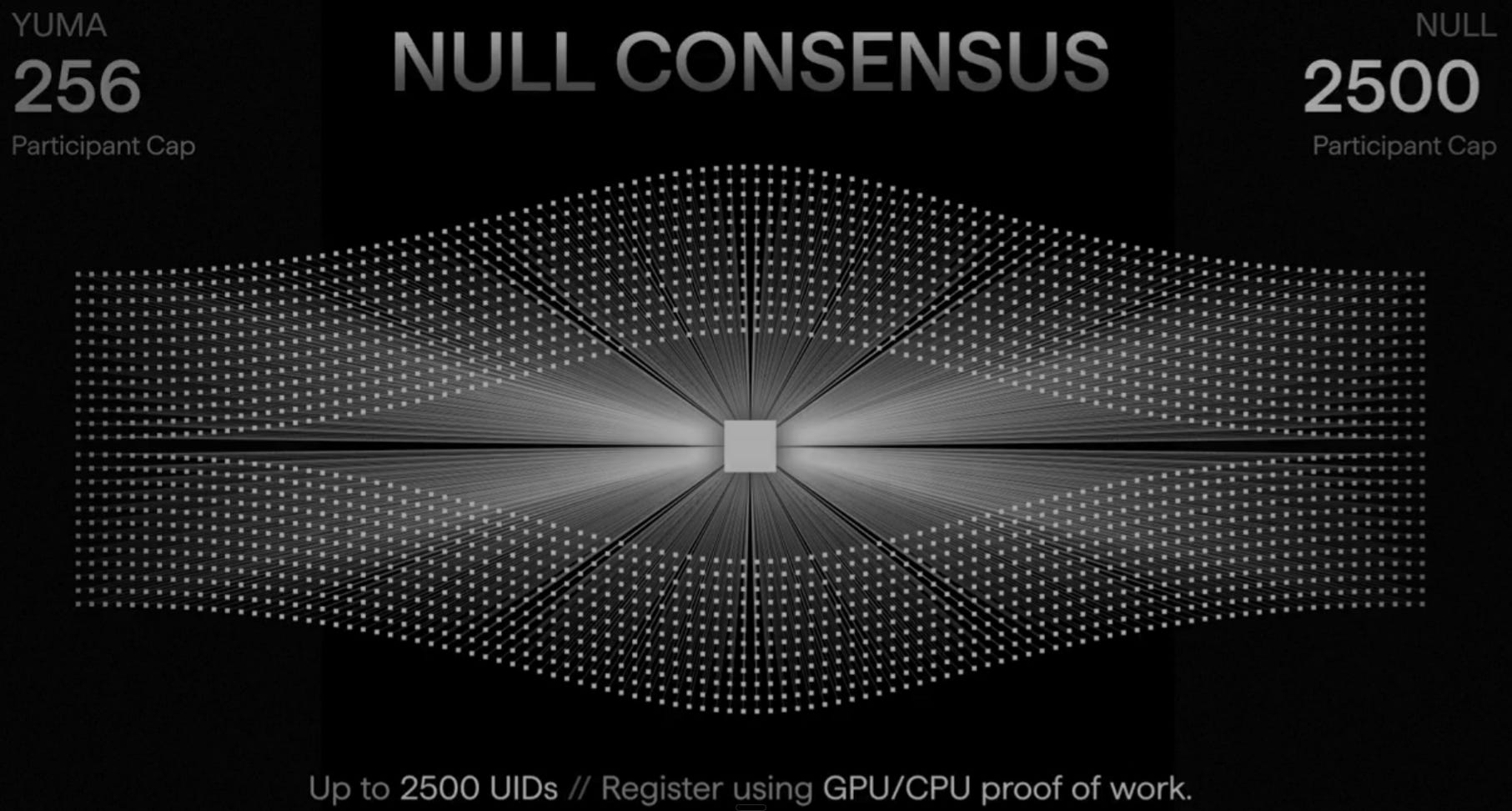
Why it matters: Under Yuma, a subnet has 256 UID slots shared by miners and validators, and multiple stake-weighted validators score miners through consensus. For compute marketplaces that want to register and reward many more participants, that can be restrictive.
Null raises capacity to 2,500 UIDs per mechanism, but gives scoring power to a single validator: the UID with the highest stake weight. That validator alone sets the weights that determine miner rewards. This removes Yuma’s consensus and bond-based defenses, creating a concentration risk: if the elected validator is malicious, mistaken, or unavailable, miner rewards can be distorted, or with no valid weights, fall back to an equal split across all registered UIDs.
In short, Null trades distributed, resilient scoring for much larger subnet capacity and simpler, high-throughput reward allocation.
The takeaway: Watch which subnets switch to Null Consensus. Compute and inference subnets with high miner counts are the natural adopters. Quality-sensitive subnets (text evaluation, fact-checking, AI safety) will likely stay on Yuma. The subnets that pick wrong, choosing Null when they need distributed scoring, or staying on Yuma when they need scale, will lose ground.
🏛️ eTAO: subnets choose their own emission splits
Twelve days after Null Consensus, on October 19, Bittensor activated eTAO (Runtime v481). Until then, every subnet split alpha emissions the same way: 18% owner, 41% validators (and their stakers), 41% miners. One size fits all.
Under eTAO, each subnet owner chooses how to divide newly emitted alpha among owners, validators, and miners. The protocol sets guardrails (every subnet must still pay the network and pay its miners), but within those limits, owners set their own ratios.
Early adopters are already diverging. Vanta removed its owner cut entirely, going to zero. Almanac increased miners’ share. Three subnets allocated 33% to owners. The chain recalculates each subnet’s baseline share every block.
Why it matters: This is the second half of the tokenomics overhaul that started with the emissions refactor in May. The old 18/41/41 split treated a compute marketplace and a text-scoring subnet identically, despite radically different cost structures. A compute subnet burning thousands in GPU costs needs a different emission profile than a fact-checking subnet running on consumer hardware.
eTAO lets subnets tune their economics like a mixing desk. More to miners to attract supply. Less to owners to signal alignment. More to validators to secure the network. The market will now determine whether a subnet’s emission split is well-designed or extractive.
And Vanta going to zero owner cut is a subnet voluntarily giving up its founder share. The thesis that subnets will evolve toward Bitcoin’s model (no founder allocation, no pre-mine, emissions purely reflecting work value) just got its first real-world data point.
The takeaway: Track eTAO split configurations on taostats. Subnets that cut owners too aggressively may struggle to fund operations. Subnets that take too much may bleed miners. The right split depends on the subnet’s cost structure, and the market will reward the ones that get it right.
💹 Three TAO ETF filings: Wall Street lines up
October saw three separate U.S. ETF filings for TAO:
Grayscale filed Amendment No. 2 to its S-1 on October 23, detailing plans to convert the Grayscale Bittensor Trust into the Grayscale Bittensor ETF on NYSE Arca under ticker GTAO. It would hold spot TAO.
Bitwise filed for a TAO Strategy ETF.
REX-Osprey filed for a TAO + Staking ETF, combining spot exposure with staking yield.
Why it matters: Three Wall Street firms filing TAO products in the same month is the strongest institutional signal Bittensor has received. Grayscale’s amendment is the most advanced, past the initial filing and into detailed listing mechanics. But REX-Osprey’s staking component is the interesting one. It would let ETF holders earn validator yield without operating a validator. That bridges the gap between passive exposure and active participation, something no other AI crypto project offers.
ETF approval timelines run in months, not weeks. But the filings themselves change the conversation. Financial advisors, family offices, and institutional desks that can’t custody TAO directly now have a pipeline. The question is whether the SEC greenlights a spot TAO ETF before the field gets crowded.
The takeaway: Grayscale has the first-mover position. Next to watch is SEC comment letters or deficiency notices on the S-1 filings. Those signal whether the regulator is engaging seriously or stalling. And as for REX-Osprey’s staking structure, if the SEC allows staking yield inside an ETF wrapper, it creates a regulated path for institutional investors to earn Bittensor validator returns.
💹 SubConnect revenue hits $50M+: the trend line holds
On October 2, SubConnect updated its Bittensor Revenue Index. The annualized subnet revenue estimate jumped from $32 to $35M (September) to $50M+ in one month. That’s a 40% month-over-month increase. Lium, Targon, and Engy drove most of the growth.
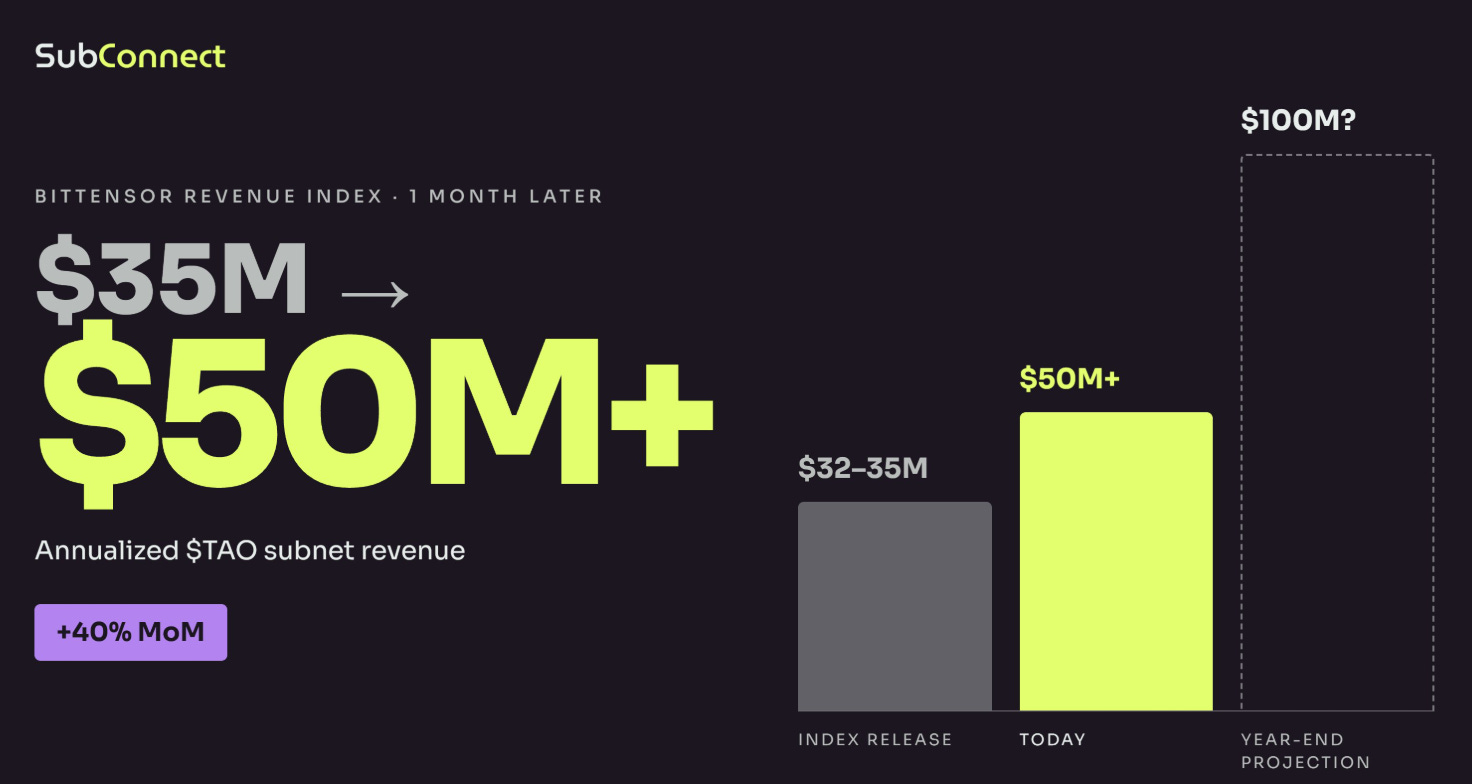
In September, I wrote that the Revenue Index was a baseline. October turned it into a trend line. RVCrypto’s $100M end-of-2026 target now looks less aspirational and more like a trajectory.
Why it matters: A 40% MoM jump means one of two things: revenue is genuinely accelerating, or the September estimates were conservative. Either way, the gap between $50M and $100M is no longer the entire investment thesis. It’s a growth question, not an existence question.
Also worth noting is that 14+ subnets are running active token buyback programs: real revenue purchasing alpha tokens on the open market. But generating revenue is step one. Building a sustainable business with margins, customer retention, and competitive moats is something else entirely.
The takeaway: The next volume of the Revenue Index is the real test. If it shows continued growth, the flywheel narrative gets data behind it. If it flattens, the bull case weakens. Until then, use the index as a screening tool. The subnets generating real revenue with active buybacks are the ones worth watching. The ones with no revenue and no buyback mechanism are running on emissions alone, and emissions are a shrinking resource post-halving.
⚙️ Affine ships Bittensor’s first public AI video studio
Affine (SN120) launched Affine Video, pairing a public MiniMax-H3 studio with a Bittensor competition to improve sparse attention in video generation. The goal is narrower than “decentralized video generation”: reduce inference compute by improving which attention blocks the model computes, without changing the underlying generator.
Miners train a selector that decides which attention blocks to keep. If it works, Affine gets lower cost per clip; if it fails, users get faster but less coherent video. The base model, inference stack, and generation schedule stay fixed, so this is a focused optimization competition rather than an attempt to train a frontier video model.
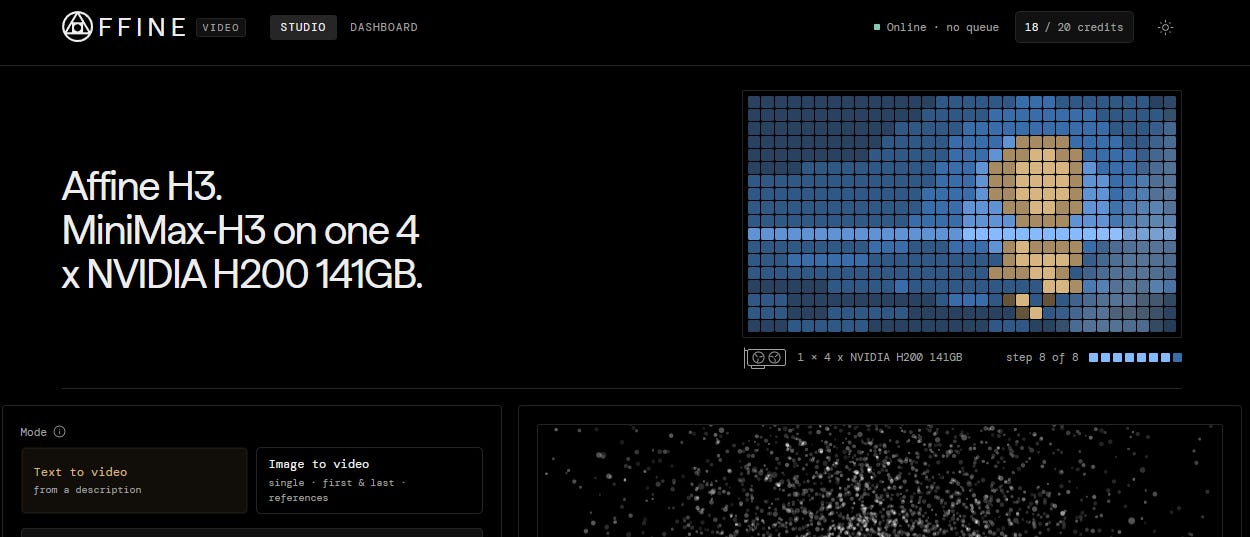
Why it matters: this is one of the first consumer-facing AI video products tied to Bittensor infrastructure. It does not yet compete with Runway or Pika on product depth, but it tests whether decentralized incentive mechanisms can improve a real inference bottleneck rather than merely produce benchmark scores.
Video is an unforgiving testbed, but even if sparse attention can save compute, dropped attention can show up as broken motion, inconsistent objects, or weaker prompt adherence. The relevant comparison for now is Affine’s sparse-attention output versus full-attention MiniMax-H3 at the same prompt and settings.
The takeaway: watch measured quality retention and cost reduction, not launch hype. If Affine can show near-parity quality at materially lower cost, it becomes evidence that Bittensor subnets can improve real AI products. If quality collapses as sparsity rises, it remains an interesting mechanism in search of a product.
Final thoughts
North (Foundation) ran this month. Null Consensus and eTAO together represent some of the most significant protocol changes since dTAO. Null changes who participates. eTAO changes how they’re paid. The protocol is in a phase of rapid iteration, shipping faster than most ecosystems plan, let alone execute.
But three runtime upgrades in one month (v475, v481, v484) plus the v482 patch is an extraordinary release cadence. It creates opportunity and risk. Every upgrade changes the rules and subnet operators are adapting in real time.
East delivered the capital story. SubConnect proved the revenue trend is real. Three ETF filings brought Wall Street to the door. The type of investor who starts paying attention when there’s an S-1 filing is different from the type who hangs out on the Subnet Summer Telegram group.
South (Technology) shipped something tangible. Affine Video is a product a non-technical person can understand: an AI video generator that runs on decentralized compute. You don’t need to know what dTAO means to grasp why that’s interesting.
And West was quiet. No narrative moment this month. But honestly, October didn’t need one. The protocol did the talking.
The through-line for all five stories: Bittensor spent October proving it can change the rules and grow at the same time. The protocol team shipped. The revenue grew. Wall Street filed. A product launched. The question for November is simpler: can the subnets keep up with the protocol?
Some can. Some can’t. That divergence is the story for the rest of 2026.
Until next time.
Cheers,
Brian
Disclaimer: This is not financial advice. I am a writer documenting the Bittensor ecosystem. Always do your own research.