

Earlier this month, my son got sick in the middle of the night. One of those stomach bugs that hits fast: nothing serious, but the cleanup was biblical.
His pyjamas, pillow, duvet, the bedroom carpet.
And worst of all, his favorite penguin teddy took the direct hit.
But he wasn’t crying. Still half-asleep, he just stood in the hallway holding the soaked penguin in one hand, waiting for me to fix it. That moment told me something: the thing wasn’t working anymore, and there was no panic. Just an expectation that Mommy and Daddy would fix it.
May felt like that for Bittensor. April’s Covenant exit cracked the seam, but May was the month the community started stitching it back together.
And luckily for me, I’d had a replacement teddy ready for a while. Now he carries around three of them, a new penguin family.

How to Read This Compass
I’m organizing these updates by direction: North, East, South, West to give you a repeatable mental model for navigating Bittensor’s complexity.
North: Foundation 🏛️ (governance, protocol, core team, security events)
The structural layer. Changes here determine who controls the network and how decisions get made.
East: Capital 💹 (markets, volume, liquidity, integrations)
The economic layer. This is where price meets liquidity and institutional conviction shows up in the data.
South: Technology ⚙️ (shipped features, benchmarks, infrastructure, ecosystem health)
The execution layer. What actually works, what got built and where’s the technical proof.
West: Adoption📡(narrative, mainstream validation, external voices)
The perception layer. This is how the outside world sees Bittensor, from industry titans to normie investors.
Each month, some directions will dominate the signal. Others will stay quiet. The goal is to see which quadrants are moving and what that means for your strategy.
Three of the four directions on the compass moved this month, one stayed quiet and another dominated. Lets review what happened.

🏛️ Conviction ships to mainnet
What Happened:
On May 13, Conviction shipped to mainnet. It’s Bittensor’s formal response to BIT-0011 and to the Covenant exit in April.
Every emission a subnet owner earns now auto-locks the moment it lands in their wallet. Conviction is calculated as stake multiplied by time, re-averaged every 30 days, and designed to make ownership more accountable.
Future plans involve converting those locked positions into transferable governance power so the community can vote underperforming owners out.
The first three subnets onboarded were the three Covenant abandoned: SN3 (Templar/Teutonic), SN39 (Basilica), and SN81 (Grail).
Why It Matters:
My April post called community miners rebuilding the abandoned subnets “ownership through commitment, not founder discretion.” Conviction is that idea, formalised at the protocol level.
What I noticed is the speed. Covenant walked out on April 9. By April 16, Steeves was on Discord explaining the mechanism. By May 13, it was code shipping to mainnet.
This is the kind of response cycle you want to see from a protocol that just took a public punch. Slow committees would have spent six months arguing. Bittensor wrote the fix, tested it, and pushed it in five weeks.
The Takeaway:
If you’re delegating, start tracking the conviction scores on the subnets you back. This is the new operator due diligence metric, and the people running the most committed teams are about to look very different from the people running the loudest ones.
For non-coders, its not quite available on Taostats yet (visible in the UI but no data), but until then you can view Total Stake Weight as proxy.
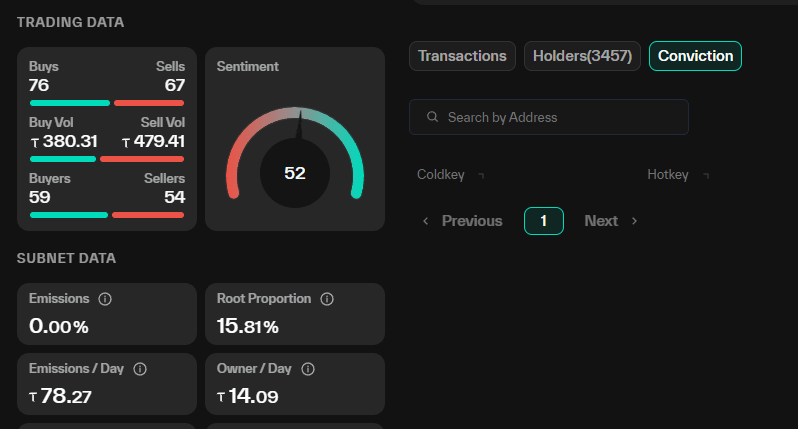
Conviction is locked alpha, and staked alpha can still be unstaked and sold, just not on a whim. But a high staked ratio means holders are parking tokens rather than keeping them sell-ready, which is the same question conviction is built to answer: who's committed, and who's liquid. So I read it as a floor, not a verdict.

🏛️ The emissions refactor changed how rewards flow
What Happened:
Around the same time Conviction shipped, Bittensor also updated its emission logic to a new model. The refactor concentrates rewards among roughly 30 productive subnets and introduces a new parameter called Net TAO flow.
The protocol now distributes newly issued TAO based on normalised flow data, tied to prior emissions and buybacks. In plain terms: the protocol now actively rewards subnets that produce useful work and starves the ones that don’t.
Why It Matters:
Conviction fixes who controls the network and now the emissions refactor fixes what the network rewards. Together they are the most significant tokenomics change since dTAO.
The economic logic is simpler now. Under the old model, low-emission subnets could still drain meaningful TAO into the market with little to show for it. Under the new model, that pressure compresses.
If you’re holding TAO, you should expect cleaner alignment between productive subnet activity and token issuance. If you’re staking into subnets, the gap between top performers and the long tail is about to widen sharply.
The Takeaway:
Emissions data over the next 90 days will be telling. Watch which subnets gain share and which lose it: the list of subnets gaining emissions share in this period could be the new smart money signal.
💹 Wormhole opens the Solana door
What Happened:
On May 5, the Solana Foundation and Wormhole Labs announced that TAO is now live on Solana via Wormhole’s Sunrise gateway. It’s a canonical bridged version of TAO trading natively on Jupiter, Meteora, Phantom, and Solflare.
Wormhole’s Native Token Transfer framework backs the bridge, which means liquidity is unified across Solana rather than fragmented across wrapped variants. Within seven days of the announcement, TAO was up 25%.
Why It Matters:
Solana wants to be the execution layer for AI agents. Bittensor is the intelligence layer for decentralised AI. Until now, those two worlds were connected through wrapped versions of TAO that fragmented liquidity and created friction. Wormhole just removed that friction.
The result is that TAO can now be used inside one of the deepest DeFi ecosystems in crypto, with the same liquidity guarantees you’d get from a native token. For the agent economy thesis, this means agents running on Solana can now hold, transfer, and stake TAO without leaving their execution environment.
The Takeaway:
Track TAO volume on Solana DEXs over the next 90 days. If volume on Solana grows faster than volume on EVM bridges, the agent economy thesis is becoming more of a reality.
📡 Sara Hooker chose Bittensor
What Happened:
On April 30, SILX AI announced that Adaption Labs is partnering with them to advance the Quasar foundation models on Subnet 24. Adaption Labs is co-founded by Sara Hooker, the former Vice President of Research at Cohere and a veteran of Google DeepMind.
Her firm raised $50 million in seed funding to advance adaptive AI research. The partnership will see Adaption Labs supply high-quality adaptive datasets to train Quasar models, with model quality and competitive SOTA performance set as priorities from day one.
Why It Matters:
Hooker has real credentials at the top of her field. She could have gone anywhere, but chose Bittensor. This is a perception-layer signal that an investor in a corporate job, listening to colleagues debate whether decentralised AI is real, can finally point to.
The Quasar thesis is that decentralised training only matters if it produces models people actually want to use. Its the standard Hooker built her career around, and it’s something that Bittensor has been failing to clear in mainstream AI press.
The Takeaway:
Watch Quasar’s HuggingFace releases over the next 12 months. If their open models start showing benchmark numbers competitive with Llama or Mistral at similar parameter counts, that would be strong evidence that decentralized training on Bittensor can produce research-grade models.
If they underdeliver on benchmarks, the claim that decentralized training produces real research becomes harder to defend, though the subnet could still be valuable in niches like long-context recall or cost efficiency.
⚙️ Quiet
May had no headline benchmarks or major shipped features outside the protocol layer. This is somewhat to be expected in a month dominated by foundation work.
Summer time is when this has potential to fire. Teutonic’s targeted trillion-parameter run, the Rayon Labs subnet trio’s continued share of emissions, and Quasar’s first model releases are the candidates. Until one of them lands, this direction is a watch-and-wait.
What sits with me most from May is the cadence. Five weeks from Covenant’s walkout to Conviction shipping live code is an unusual response time.
But its classic Bittensor, the kind of velocity you only see when the people building know exactly what’s broken and have already designed the fix.
The optimist’s read is that this network is more antifragile than its critics give it credit for. The skeptic’s read is that a fast patch can paper over a deeper governance problem, and we’ll only know which it is in the next couple of years.
Which of these moves you the most? The protocol moving fast on Conviction, or a researcher of Hooker’s calibre choosing Bittensor over a closed lab?
And if I missed something important from May, what would you add? Reply to this email and let me know. I reply to every single one.
Until next time.
Cheers,
Brian
Disclaimer: This is not financial advice. I am a writer documenting the Bittensor ecosystem. Always do your own research.