

If you look at the product lifecycle of any major cloud platform, there is always a distinct inflection point.
Take early AWS back in 2006. It starts as a chaotic, internal experiment: loosely structured, developer-first, and full of edge-case failures. But its real inflection point came when Amazon imposed strict service-level guarantees, standardized APIs, and operational discipline, transforming it from a tinkerer’s toolkit into infrastructure that enterprises could reliably build on.
This is analogous to what we just witnessed across the Bittensor network. June 2026 is the month the ecosystem stopped being a speculative playground and started becoming real infrastructure.
How to Read This Compass
I’m organizing these updates by direction: North, East, South, West to give you a repeatable mental model for navigating Bittensor’s complexity.
North: Foundation 🏛️ (governance, protocol, core team, security events)
The structural layer. Changes here determine who controls the network and how decisions get made.
East: Capital 💹 (markets, volume, liquidity, integrations)
The economic layer. This is where price meets liquidity and institutional conviction shows up in the data.
South: Technology ⚙️ (shipped features, benchmarks, infrastructure, ecosystem health)
The execution layer. What actually works, what got built and where’s the technical proof.
West: Adoption📡(narrative, mainstream validation, external voices)
The perception layer. This is how the outside world sees Bittensor, from industry titans to normie investors.
Each month, some directions will dominate the signal. Others will stay quiet. The goal is to see which quadrants are moving and what that means for your strategy.
All four directions on the compass moved this month. Two held their own, but the others took center stage. Lets review what happened.

💹The Core Incentive Engine Gets a Radical Tune-Up
Bittensor’s economic engine just received its most aggressive overhaul since Dynamic TAO (dTAO) went live. Two massive structural changes hit the network in the exact same window.
First, the network activated a major shift in how daily token emissions are carved up across subnets, moving back to a rigorous price-based model that replaces the older flow-based framework.
The mathematical allocation now actively penalizes unproductive or withheld emissions while shifting weight toward newer, high-performing subnets over time.
Second, and far more dramatically, OpenTensor shipped a protocol update on June 22 that completely blocked token emissions to 57 inactive and exploitative subnets.
This single move redirected roughly a third of all network emissions directly into the pockets of subnets that are actually building out real code. A new “miner-burn penalty” was instituted to eliminate squatters who route rewards to themselves without delivering meaningful output, and subnet eligibility is now scrutinized on a strict weekly review cycle.
The immediate beneficiaries are exactly who you would want to win: Chutes (SN64), the powerhouse AI inference subnet that generated $43M in Q1 2026 real AI revenue, and Targon (SN4), Manifold Labs’ confidential decentralized compute platform that currently ranks as the highest-revenue subnet for enterprise hardware-enforced AI workloads.
Why It Matters
For two years, the ecosystem tolerated dead weight collecting emissions, acting as a massive drag on protocol efficiency and network credibility. Shifting emissions to high-utility subnets forces capital allocation to map directly to real-world demand and revenue generation rather than arbitrary timing games.
The Takeaway
This is Bittensor’s first genuine quality enforcement mechanism. The network is finally learning to reward builders over squatters.
🏛️Validators as Fund Managers? The Root Reborn Debate
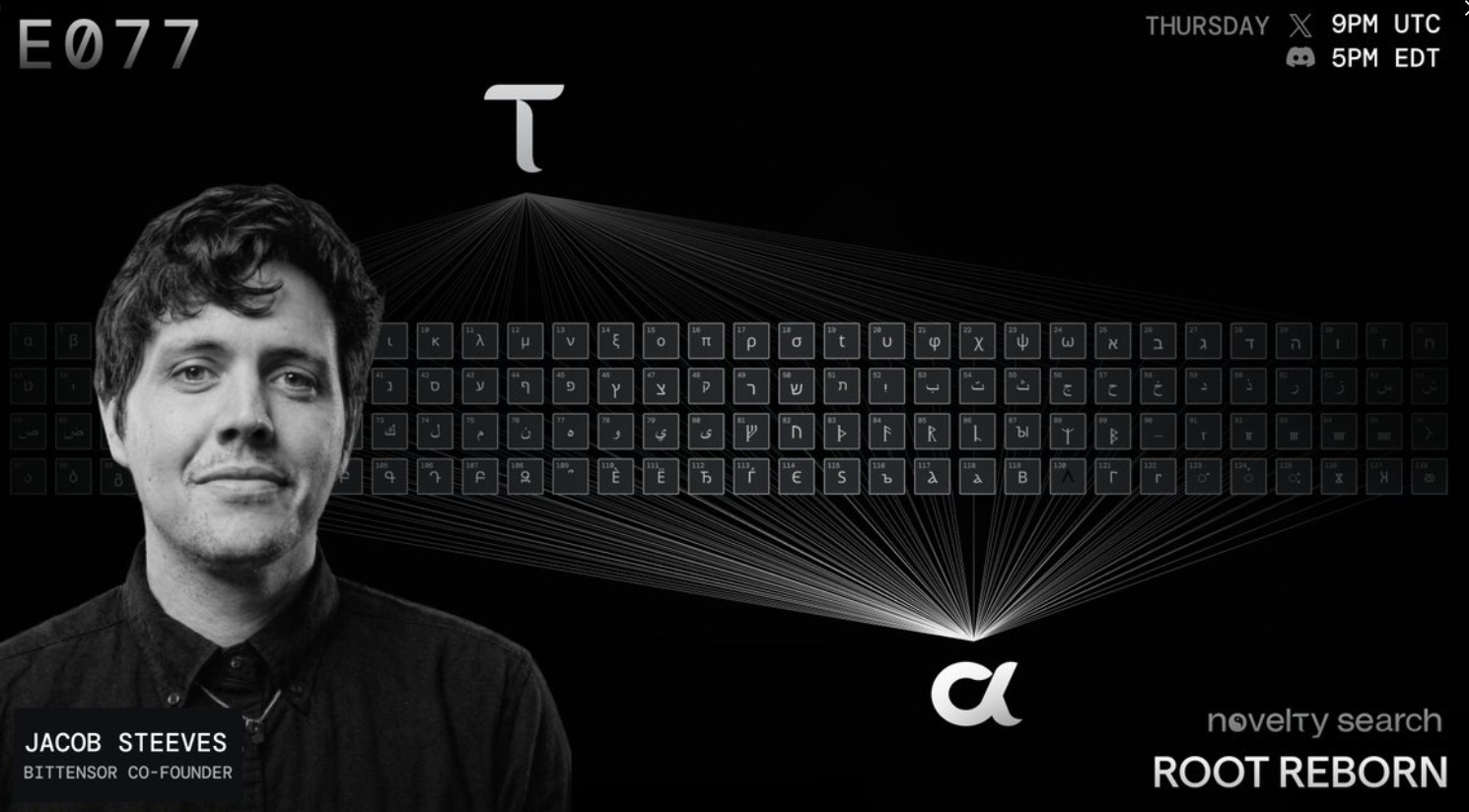
On June 16, Bittensor co-founder Const unveiled the “Root Reborn” proposal, triggering the most intense governance debate the ecosystem has seen in months. The underlying problem is simple: right now, root stakers automatically liquidate subnet alpha tokens, which exerts persistent, structural sell pressure across the entire subnet market.
Root Reborn proposes a total rethink: replacing that automated dump mechanism with validator-directed reinvestment baskets. Instead of blindly dumping subnet tokens onto the open market, validators would actively choose which productive subnets to back and compound their yield into.
The pushback, however, was immediate and severe. On June 19, Yuma (a DCG subsidiary) published a scathing analysis warning of deep moral hazard. They argued that giving validators this level of centralized capital allocation authority introduces substantial risks to the underlying balance of power. Institutional voices like Safello CEO Frank Schuil quickly weighed in, and the debate dominated OpenTensor’s weekly Novelty Search community call.
Why It Matters
Automated liquidations create a structural drag on subnet token prices, suppressing the native economies of productive subnets. Fixing this changes the economic incentives of validators from passive gatekeepers to active ecosystem asset managers, but doing it incorrectly risks centralizing too much power in a few hands.
The Takeaway
If Root Reborn passes, it could completely alleviate the artificial price ceilings that have suppressed subnet token prices since dTAO launched. But the real win here is the maturity of the governance itself. This isn’t a founder handing down dictates from a mountaintop; it’s a sophisticated, multi-billion-dollar architectural negotiation.
🏛️The Hard Road to Full Decentralization
On June 22, co-founder Jacob Steeves (Const) published a remarkably candid decentralization roadmap that began with an admission most crypto founders would never dare utter publicly: “Bittensor is currently not a decentralized protocol in the way Bitcoin is. It can be, and it will be, but it isn’t yet.”
Specifically, Const acknowledged that Bittensor’s core economic incentive layer remains fundamentally centralized. This transparency follows a highly volatile period of governance friction, most notably the Covenant AI departure in April 2026. At the time, subnet founder Sam Dare publicly accused the core team of unilateral control and halting emissions without consensus, a dispute that triggered a painful crash in the price of TAO.
The new 18-month roadmap explicitly targets full decentralization by December 2027. Const explained that the foundation intentionally prioritized rapid development speed over absolute decentralization during the early hyper-growth phase of the network. Now, the timeline is locked in.
Why It Matters
Centralization is the ultimate bear case that traditional and institutional investors use to dismiss the network. By openly acknowledging the current centralization gaps, the core team eliminates a major narrative vulnerability and creates a transparent, multi-year benchmark for real accountability.
The Takeaway
The core team has given the community a visible yardstick to hold them accountable. Longevity requires decentralized foundations, and the network is finally drawing the blueprint.
💹Retail & Institutions Get One-Click Access
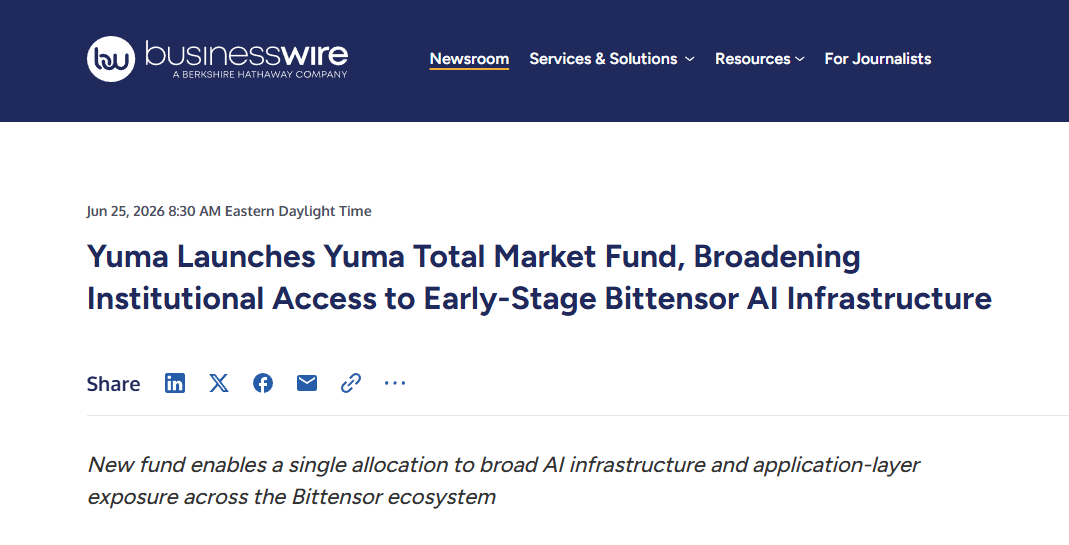
On June 25, Yuma announced the launch of the Yuma Total Market Fund, an institutional-grade investment vehicle that offers a single entry point into both TAO and the wider subnet alpha token ecosystem. As Barry Silbert framed it, the fund represents a paradigm shift: decentralized AI investing is no longer restricted to venture capital or standard hardware equities like Nvidia.
But the access expansion isn’t just for institutions anymore. This is part of a broader standardizing trend we’ve seen all month:
Retail Exchange Listings: On June 29, Kraken announced they are listing several Bittensor subnet alpha tokens directly on their centralized exchange. This allows retail traders to seamlessly access these AI-focused assets without having to navigate complex on-chain automated market maker (AMM) pools.
Regulated European Access: On June 2, Safello and Deutsche Digital Assets cross-listed the Staked TAO ETP (ticker: STAO) on Euronext Paris, expanding access to yield-bearing TAO across major European exchanges.
The Louvre Track: The Proof of Talk 2026 conference featured a dedicated Bittensor Track, putting the network directly in front of 2,500 C-level asset managers representing a staggering $18T in collective AUM.
DeFi Primitive Alpha: On June 25, Forge opened its public testnet for Bittensor-native TAO borrowing against alpha token collateral, providing the first real glimpse of capital efficiency rails for subnet investors.
Why It Matters
Complex on-chain AMM pools, custom wallets, and fragmented liquidity have historically locked out traditional and retail capital. Bringing these assets onto centralized venues and regulated ETPs radically expands the addressable market and removes the operational friction of the ecosystem.
The Takeaway
For a long time, the mission of making decentralized AI accessible to regular investors was stalled by complex user experiences. This new centralized exchange and institutional plumbing bridges that gap. Bittensor is evolving from an esoteric crypto experiment into a highly accessible alternative AI infrastructure thesis.
⚙️Chutes Levels Up
This month, Chutes completed a full move onto TEE (Trusted Execution Environments) and brought its first Blackwell B200s online, while also expanding distribution through openGPU. This is a concrete sign that the network’s AI compute stack is maturing into something highly reliable and deployable.
Why It Matters
When we look at decentralized AI through a traditional product management lens, enterprise adoption always stalls on two major product risks: feasibility (can it scale?) and business viability (is it secure and compliant?).
By bringing Blackwell B200s online and expanding through openGPU, Chutes is actively solving the feasibility problem: proving that a decentralized network can handle heavy, enterprise-grade compute demands.
But the real quiet victory here is the rollout of TEE. For the non-technical investor, TEE translates directly to “verifiable inference”: cryptographic proof that an AI model executed exactly as requested without ever exposing the underlying prompt or sensitive data. It is the exact security baseline corporate clients demand before letting proprietary business data touch an open-source network.
The Takeaway
We are watching Bittensor evolve from a fascinating technical experiment into commercial-grade infrastructure. For long-term investors, this is exactly the transition you want to see: a shift away from token speculation and toward shipping sticky, B2B-ready products that can compete directly with centralized cloud providers.
📡Centralized AI Stumbles, The Decentralized Narrative Accelerates
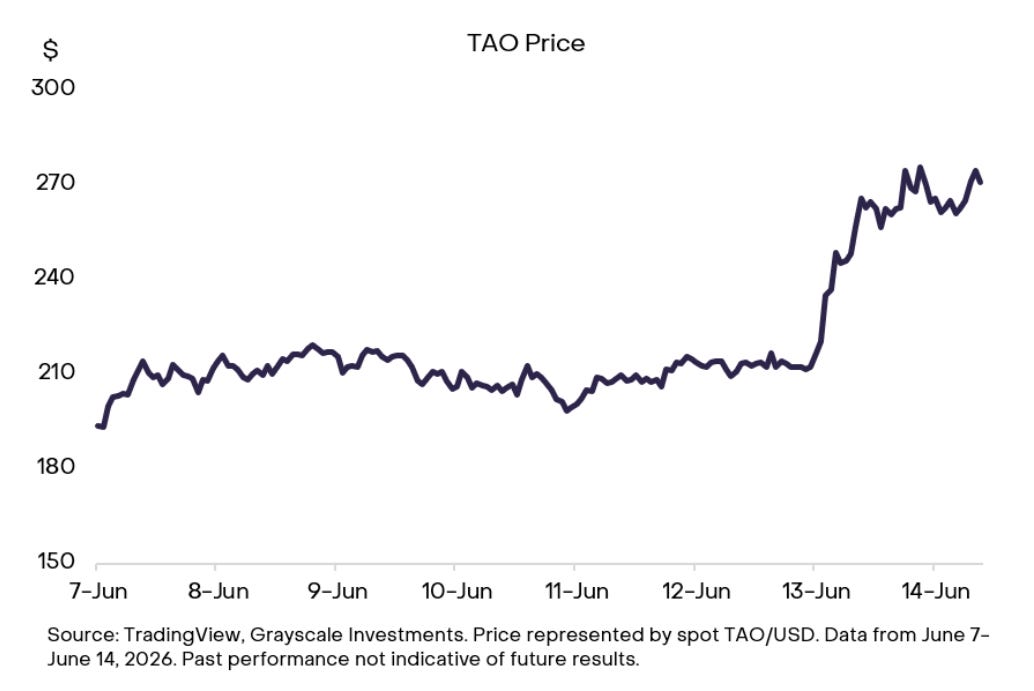
On June 13, the US government abruptly suspended export access to Anthropic’s AI models, sending shockwaves through global tech hubs. The sudden suspension put the core vulnerability of centralized AI on full display: an entire enterprise pipeline can be severed overnight by a single regulatory stroke.
Grayscale immediately capitalized on the moment, publishing extensive research positioning Bittensor as the premier decentralized AI alternative. Their analysts explicitly noted that demand for permissionless, open-source AI infrastructure is bound to accelerate as centralized moats face increasing geopolitical and regulatory interventions.
The market response was immediate and violent: TAO surged nearly 30% within 12 hours of the news as capital rotated heavily into the decentralized AI narrative.
Why It Matters
It demonstrates that centralized AI pipelines are inherently exposed to single points of geopolitical and regulatory failure. Enterprise clients cannot afford to have their foundational infrastructure cut off overnight due to cross-border policy shifts.
The Takeaway
This was a fundamental proof of concept. Every closed, corporate AI provider is one executive order away from restriction, and Bittensor’s globally distributed architecture is the natural insurance policy against that exact point of failure.
Final Thoughts
We’re entering the 18-month window that will define whether Bittensor becomes infrastructure or remains an experiment. The roadmap to full decentralization is public, low-signal subnets are being ejected, and capital onramps for both retail and institutional players are operational.
The experimental era just ended. Now comes the stress test: can this architecture actually handle scale?
Here’s what I want you to do: Don’t just read this and move on. Choose one development from this month; tracking alpha token price action on Kraken, scrutinizing whether the decentralization roadmap is hitting its marks, whatever resonates, and actively test your conviction. Are you in this for returns? Or because you believe Bittensor represents something bigger than profit? Because if Bittensor succeeds at the latter, the former takes care of itself.
Disclaimer: This is not financial advice. I am a writer documenting the Bittensor ecosystem. Always do your own research.
Great Article thank you Peter. These monthly summaries are gold and how you broke it down into 4 pillars is superb.
Great article Brian. I originally came in for the investment returns, but the longer I am here, read and listen, I am excited for what is being built. I hope to use some of these Projects, if I can figure out how, in my daily life.