


My older son spent nine months refusing to let go of the pool wall. Swimming lessons every Saturday. He’d kick, he’d blow bubbles, he’d practice the arm motions on dry land in the living room. But the moment his instructor said “let go,” and he has had three different instructors, his hand shot back to the tiles like a magnet.
Then one Saturday, he just swam. To my disbelief, with no fanfare or countdown, he let go and went. Four meters, face in the water, doggy-paddling like he’d been doing it his whole life. His instructor didn’t even cheer. He just nodded like he knew it was coming.
All that groundwork, invisible to anyone watching from the deck. And then one day, the proof. July felt like that for Bittensor.
For four months, the compass pointed North (Foundation). Governance fixes, emissions overhauls, decentralization roadmaps. The kind of progress that matters but doesn’t make headlines outside the Discord. In May, I wrote that South (Technology) was quiet, waiting for summer. In June, I asked whether the architecture could actually handle scale.
July answered with some real achievements. I’ve filtered them down to two for this piece.
Even Jensen Huang is out there writing open letters about why open source AI matters. The wind is at our backs. Bittensor made its own this month.
How to Read This Compass
I’m organizing these updates by direction: North, East, South, West to give you a repeatable mental model for navigating Bittensor’s complexity.
North: Foundation 🏛️ (governance, protocol, core team, security events) The structural layer. Changes here determine who controls the network and how decisions get made.
East: Capital 💹 (markets, volume, liquidity, integrations) The economic layer. This is where price meets liquidity and institutional conviction shows up in the data.
South: Technology ⚙️ (shipped features, benchmarks, infrastructure, ecosystem health) The execution layer. What actually works, what got built and where’s the technical proof.
West: Adoption 📡 (narrative, mainstream validation, external voices) The perception layer. This is how the outside world sees Bittensor, from industry titans to normie investors.
Each month, some directions dominate the signal. Others stay quiet. This month, three directions moved. One fired. Let’s review what happened.
🏛️ v440: The Emission Gate Opens
On July 28, Bittensor shipped v440. The “Emission Gate.” It introduces a demand threshold for subnet emissions. Idle subnets that can’t show real demand now see their base return drop to near-zero.
The protocol team modeled the gate against a July 2026 mainnet snapshot of all 128 subnets, treating every subnet as emission-enabled. The math is simple: subnets without genuine usage face a dramatic emission haircut. Productive subnets see their rewards increase.
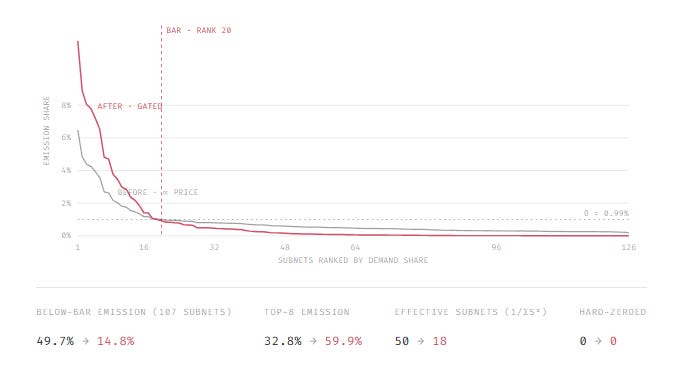
This is the final piece of an emissions puzzle I’ve been tracking since May when the reward logic was rewritten. Then, June purged 57 dead subnets with a hard cutoff. Now v440 introduces market mechanics, letting demand naturally starve out idle subnets instead of manually blocking them.
Why It Matters: The network is now systematically engineering capital toward subnets that earn real revenue. June was about blocking bad actors. July is about making idle subnets structurally unviable over time.
The Takeaway: The v440 effects will show up in August emission data. Watch which subnets gain share and which lose it. The list of gainers is your smart money signal.
🏛️Two Subnet Owner Wallets Drained in Social Engineering Attack
On July 13, two Bittensor subnet owner wallets were compromised on the same day. ORO (SN15) lost 147,000 alpha tokens, drained and sold over roughly 10 hours. Connito AI (SN102) lost 2,500 TAO from their owner wallet.
ORO attributed the attack to a North Korean state-backed threat group. A team member clicked a fake Zoom/Teams meeting link and the attacker drained the owner wallet.
The breach was thankfully contained to the owner wallet, with validator keys, user data, and the subnet itself untouched. Both subnets stayed operational.
Three days earlier, Bittensor shipped v437 with air-gapped signing, but the team hadn’t migrated yet.
ORO published a full post-mortem on July 21, completed a coldkey swap, and moved owner keys to multisig hardware protection. Crucible Labs noted that both teams “chose transparency over silence.”
Why It Matters: Bittensor can ship air-gapped signing, miner collateral, and emission gates, but none of that stops a team member from clicking a meeting link that looks real enough in the moment. The response also matters: ORO published a detailed post-mortem within eight days, while Connito openly acknowledged the incident. Its the type of the culture you want when something breaks, write the report yourself and don’t wait for a press release.
The Takeaway: If you’re a subnet team, move your owner keys to hardware-backed multisig today. The tools now exist with v437. If you’re an investor, start asking subnet teams about their key management the same way you’d ask about revenue. “Who holds the keys and how?” is the new due diligence question.
💹 Kraken Builds a Subnet Token Pipeline and Lists SN8
On July 3, Kraken announced they had completed native integration of Bittensor’s dTAO and will begin listing subnet tokens in the near future. Seven Bittensor subnet alpha tokens were added to its listings roadmap.
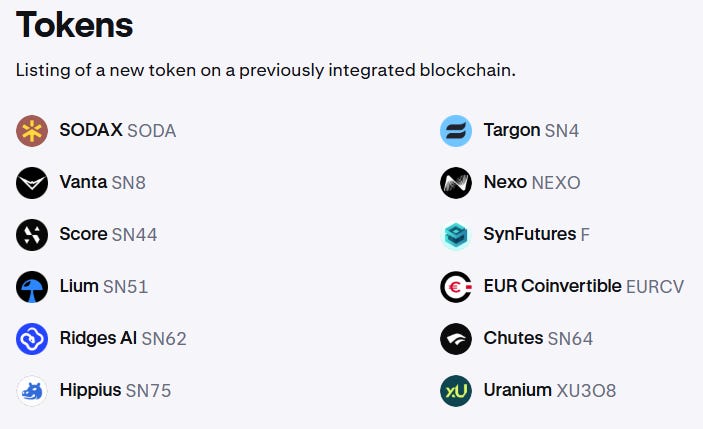
On July 16, Kraken listed Vanta Network (SN8) for spot trading. The first Bittensor subnet token to get a dedicated trading pair on a Tier-1 exchange.
Vanta Network operates as fintech infrastructure within Bittensor, enabling financial services across subnets. After listing, SN8 found its floor at $5.14 on July 28. This is price discovery backed by Kraken’s order book depth, a different animal than the AMM pools subnet tokens typically trade on.
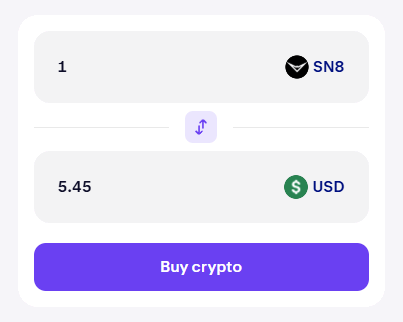
Why It Matters: Retail investors can now buy subnet tokens the same way they buy SOL or ETH. The dTAO market graduates from DeFi natives to mainstream crypto traders. Every listing brings new liquidity, new price discovery, and new attention to subnets that previously lived in the shadows of TAO itself.
The Takeaway: Track which of Kraken’s 7 roadmap tokens list next. Each listing is a new price discovery event for a subnet economy. The subnets that list first get the first wave of retail liquidity, and that order matters.
💹Synth (SN50) Posts Profitable Q2, Announces $100K Buyback
Synth, the financial intelligence subnet co-founded by Mode Network, published its “Synth Reborn: Q2 Alpha Update” with two milestones: Q2 was profitable, and they’re committing $100,000 to an SN50 alpha token buyback over 8 weeks, executed weekly.
This is the subnet I spotlighted in Machine Allocators Don’t Want Your Best Guess. Hundreds of competing AI models submit 100 simulated price paths every 5 minutes. Validators score them on how close their probability cones matched reality. The output is a live API that financial traders, DeFi protocols, and AI agents can query for volatility data.
The buyback comes with what Opentensor’s ecosystem highlights called “a renewed focus on turning revenue into value capture.”
Why It Matters: Every subnet talks about value accrual. Synth is the first financial subnet to put $100K of real revenue behind that talk. If the buyback is transparent, it gives the market a measurable signal of subnet revenue health.
The Takeaway: Watch SN50’s alpha price response over the 8-week window. If the buyback stabilizes or lifts the price, other revenue-generating subnets will copy the playbook. The first one to prove the model becomes the template for the rest.
⚙️ Chutes Trains a 20B Model for Under $10 an Hour
Chutes pre-trained a 20-billion parameter AI model for under $10 per hour. Without a dedicated cluster. The achievement used Chutes’ “Parallax” approach, coordinating rented GPUs across distributed hardware to train a model that would normally require a centralized server farm.
This is the same Chutes that generated $43M in Q1 2026 real AI revenue and moved to fully Trusted Execution Environments in June. July is the payoff.
Why It Matters: If you can train a 20B model on distributed rented GPUs for under $10 an hour, the cost advantage over centralized cloud is no longer theoretical. It’s a published number you can compare against any provider’s pricing page.
The Takeaway: Watch whether other subnets replicate the Parallax approach to distributed training. If training at this cost becomes repeatable across multiple subnets, centralized cloud providers lose their last structural argument.
⚙️ Targon (SN4) Launches TargonOS: Permissionless VM Rentals with Root Access
Targon shipped TargonOS to production. The first permissionless compute network offering full virtual machine rentals, with root access from day one, hardware-attested isolation, and end-to-end encrypted workloads.
Most decentralized compute platforms offer sandboxed environments with limits. TargonOS gives you everything: root access means you can install whatever you want, configure it however you need, and run whatever workload you have. This is the type of feature set enterprises demand before migrating off AWS.
At $3.29 an hour for an H200, the cost conversation against centralized cloud gets very uncomfortable for the incumbents.
Why It Matters: Enterprises don’t deploy production workloads in sandboxes. They need full machines with verifiable isolation and encrypted data paths. TargonOS delivers that feature set at a price that makes the migration conversation with AWS very short.
The Takeaway: Watch TargonOS adoption metrics: VM rental volume, unique customers, enterprise signups. If enterprises actually rent H200s at $3.29 an hour, Bittensor compute transitions from competing to winning.
Final Thoughts
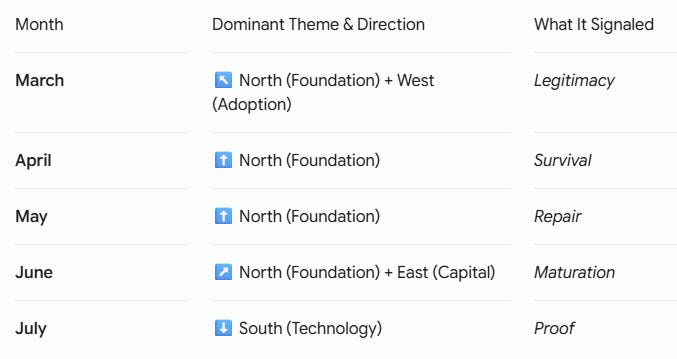
For four months, the compass pointed North. Governance fixes, emissions overhauls, security patches, critical infrastructure. The kind of work that keeps a network alive but doesn't make headlines outside the Subnet Summer Telegram group.
Then July delivered what all that foundation work was building toward. It’s coordinating intelligence at price points that make centralized alternatives sweat. The technology works and the products are shipping.
But there is still a disconnect. The price doesn’t reflect any of this yet.
TAO is trading like it’s still in survival mode and the only story that matters is emissions schedules and validator drama. But that's not where we are anymore.
I’m more excited about this ecosystem now than I was six months ago. Not because of price action, as that will eventually catch up. I’m excited because the infinite game is playing out exactly as it should: the builders who stuck through the heavy months are now shipping proof. That’s the signal I trust more than any chart.
The compass keeps turning. July proved the direction was right all along.
Disclaimer: This is not financial advice. I am a writer documenting the Bittensor ecosystem. Always do your own research.