


My younger son is obsessed with testing things. He drops food off his plate not because he doesn’t want it, but because he wants to know what happens.
He’s learning cause and effect: broccoli and potatoes mashed on the floor for Daddy to clean up.
The experiments never stop, even if he doesn't know to call them that yet.
April felt like that, except nobody planned this month’s experiment. One operator pulled out of three subnets, dumped $10 million in TAO, and walked away. The community left behind picked up the pieces.
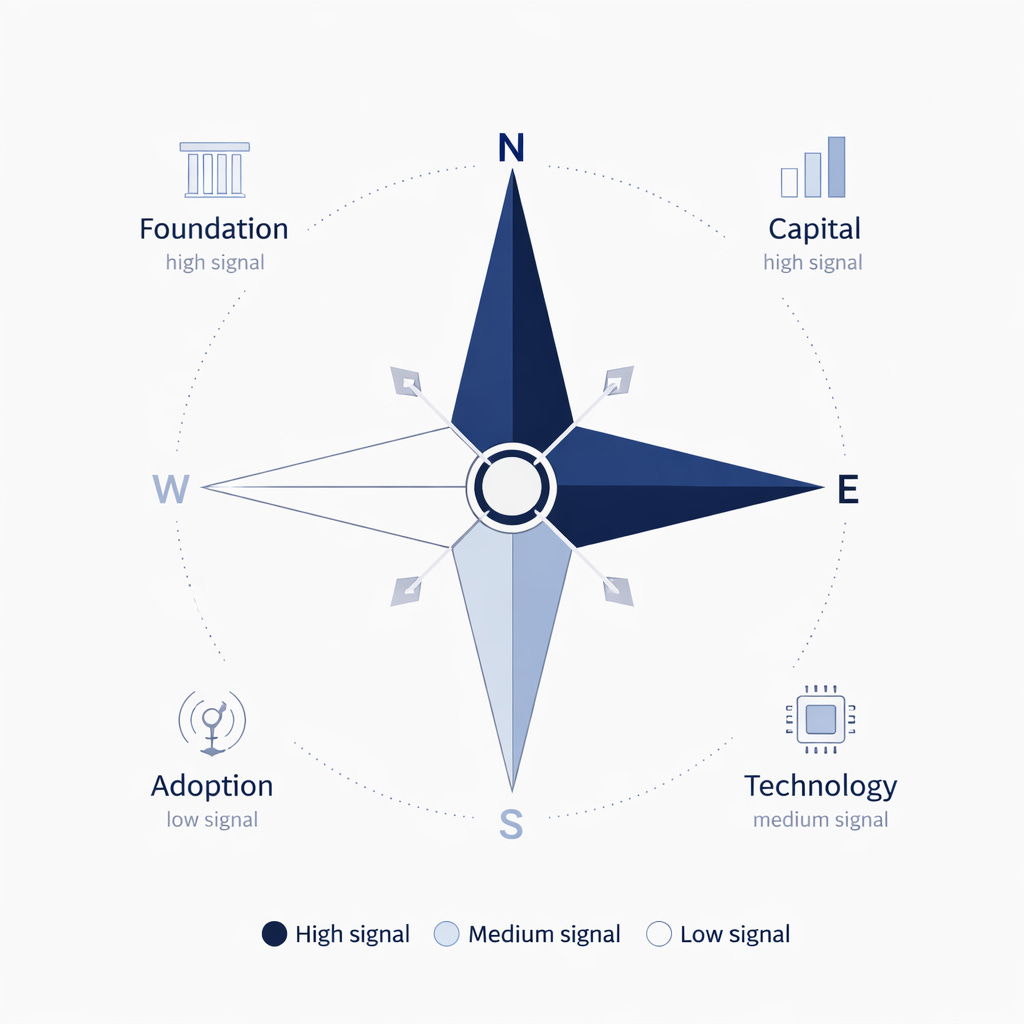
This month’s issue covers the four compass directions for April. Two of them dominated, another went quiet and the last one kept building like nothing happened.
How to Read This Compass
I’m organizing these updates by direction: North, East, South, West to give you a repeatable mental model for navigating Bittensor’s complexity.
North: Foundation 🏛️ (governance, protocol, core team, security events)
The structural layer. Changes here determine who controls the network and how decisions get made.
East: Capital 💹 (markets, volume, liquidity, integrations)
The economic layer. This is where price meets liquidity and institutional conviction shows up in the data.
South: Technology ⚙️ (shipped features, benchmarks, infrastructure, ecosystem health)
The execution layer. What actually works, what got built and where’s the technical proof.
West: Adoption📡(narrative, mainstream validation, external voices)
The perception layer. This is how the outside world sees Bittensor, from industry titans to normie investors.
Each month, some directions will dominate the signal. Others will stay quiet. The goal is to see which quadrants are moving and what that means for your strategy.
🏛️“Decentralization Theater”: the governance crisis and the aftermath
What Happened:
On April 9, Covenant AI announced it was leaving Bittensor.
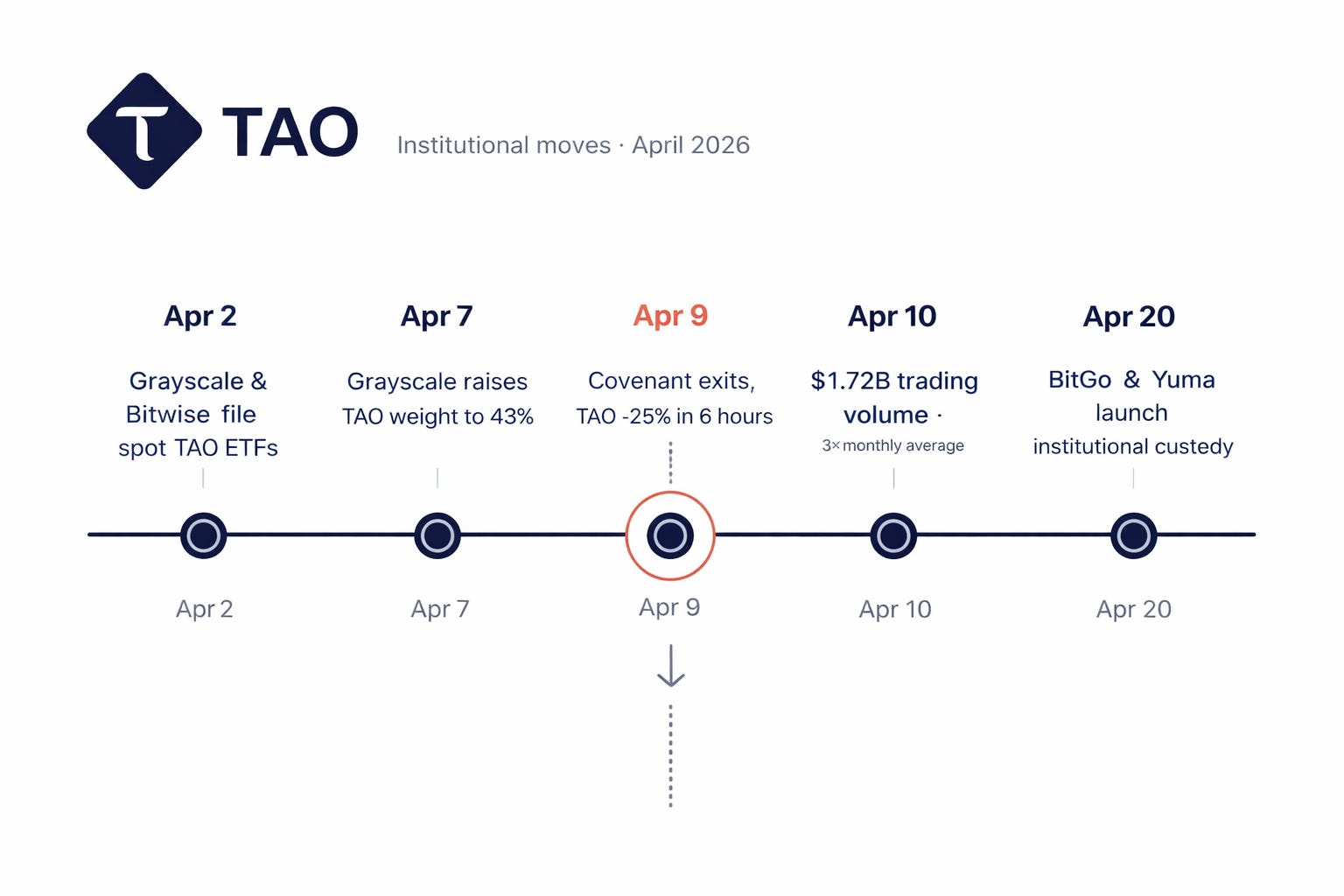
They shut down three subnets: SN3, SN39, and SN81, dumped 37,000 TAO worth roughly $10.2 million into the market, and publicly accused co-founder Jacob Steeves of centralized control.
The specific allegations were pointed: that Steeves unilaterally suspended subnet emissions, overrode operator authority, and used large visible token sales as a tool to enforce compliance.
Founder Sam Dare called it “decentralization theater.”
TAO dropped 25% in six hours. $650 million in market cap gone with $9.1 million in long liquidations. Trading volume spiked to $1.72 billion on April 10, more than triple the monthly average.
I covered the allegations in my piece here.
Why It Matters:
The crypto press covered the 25% drop. They missed what followed: community miners, with no guidance from founders and no central operator involvement, rebuilt all three subnets from open-source code. The chain continued running normally.
This was widely reported as a demonstration of the protocol’s antifragility and organic decentralization in action. New teams (e.g., Teutonic stepping in for Templar) picked up the work and the subnets resumed operations.
I’ve been writing about Bittensor’s antifragility thesis for a long time. This was the first real test at scale.
The protocol’s direct response was BIT-0011: the Conviction Mechanism. Subnet founders and stakers will lock alpha tokens across 30-day intervals to earn conviction scores. The staker holding the highest score gains ownership of the subnet.
And crucially, tokens locked during the active period can’t exit (rug) until the interval closes.
It formalizes at the protocol level exactly what the community just demonstrated organically: ownership through commitment, not through founder discretion.
The Takeaway:
Watch BIT-0011 closely. After it goes live, if you’re delegating to subnets, understanding which teams are locking tokens needs to become part of your due diligence from here.
The governance layer fractured in April. The response revealed as much as the failure.
💹Institutional capital made its moves before the crash
What Happened:
On April 2, a full week before Covenant AI went public, Grayscale and Bitwise both filed for spot TAO ETFs on NYSE Arca. An SEC review is underway with the decision window in August 2026.
On April 7, two days before the worst day of the month, Grayscale raised its TAO weighting inside its AI-focused fund to 43%. Its largest single-asset reallocation in the fund’s history. They did that before the broader market knew what was coming.
On April 20, BitGo and Yuma launched institutional-grade custody and staking for Bittensor subnet tokens: the first regulated, secure access point for large capital to get direct exposure to subnet economics. DCG’s Barry Silbert called it a meaningful step forward for institutional participation in Bittensor.
Why It Matters:
This is the timing detail that nags at me.
What does it mean that the biggest institutional moves of April happened before, and immediately after, the worst governance crisis in Bittensor’s recent history?
It means institutional analysts are not reading the same headlines retail is.
They’re reading the staking data, revenue figures and structural supply dynamics post-halving. What they see apparently survives a 25% single-day drop without changing the thesis.
The Takeaway:
The August 2026 ETF decision window is now a live catalyst on your calendar. A positive signal from the SEC unlocks a whole class of capital that currently can’t touch Bittensor even if they wanted to.
⚙️The execution layer didn’t notice
What Happened:
The network generated $43 million in revenue across 128 active subnets in Q1 2026. That number didn’t move when Covenant AI left (their subnets were research-based).
Covenant operated three of Bittensor’s highest-emission subnets. Their exit was the single largest operator departure the network had seen. And the revenue baseline held because the network doesn’t run on any one team’s output. It runs on 128 markets competing simultaneously.
Looking forward: Teutonic (formerly Templar) is targeting a 1-trillion-parameter model training run by late May.
After Covenant-72B proved in March that decentralized training at 72 billion parameters wasn’t a whitepaper concept, a trillion-parameter attempt is a real escalation. It would be the largest decentralized training run ever attempted.
Why It Matters:
When the biggest operator in the room walks out and the revenue line doesn’t flinch, it’s worth noticing. The timing of the potential trillion-parameter run also matters, as that milestone could land inside the ETF’s highest-visibility window during the SEC review calendar. If Teutonic delivers, attention from the AI world becomes a real possibility.
The output layer is accelerating independent of the drama layer.
The Takeaway:
The trillion-parameter run and the ETF review window overlapping is not a coincidence to ignore. Successful decentralised training at that scale is exactly the proof of utility the institutional thesis needs to go mainstream.
📡No Mainstream Breakthrough
What Happened:
Nothing meaningful here this month.
April had no Jensen Huang moments or Jack Clark quotes. No mainstream AI press picking up the Bittensor story. The governance crisis got crypto coverage but not AI coverage.
Why It Matters:
The Covenant crisis was legible to crypto investors who already know what a subnet is, but it wasn’t legible to the broader AI audience that would need to understand why decentralized training matters to care.
This story requires context most AI journalists don’t have yet, so the translation gap is still wide open.
The Takeaway:
Track mainstream AI media, not just crypto media. When Bittensor breaks through to that audience (and April wasn’t the month) you’ll feel it in adoption before you see it in the price.
Which of these moves your conviction most: the protocol’s response to the governance crisis, or the institutional positioning that happened before it? I’m genuinely curious where your head is at after this month.
And if I missed something important from April, what would you add?
Reply to this email and let me know. I read every single one.
Until next time.
Cheers,
Brian
Disclaimer: This is not financial advice. I am a writer documenting the Bittensor ecosystem. Always do your own research.
I’ve been watching how closely this weekend it seems it has disconnected a little while from bitcoin it’s price is accelerated while bitcoin daily move. It’s price went up $50. I’m getting more more alerts of people putting massive amounts of.TAO into the subnet from Binance +70% of Tao is ready staked which only leaves about 3 million liquid with another 128 subnets on the way at minimum 7000 each makes the supply lesson less. ETFs are on the way. I think things are looking much better. What do you say?
Thanks a lot Brian, you are my main source regarding Bittensor developments! Really well done 👍✅