

This is a magical time of year they say. Lots of food, family, gifts and entertainment.
It’s also the time, if you’re so inclined, for the end of year review, where you sit back and ponder how your year went, journal on where it all went wrong and plan feverishly for a new start in January.
In reality, year end reviews do matter: it’s easy to forget how action‑packed a year was and what it taught you.
Between Bittensor’s first halving and the dTAO upgrade rewiring incentives and my own push to contribute more meaningfully to the ecosystem, this year felt like one long, intense upgrade cycle.
Looking back, Bittensor evolved from a promising experiment into a battle-tested network. Subnets multiplied, incentives sharpened, and yes, there was plenty of drama to keep things interesting.
As for me, writing this newsletter turned from a side project into my main vehicle for making decentralized AI accessible.
Today, I’m reviewing the highs, lows, and lessons from 2025. Both for the ecosystem and my journey in it.
Bittensor’s 2025: From Halving Hype to Real Maturity
After a messy, high velocity 2024, Bittensor hit maturity in 2025. This was a year of enforced focus: cap, pruning, flow emissions, and the halving pushed value toward utility.
Key highlights:
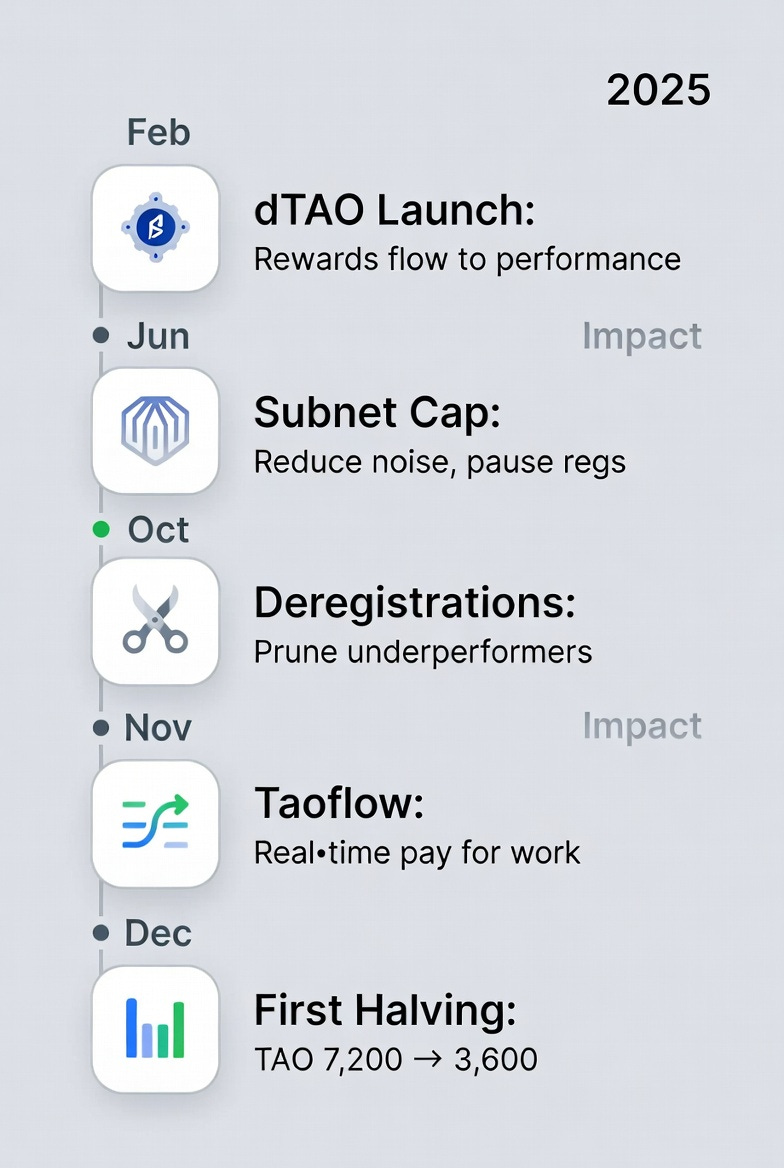
February 2025: dTAO Launch
Introduction of dynamic TAO (dTAO) as subnet-specific “Alpha” tokens. Instead of rewards being handed out from one big central pot, they now flow to subnets that actually perform well.
This resulted in less freeloading, fairer rewards, and value routed toward real work.
June 2025: Subnet Cap Announced
Temporary subnet cap introduced at 128 (deployed in September) following rapid expansion in the prior months.
New registrations were paused to reduce noise, improve technology quality and allow deeper exploration of scaling impacts.
October 2025: Subnet Deregistrations Begin
This “pruning” mechanism enforced performance standards, automatically removing underperforming subnets after a 4-month immunity period (SN100 was the first to go), keeping the network lean and focused on quality.
New registrations were reinstated alongside the pruning.
November 2025: Taoflow Transition
Shift to the “Taoflow” flow-based emission model. Instead of paying everyone on a fixed schedule, the network now pays subnets in real time based on the work they actually do.
If a subnet is useful and active, it earns more; if it’s idle, it earns less, cutting waste and rewarding real contributions.
December 2025: The First Halving
The big one. Daily TAO emissions were cut in half, from 7,200 to 3,600 per day. Leading up, prices dipped as miners repositioned, but post-halving, we’ve seen stabilization that hints at stronger fundamentals.
It wasn’t the moonshot some predicted, but it pruned inefficient subnets and rewarded those with real utility.
As I covered previously, halvings aren’t fireworks; they’re the quiet force that builds long-term value.
Ecosystem Milestones
Community activity surged, with visible growth in social engagement and developer chatter (OpenDev, Discord, Telegram, X).
DeFi integrations grew and tools like Bitstarter made funding more accessible.
We saw major emission changes to root stake in December, shifting power dynamics and emphasizing sustainable incentives.
OpenDev’s weekly summaries kept everyone aligned, covering deployments and plans into 2026.
Challenges That Defined Us: The Messy Side of Decentralization
Post-Halving Volatility and Price Pressure
The December halving tested the network, with TAO’s price falling roughly 20% amid miner repositioning and market jitters.
This exposed overinflated subnet valuations and squeezed margins, but it consolidated capital around proven utilities, stabilizing fundamentals over hype.
Deregistration Drama and Pruning Pressures
September’s subnet cap rollout and October’s deregistration sparked debates, with over 10 subnets at risk and disappointment at subnets with a real use case losing out to others offering no value to the ecosystem.
Incentive Misalignments and the “Death Spiral” Fears
dTAO’s early launch fixed static emissions, yet grifting accusations and miner margin collapses raised “death spiral” alarms at launch: where declining value, participation and rewards could create a vicious cycle leading to network collapse.
Technical and Scaling Hurdles
The codebase faced criticism for messy metrics, scaling issues complicated onboarding for new users and exposed centralization risks.
Adoption and External Pressures
Real-world traction lagged in areas, competing with centralized AI giants amid regulatory shadows on tokens. Alignment woes, like corporate-biased AIs, underscored Bittensor’s edge but kept skepticism alive on utility and incentives.
Overall, 2025 proved Bittensor’s thesis: incentives coordinate intelligence without gatekeepers. The network’s Total Addressable Market expanded as real-world apps emerged, from Claude Code killers like Ridges to confidential compute in Targon. If you’re new, this was the year we moved from “cool idea” to “essential infrastructure.”
End of term grade: B
Maturity gains (dTAO/Taoflow/halving, pruning) offset by onboarding/UX/messaging gaps that still slow mainstream adoption.
My Contributions: Turning Confusion into Clarity
This newsletter started as my way to make sense of Bittensor. Six months later, it’s become a bridge for non-coders like me to navigate the ecosystem. Here’s what I shipped in 2025:
Practical frameworks: the 5-Stage Awareness Journey for newcomers, plus VITALS and the RALLY plan to help subnet owners avoid deregistration.
Subnet spotlights: Bitmind (deepfake detection), Aurelius (alignment), Hippius (cheap private storage), with real-use examples like verifying viral posts or ditching Google Drive.
Ecosystem insights: marketing pitfalls, the “Infinite Game” of network drama, and the Funnel Framework for entry points (from creators to miners) plus UX critiques to make pages clearer.
Community Engagement: I lurked in Discords and X, and incorporated reader feedback. My goal is to make decentralized AI feel like flipping a light switch with no PhD required. If even one reader went from lurker to contributor because of these pieces, mission accomplished.
Personal routines that made it possible:
Productivity: As a Dad with limited time, Pomodoros turned paralysis into progress: 25-minute sprints on one task (a subnet CTA, a draft), break, repeat. Gamifying each burst finally made me consistent.
Tip: Define your One Thing (e.g. master one new tool weekly), measure it and start with Pomodoros—the simplest habit that compounds.
These aren’t revolutionary ideas, but they helped make Bittensor feel a little less chaotic.
From Survival to Signals: Turning 2025’s Lessons into 2026 Wins
2025 wasn’t perfect, but it solidified Bittensor as the infinite game: coordinating global intelligence without collapsing under its own weight. For me, this newsletter proved non-coders can add value—through frameworks, spotlights, and honest takes.
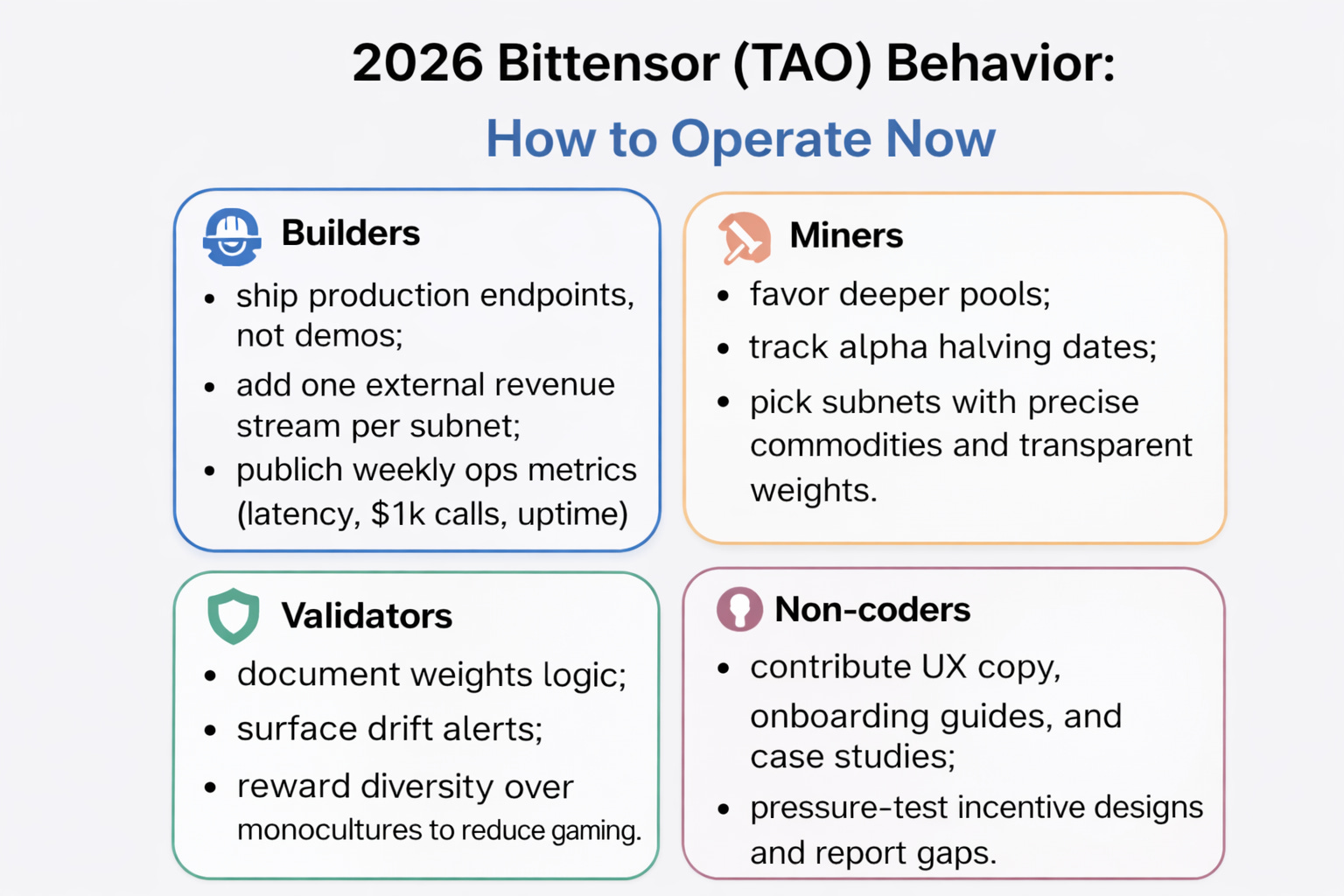
Looking to 2026: Expect a shift from experimental to production-grade outputs, with revenue from real-world AI outputs surprising skeptics and driving organic growth. I’ll keep delivering practical tools to make it accessible.
What’s your 2025 Bittensor highlight? Biggest lesson or win? Hit reply or comment here I’d love to know.
Best wishes to you for the holiday period- I’ll be refereeing an impending war over Spider-Man Lego pieces at home for the next two weeks, so I’ll talk to you next in 2026.
Cheers,
Brian
i shared your post on reddit r/bittensor_
A great and very useful read as usual. Happy Holidays!